
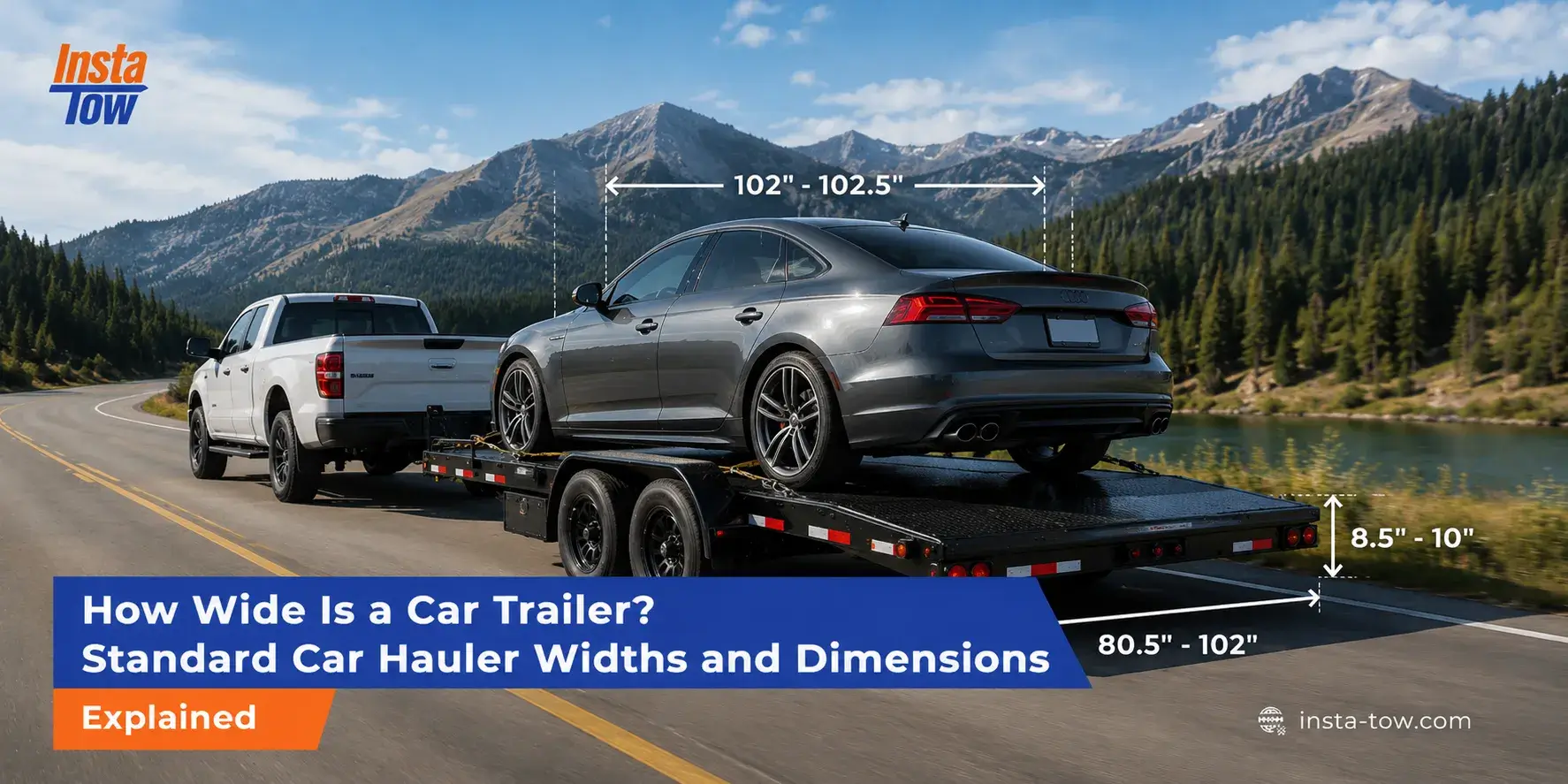
Determining the correct dimensions is the first step in successful vehicle transport.
Whether you are moving a classic sedan or a heavy-duty truck, understanding how wide is a car trailer helps prevent damage during loading and ensures compliance with highway regulations.
At Instatow, we prioritize safety and precision, which is why we guide our clients through these essential measurements before any vehicle hits the road.
What Is the Standard Width of a Car Trailer?
When asking how wide is a car trailer, the answer often depends on the specific design of the hauler.
Most consumer and commercial trailers follow a specific set of parameters to remain compliant with U.S. road laws.
While variances exist, manufacturers typically standardize these builds to balance stability with maneuverability.
Average Car Trailer Width in the United States
The industry standard for trailer width typically measures between 8.5 feet (102 inches) for the exterior frame.
This measurement is crucial because it aligns with federal limits, allowing the trailer to navigate standard highway lanes safely.
Knowing how wide is a car trailer allows owners to plan their route effectively, particularly when navigating narrow construction zones or tight urban streets.
Standard Car Hauler Width for Open and Enclosed Trailers
Differences exist between an open car trailer and an enclosed auto carrier regarding internal and external width.
An open trailer typically utilizes the full width for the deck, whereas an enclosed auto carrier must account for the interior wall structure.
Open Car Hauler: Typically 8.5 feet exterior width.
Enclosed Auto Carrier: Usually 8.5 feet exterior, but interior width may be slightly less due to wall insulation and framing.
Deckover Trailer: Often designed to be wider than standard models to accommodate heavy equipment or wider vehicles.
Maximum Legal Trailer Width on U.S. Roads
Drivers must adhere to the maximum legal width set by the Department of Transportation to avoid fines or safety hazards.
In the United States, 102 inches (8.5 feet) is generally the standard maximum legal width for vehicles and trailers operating on the interstate system without special wide-load permits.
Any trailer exceeding this dimension requires specific oversize permits and additional pilot vehicles.
If you are ever unsure about how wide is a car trailer, consulting local state regulations is a necessary step before beginning your transit.
You can also read: 2026 Market Guide: Car Hauler Prices and Rates

Car Trailer Width Between Fenders Explained
The distance between the fenders is arguably the most critical measurement for loading.
This specific dimension determines whether your vehicle's tires will clear the wheel wells without causing cosmetic or structural damage to your rocker panels.
How Wide Is a Car Trailer Between Fenders?
When evaluating how wide is a car trailer between the fenders, you will find that most standard models provide approximately 79 to 82 inches of clearance.
This space is intended to accommodate the track width of most passenger cars, SUVs, and light trucks.
If your vehicle is wider than this measurement, you might experience significant challenges during the loading process.
Why Fender Clearance Matters During Loading
Inadequate fender clearance leads to several common issues that can compromise your vehicle's condition.
During the loading process, even a slight misalignment can result in contact between the car door and the trailer fender.
Risk of tire rubbing on the interior of the fender.
Potential for door damage when opening the vehicle once loaded.
Structural strain on the trailer if the vehicle is forced into a tight fit.
Difficulty in strapping down the vehicle securely due to limited access.
Typical Width Between Trailer Fenders
To help you visualize the required space, consider the following common configurations found on most commercial and personal haulers.
Always verify these specific measurements with the manufacturer or rental agency before loading.
Understanding how wide is a car trailer between the fenders ensures you choose a configuration that minimizes the risk of impact during transport.
Car Trailer Deck Width vs Overall Trailer Width
Understanding the critical distinction between frame dimensions and available surface area is the foundation of safe transport.
A common error many drivers make when researching how wide is a car trailer is confusing the total structural frame measurement with the actual usable loading surface.
While the exterior frame width is standardized for road compliance, the deck space is what truly determines whether your vehicle will fit securely.
What Is Car Trailer Deck Width?
The deck width refers to the horizontal surface area available between the side rails, interior walls, or fenders of the trailer.
This measurement is significantly different from the overall exterior width because it excludes structural components like the main frame, outer railing, and exterior lighting that make up the trailer's total footprint.
When investigating how wide is a car trailer, you must prioritize the deck measurement over the frame width, as this determines if your vehicle's tire track will allow it to sit flush on the loading surface without risking overhang or tire sidewall damage.
Exterior Width vs Usable Loading Space
Manufacturers typically define the standard trailer width based on the widest points of the external frame, which is usually capped at 102 inches to remain compliant with U.S. highway regulations.
However, the usable loading space inside this frame is almost always narrower.
By understanding the difference between the frame and the deck, you can avoid the common mistake of assuming a trailer is large enough for your vehicle simply because its exterior dimensions seem compliant.
Overall Exterior Width: The total footprint of the trailer including fenders, rub rails, and lights (usually 102 inches).
Usable Deck Width: The actual clearance available for vehicle tires, which typically ranges from 78 to 84 inches.
Structural Obstruction: Space consumed by wheel wells, interior cabinetry in enclosed units, or side-mounted winch boxes.
Why Trailer Deck Width Matters for Vehicle Safety
Calculating accurate car hauler dimensions is essential for maintaining the vehicle's center of gravity during transit.
If the deck width is too narrow for your vehicle's track width, the tires may sit on the edge of the rails or fenders rather than the center of the deck.
This misalignment is hazardous because it risks tire sidewall damage and makes the vehicle prone to shifting during highway maneuvers.
Proper weight distribution relies entirely on having a deck that is appropriately sized for your specific vehicle, ensuring the load remains centered, stable, and firmly secured throughout the journey.
How Wide Are Car Hauler Trailers by Type?
Not all haulers are designed with the same footprint, and the type of trailer you select significantly alters the loading experience.
Determining how wide is a car trailer depends largely on whether the unit is an open-frame design, an enclosed carrier, or a specialized equipment trailer.
Each design offers specific advantages regarding width, accessibility, and protection.
Open Car Hauler Trailer Width
An open car trailer is often preferred for its ease of use and versatility, particularly for roadside assistance or general automotive transport.
These units typically utilize a flat deck design that provides a consistent width from front to back, maximizing the available space for different vehicle types.
Because there are no interior walls, these trailers often provide a more forgiving environment for wider vehicles, assuming the fender clearance is sufficient.
Enclosed Car Trailer Width
When choosing an enclosed auto carrier, the interior dimensions are the primary concern, as they are almost always narrower than the exterior frame.
The wall structure, insulation, and potential interior cabinets can reduce the usable space, making the interior narrower than an equivalent open-frame model.
If you are transporting a wider vehicle, it is essential to verify the interior width specifically, as the exterior measurement can be misleading regarding how wide is a car trailer for the purpose of loading.
Deckover Trailer Width
A deckover trailer is engineered with the deck positioned above the wheels, which effectively eliminates the constraints of fender width.
This design allows for a much wider loading surface compared to standard trailers, making it an excellent choice for oversized trucks or commercial equipment.
By removing the fenders from the loading path, you gain significant flexibility, allowing you to utilize the full width of the trailer frame for your cargo.
Drive-Over Fender Trailer Designs
Some modern haulers feature drive-over fender designs, which are specifically built to be low-profile while still accommodating vehicles with wider wheelbases.
These fenders are reinforced to support the weight of the vehicle being loaded, meaning you can drive over the fender if necessary.
Open Trailers: Offer maximum versatility and often utilize the full frame width.
Enclosed Trailers: Provide superior protection but feature restricted interior width.
Deckover Units: Utilize the full frame width by placing the deck above the wheels.
Drive-Over Fenders: Allow for wider vehicles by utilizing reinforced, low-profile fender covers.
Understanding how wide is a car trailer based on these specific designs will streamline the selection process, ensuring you match the right equipment to your vehicle's footprint.

How Wide Does a Trailer Need to Be to Haul a Car?
Determining if your vehicle fits securely is a critical step in professional vehicle transport.
Simply asking how wide is a car trailer is not enough; you must also consider the specific track width of the vehicle you intend to move.
The ideal scenario involves a setup where the vehicle sits comfortably on the deck without requiring complex maneuvering or risking damage to the doors or rocker panels.
Trailer Width for Sedans
Most standard passenger sedans fit easily within the dimensions of a conventional trailer.
Since most sedans have a track width ranging from 60 to 70 inches, a trailer with a standard 8.5-foot exterior width and an 80-inch internal deck width provides ample room.
When choosing a setup for a sedan, you generally have the most flexibility, allowing you to prioritize other features like ramp length or tie-down points rather than width capacity.
Trailer Width for SUVs and Pickup Trucks
SUVs and light-duty trucks often feature a much wider track than sedans, sometimes pushing the limits of standard trailer fenders.
For these larger vehicles, knowing how wide is a car trailer is paramount because the tires may sit dangerously close to the fenders or, in some cases, partially on top of them.
If you are transporting a wider SUV, ensure the trailer has sufficient deck width to support the vehicle's footprint while allowing enough room for the driver to exit the vehicle if necessary.
Trailer Width for Wide-Body or Lifted Vehicles
Wide-body vehicles or those with aftermarket lifted suspension packages present unique challenges for standard equipment.
These vehicles often exceed the typical 80-inch internal clearance, requiring specialized equipment such as a deckover trailer.
These designs remove the fender obstruction, allowing the vehicle to sit securely on a flat, unobstructed surface.
Without this added width, you risk frame damage or being unable to load the vehicle safely.
Minimum Recommended Clearance Space
To ensure a safe and successful loading process, you should aim for a minimum of 2 to 4 inches of clearance on both sides of the vehicle tires.
This buffer accounts for potential shifts during transport and ensures you have enough room to properly secure your ratchet straps.
Compact Cars: 6-8 inches of total clearance is ideal.
Standard Sedans: 4-6 inches of total clearance.
Full-Size SUVs/Trucks: Minimum 2-4 inches of clearance.
Wide-Body/Lifted: May require specialized haulers to avoid fender contact.
Following these clearance guidelines prevents the most common loading errors and ensures that your vehicle remains stationary throughout the transport process.
For more information: What Size Trailer Do I Need to Haul a Car?
Standard Car Trailer Dimensions You Should Know
Understanding the industry norms regarding car hauler dimensions is vital for efficient planning.
By aligning your vehicle's specs with standard trailer configurations, you can avoid last-minute complications.
When you research how wide is a car trailer, you are essentially looking for the baseline that manufacturers use to optimize for both highway stability and cargo capacity.
Common Trailer Width and Length Combinations
Most manufacturers build trailers in specific length-to-width ratios designed to maximize stability while maintaining the standard trailer width of 102 inches.
A common configuration for a two-car hauler or a long-bed single vehicle hauler involves an 18 to 22-foot deck length.
This length ensures that the vehicle weight is properly distributed over the axles, preventing swaying during highway speeds.
Single-Axle vs Tandem-Axle Trailer Sizes
The number of axles on a trailer significantly impacts its load-bearing capacity and stability.
Tandem-axle trailers are the industry standard for transporting automobiles because they provide better weight distribution and safety in the event of a tire blowout.
Single-Axle Trailers: Generally limited to lighter loads; may have a smaller overall footprint.
Tandem-Axle Trailers: Provide superior stability and higher weight capacity for full-size vehicles.
Triple-Axle Trailers: Reserved for heavy-duty commercial transport or extremely long, heavy vehicle loads.
Open vs Enclosed Trailer Dimensions
When comparing an open car trailer to an enclosed auto carrier, the primary difference lies in usable width.
An open trailer typically utilizes the full frame width because there are no sidewalls, whereas an enclosed trailer must sacrifice a few inches of width to accommodate the structural integrity of the box.
Open Haulers: Offer unobstructed lateral space, making them easier for loading wider vehicles.
Enclosed Haulers: Provide weather protection and security but require precise measurement of the interior door opening and wheel well placement.
Maximum Legal Width: Regardless of type, all standard trailers must remain under the 102-inch limit to avoid requiring special oversize permits on public roads.
By focusing on these structural standards, you can quickly determine how wide is a car trailer and whether it aligns with your specific transport requirements.

How to Measure Your Vehicle for a Car Trailer
Taking precise measurements of your vehicle is the only way to avoid complications during the loading process.
Even when you understand how wide is a car trailer in general terms, your specific vehicle's dimensions are what dictate a successful trip.
A small oversight in measuring can lead to significant headaches, so follow a structured approach before you commit to any rental or transport plan.
Measuring Tire Track Width
The tire track width is the distance from the outside edge of one front tire to the outside edge of the other.
This measurement is critical because it tells you exactly how much space the tires will occupy on the trailer deck.
When you know this measurement, you can compare it against the available trailer fender clearance to ensure the vehicle will fit without rubbing.
If you are unsure about how wide is a car trailer for your specific needs, always measure this width at the widest point of the tire contact patch.
Measuring Overall Vehicle Width
While track width is vital, the overall width of the vehicle including mirrors and body panels is equally important, especially for enclosed haulers.
You should measure from the widest point of the vehicle, which is often the side-view mirrors or the rear fenders.
Knowing this total width helps you determine if the vehicle will pass through the door opening of an enclosed auto carrier without risking damage to the paint or the trailer structure.
Checking Door Clearance and Mirror Space
When evaluating how wide is a car trailer for your transport needs, consider the space required to actually exit the vehicle once it is loaded.
If the trailer is a tight fit, you may not be able to open the car doors fully.
Measure the distance from the side of the vehicle to the trailer wall or railing.
Account for door swing radius; if space is less than 12 inches, you may need to use a trailer with removable fenders or a side-access door.
Check if mirrors need to be folded in to prevent scraping against the interior walls of an enclosed hauler.
Common Measurement Mistakes to Avoid
Many drivers focus solely on the vehicle's published width from the manufacturer's manual, but this often ignores aftermarket modifications.
If your vehicle has wider tires, a lift kit, or body kits, the factory numbers will be inaccurate.
Always verify the physical measurements yourself to get a realistic picture of how wide is a car trailer in relation to your modified vehicle.
Do Cars Fit in Shipping Containers? Everything You Need to Know
Real-World Loading Challenges Most Drivers Ignore
Even after you have confirmed how wide is a car trailer and verified your vehicle's dimensions, physical loading can present unexpected hurdles.
Understanding these common real-world challenges allows you to prepare for the nuances of professional vehicle transport, ensuring your vehicle arrives at its destination in pristine condition.
Fender Scraping Risks
Fender scraping occurs when the vehicle's track width is too close to the width of the trailer fenders.
Even if the vehicle fits, a minor alignment error during the drive-up can cause the tire to rub against the metal, damaging the tire sidewall or the fender itself.
Knowing how wide is a car trailer versus the specific fender-to-fender width is essential to avoid this risk.
Tight Door Clearance Inside Enclosed Trailers
Enclosed haulers offer excellent protection, but the interior space is often constrained by wheel wells and wall framing.
Loading a modern wide-body car into an older enclosed trailer can be a test of patience.
You might find that while the car fits on the deck, you lack the room to open the driver's side door to exit.
In these instances, utilizing a trailer with a winch system or a side-access door is the most effective solution.
Loading Low-Clearance Sports Cars
Sports cars with low ground clearance require not only sufficient width but also an appropriate ramp angle.
As you consider how wide is a car trailer, remember that the trailer's width often correlates with the ramp design.
Wider trailers may feature longer, lower-angle ramps that make loading low-profile vehicles much safer, preventing damage to the front splitter or undercarriage.
Turning and Lane Space While Towing
Once loaded, the overall width of your trailer influences how it tracks behind your tow vehicle.
A wider trailer creates a larger footprint, which can be challenging on narrow roads or tight turns.
Be aware of off-tracking, where the trailer cuts the corner tighter than the towing vehicle.
Ensure your mirrors are extended to provide a clear view of the trailer's sides.
Plan your route to avoid sharp turns that might force the trailer into curbs or obstacles.
Monitor your lane position; a wide trailer will occupy more of the lane, leaving less room for error.
By addressing these practical challenges, you gain a better understanding of how wide is a car trailer beyond just the static dimensions, allowing for a safer and more confident towing experience.
Can Your Vehicle Fit on a Standard Car Trailer?
Evaluating vehicle fitment is the final hurdle before booking a transport service.
While most standard passenger vehicles will fit on a conventional open car trailer, larger vehicles and trucks require more scrutiny.
When determining the logistics, you must cross-reference your vehicle's width against the interior dimensions provided by your transport provider to avoid loading issues.
Compact Car Examples
Compact cars are the easiest to transport because they rarely challenge the width limits of standard haulers.
Most modern hatchbacks and small sedans have a track width well under 70 inches, providing plenty of buffer space on a standard trailer deck.
Because these vehicles are narrow, they are less likely to experience fender scraping or door clearance issues.
SUV and Truck Fitment Examples
SUVs and light-duty trucks often push the boundaries of an enclosed auto carrier.
These vehicles have wider tracks and higher ride heights, which can make them sit dangerously close to the trailer’s structural wheel wells.
If you are moving a full-size SUV, you should specifically request a trailer with wider deck dimensions to ensure the tires sit squarely on the metal and not on the edge of the fender.
Dually Truck and Oversized Vehicle Considerations
Dually trucks present a unique challenge because their rear-end width significantly exceeds that of standard passenger vehicles.
A conventional car hauler is almost never sufficient for these heavy-duty trucks.
Instead, you will typically need a deckover trailer or a flatbed transport service that offers the necessary width to accommodate the dual rear tires safely.
Compact Sedans: Generally fit easily; plenty of clearance for door opening.
SUVs/Light Trucks: May require extra caution regarding fender wells.
Dually/Oversized Trucks: Rarely fit standard car trailers; require flatbed or specialty commercial transport.
Legal Car Trailer Width Regulations in the United States
Navigating the legal landscape of vehicle transport is as important as the physical loading process.
Every state has specific rules governing the width of trailers on public roads, and ignorance of these laws can lead to significant fines or forced detours.
To operate safely, transporters must stay within the established parameters for vehicle width and load size.
Federal Width Limits
The Federal Highway Administration (FHWA) sets the standard maximum legal width for vehicles and trailers at 102 inches (8.5 feet) on the National Network.
This limit is designed to ensure that trailers can navigate standard highway lanes without encroaching on adjacent lanes or creating safety hazards for other motorists.
Adhering to this limit is standard practice for most reputable vehicle transport companies.
Oversize Permit Requirements
If your load or the trailer itself exceeds the 102-inch limit, you are legally required to obtain an oversize permit.
These permits vary by jurisdiction and often dictate specific routes, travel times, and safety equipment (such as flags or pilot cars).
Failing to secure these permits before transport can result in significant legal consequences and immediate cessation of the move.
State-to-State Width Restrictions
While federal law provides a baseline, individual states retain the right to impose stricter regulations on local roads.
A route that is legal in one state might require a permit just a few miles later across a state line.
Standard Roads: Typically capped at 8.5 feet (102 inches).
Permit-Required: Needed for any load width exceeding 102 inches.
Seasonal Restrictions: Some states limit oversize loads during peak traffic hours or poor weather conditions.
Route Planning: Always consult state Department of Transportation maps before planning a cross-country route.
Professional vehicle transport planning requires knowledge of these varying regulations to ensure your move remains legal and timely from start to finish.

How to Choose the Right Car Trailer Width
Selecting the appropriate equipment is a critical decision that directly impacts the safety and efficiency of your move.
When you evaluate how wide is a car trailer, you must look beyond general specifications and consider the unique dimensions of your specific vehicle.
Making an informed choice prevents mechanical failures, protects your car’s finish, and ensures you remain compliant with transportation standards.
Matching Trailer Width to Vehicle Type
The first step in choosing a trailer is assessing the track width of your vehicle.
A standard sedan might only require 70 inches of clear space, but wider SUVs or custom-built trucks often demand the full 80-to-84-inch clearance found on heavy-duty haulers.
Always measure your vehicle at its widest point typically the outer edge of the tires to ensure it aligns with the deck dimensions of the trailer.
If you are unsure how wide is a car trailer you are considering, request the manufacturer’s specification sheet to confirm the usable deck width before making a commitment.
Choosing Between Open and Enclosed Haulers
The choice between an open car trailer and an enclosed auto carrier often comes down to protection versus convenience.
Open trailers offer the most flexibility, as they lack side walls that might interfere with wider vehicles or door openings.
Conversely, enclosed trailers offer superior weather protection but come with restrictive interior wall structures.
Open Trailers: Better for wider vehicles; easier to load; often cheaper.
Enclosed Trailers: Ideal for high-value or classic cars; requires careful interior measurement.
Consideration: If your car is a tight fit, the wall width of an enclosed unit might prevent you from opening the doors after loading.
When You Need a Deckover Trailer
A deckover trailer is the superior solution when dealing with oversized or commercial-grade equipment.
Because the deck sits above the wheels, there are no fender wells to obstruct the loading process.
This design allows you to utilize the entire width of the frame, which is essential for dually trucks, farm equipment, or vehicles with extremely wide track widths.
By removing the limitation of fender clearance, a deckover trailer simplifies the loading of specialized vehicles that would otherwise be impossible to transport on a standard unit.
Renting vs Hiring a Professional Transport Service
Choosing whether to do it yourself or hire a service like Instatow involves balancing cost against risk.
When you rent a trailer, you are responsible for selecting the right size and securing the load correctly.
If you are not confident in your ability to calculate how wide is a car trailer for your specific vehicle, hiring a professional transport service is the safer alternative.
Professionals possess the equipment, expertise, and insurance coverage to handle vehicles of any size, reducing the risk of transit damage to near zero.
Why Professional Vehicle Transport Planning Matters
Effective transport planning is more than just securing a vehicle to a flatbed; it is a systematic approach to risk mitigation.
When you work with experts, the question of how wide is a car trailer is answered through precise logistical planning, ensuring that every load is matched with the ideal equipment for the route, vehicle type, and distance.
Preventing Loading and Clearance Problems
Clearance issues are the most frequent cause of preventable damage during vehicle transport.
A professional team assesses your vehicle's width, ground clearance, and suspension setup before the trailer is ever dispatched.
By verifying these metrics early, they prevent scenarios where a vehicle is too wide for the deck or where the door cannot open inside an enclosed unit.
This proactive approach saves time and ensures the loading process remains smooth and damage-free.
Choosing the Correct Trailer Type
Not every job requires the same tool.
Professional planners categorize vehicles into tiers based on their dimensions and structural requirements.
Standard Transport: For average sedans, using conventional open or enclosed haulers.
Wide-Load Transport: Specifically designated for vehicles that exceed standard width limits, requiring specialized deckover or flatbed equipment.
Custom Securement: Tailored setups for vehicles with low ground clearance, wide tires, or custom body modifications.
Reducing Damage Risks During Transport
Professional transport services utilize specialized equipment and tie-down protocols to minimize stress on the vehicle.
This includes using soft-tie straps that won't damage wheel finishes and ensuring that the vehicle is centered on the deck to maintain optimal weight distribution.
When you prioritize professional planning, you remove the guesswork associated with determining how wide is a car trailer and eliminate the potential for human error.
By relying on expert planning, you ensure that your vehicle remains safe, secure, and undamaged throughout the entire transport process, regardless of its size.
Final Thoughts on Choosing the Right Car Trailer Width
Selecting the correct trailer width is not just a logistical detail, it is the foundation of a safe and successful transport operation.
From verifying the track width of your vehicle to understanding the differences between open and enclosed hauler dimensions, taking the time to plan ensures that your car arrives in the same condition it left.
Professional transport planning eliminates the stress of measuring, loading, and navigating legal regulations.
Whether you are moving a classic car across the state or relocating a work truck, the expertise provided by a professional service like Instatow guarantees that the trailer chosen is perfectly matched to your vehicle’s footprint.
By prioritizing these measurements, you protect your investment, stay compliant with road regulations, and enjoy peace of mind throughout the transit process.
Frequently Asked Questions About Car Trailer Width
Understanding the technical nuances of equipment can be daunting, but having clear answers helps streamline your logistics.
Below are the most common inquiries our team at Instatow receives regarding trailer specifications.
What Is the Average Width of a Car Hauler Trailer?
Most standard car haulers feature an exterior frame width of 8.5 feet (102 inches).
When considering how wide is a car trailer, remember that this dimension is the industry standard for maximum road-legal exterior width, ensuring compatibility with standard interstate lanes.
What Is the Standard Width Between Trailer Fenders?
On most open-car trailers, the width between the fenders typically ranges from 79 to 82 inches.
This is the usable width for the vehicle's tires, and it is a critical measurement to verify before attempting to load wider vehicles like SUVs or trucks.
Can a Full-Size Truck Fit on a Standard Car Trailer?
It depends on the specific track width of the truck.
While many standard trailers can accommodate modern pickup trucks, dually trucks often exceed the 82-inch fender clearance limit.
For these larger vehicles, we generally recommend using a deckover trailer or a flatbed service to avoid tire or fender damage.
Are Enclosed Trailers Narrower Inside?
Yes, enclosed trailers are almost always narrower on the inside than their exterior frame suggests.
The interior dimensions must account for structural wall framing, insulation, and protective paneling, which can reduce the usable width by 4 to 6 inches compared to an open-frame model.
What Trailer Width Is Best for SUVs?
For SUVs, particularly those with wider track widths, a trailer with at least 82 inches of fender clearance is recommended.
If your SUV is particularly wide, a deckover trailer is the safest choice because it removes the fender obstruction entirely, allowing the vehicle to sit securely on a flat, unobstructed deck.
Quick Reference Guide:
Standard Sedan: 79-82 inch clearance is sufficient.
Large SUV: Look for 82+ inch clearance or deckover designs.
Commercial/Dually: Always use flatbed or deckover haulers.