
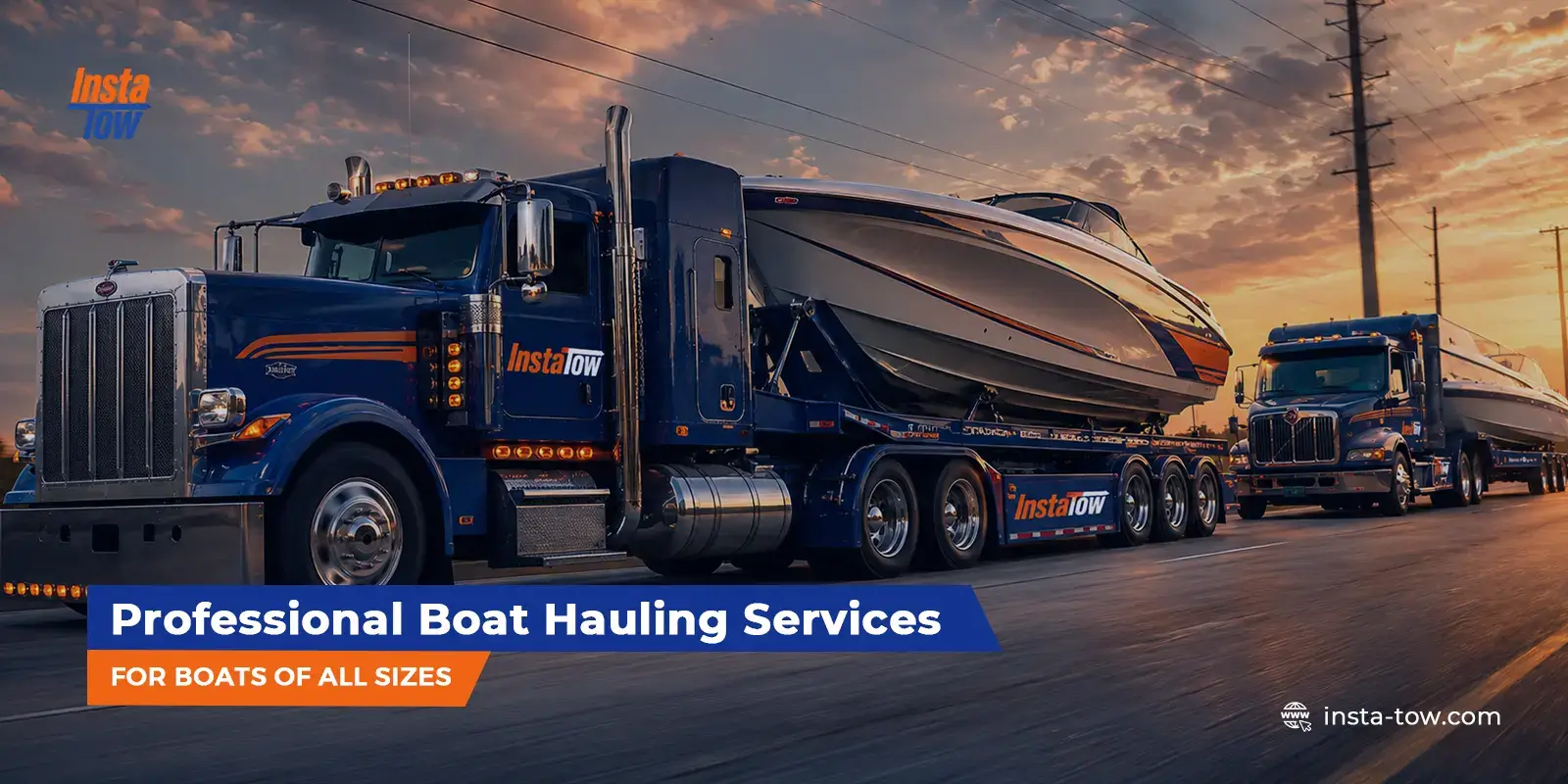
When you own a boat, the joy of the open water is the ultimate goal.
However, moving that vessel between bodies of water, to a vacation destination, or to a winter storage facility presents logistical challenges that require specialized equipment and expertise.
At Instatow, we specialize in high-end boat hauling services designed to remove the stress from your marine logistics.
Whether you are relocating a small center console or managing the transport of a luxury yacht, understanding the nuances of professional transport is the first step toward a safe, successful journey.
Our team ensures that your vessel remains protected from the moment it leaves the water until it reaches its new destination.
Is Your Boat Ready for Transport?
Preparing for the road requires more than just hooking up a trailer; it demands careful planning to ensure your vessel arrives in pristine condition.
Recognizing when it is time to call in professionals makes all the difference in maintaining your boat's value and structural integrity.
When boat hauling is the best transportation option
Many boat owners assume they can handle transport themselves, but several indicators suggest that professional boat hauling services are the safer, more efficient choice.
Relying on experts is particularly important when managing complex marine transport logistics or navigating strict state highway laws.
Consider these scenarios:
Long-Distance Relocation: When your destination exceeds a reasonable driving distance, professional teams eliminate the fatigue and risk associated with long hauls.
Equipment Limitations: If you lack a heavy-duty truck or a specialized trailer suited for your boat’s specific hull shape, professional carriers provide the necessary hardware.
Insurance and Liability: Professional transport providers carry specialized cargo insurance that covers your vessel throughout the journey, unlike standard consumer vehicle policies.
Time Constraints: Coordinating a major move takes significant time; outsourcing the task allows you to focus on your schedule while we handle the transit.
Situations where owners typically need hauling services
While some owners manage short trips, specific events often necessitate a transition to professional boat carriers.
The following table outlines common scenarios where professional assistance is standard practice:
Utilizing long distance boat transport for these scenarios ensures that the vessel remains free from the wear and tear associated with personal towing.
Can your boat be transported legally on U.S. roads?
Navigating federal and state boat towing regulations is one of the most complex aspects of the process.
Every state has unique height, width, and weight restrictions that determine if your boat requires an oversized permit.
Before attempting to move your vessel, it is critical to understand the following:
Permit Requirements: Boats exceeding 8.5 feet in width often require oversized load permits in many jurisdictions.
Escort Vehicles: For extremely wide or tall loads, state laws may mandate the use of pilot cars to warn other motorists.
Travel Restrictions: Many states prohibit the transport of oversized loads on weekends, holidays, or during nighttime hours to ensure road safety.
Compliance: Ensuring your carrier is properly licensed for oversized boat shipping keeps you legally protected and prevents expensive delays or fines at weigh stations.
How Boat Hauling Services Actually Work
The process of moving a vessel requires a systematic approach that prioritizes safety and regulatory compliance.
Professional boat hauling services rely on a proven methodology to ensure that every transition, whether across state lines or simply to a local marina, is executed with precision.
By following a structured workflow, transport teams eliminate the guesswork, transforming complex logistical challenges into a seamless operational sequence.
Step 1: Evaluating boat dimensions and transport requirements
Before any equipment is dispatched, your transport team must establish an accurate profile of your vessel.
This evaluation serves as the foundation for the entire operation, dictating the necessary trailer type and route planning.
Length Over All (LOA): Measuring from the bow to the swim platform or engine.
Beam Width: Assessing the widest part of the vessel to determine if it exceeds standard lane widths.
Height Above Trailer: Calculating the distance from the keel to the highest point to ensure clearance for bridges and power lines.
Weight Assessment: Verifying the actual weight, including fuel and gear, to match the towing vehicle’s capacity.
Step 2: Selecting the right trailer and equipment
Not every trailer is suitable for every hull shape.
Selecting the correct equipment is vital for maintaining the center of gravity and ensuring the boat remains stable throughout transit.
Hydraulic Trailers: Ideal for loading boats without the need for a crane, effectively lifting the vessel from its current position.
Air-Ride Suspension: Essential for protecting sensitive electronics and hulls from road vibrations during long distance boat transport.
Cradle Support: Custom-fitted blocking or stands to prevent hull deflection or stress points.
Tie-Down Systems: Heavy-duty straps and chains designed to secure the vessel against shifting forces.
Step 3: Planning permits and transport routes
Professional boat hauling services involve more than just driving; they require meticulous route analysis to navigate regional infrastructure restrictions.
Route Surveys: Avoiding roads with weight-limited bridges or insufficient overhead clearance.
Permit Procurement: Securing necessary state-issued documentation for each region the transport will traverse.
Escort Coordination: Arranging pilot cars for oversized loads to ensure safety during transit through high-traffic corridors.
Timing Restrictions: Planning departures and arrivals to avoid peak traffic and state-mandated nighttime travel bans.
Step 4: Pickup, transit, and delivery
The final stage focuses on the physical movement and handover of your boat.
Consistent communication ensures you are kept informed as your vessel progresses toward its final destination.
Pre-Loading Inspection: A thorough walkthrough of the boat’s condition prior to pickup.
Securement Verification: Final safety checks on all tie-downs and equipment before the carrier departs.
Real-Time Tracking: Monitoring progress to provide accurate delivery estimates.
Offloading and Inspection: A guided handover at the destination to verify the boat’s arrival condition.
The 3 Factors That Determine Your Boat Transport Plan
Developing an effective strategy depends on three primary variables that influence the entire logistical chain.
Understanding these factors helps in balancing your timeline with the specific requirements of oversized boat shipping.
Boat size and weight
The physical dimensions of your vessel are the primary drivers of the entire transport plan.
Larger, heavier boats require specialized trailers, more powerful tow vehicles, and often, additional boat shipping requirements such as police escorts.
Weight Class: Vessels exceeding standard highway limits require permits to distribute the load effectively across the axles.
Beam Limits: Anything over 8.5 feet is typically classified as an oversized load, requiring specific regulatory adherence.
Center of Gravity: Height and weight distribution dictate how the vessel is positioned on the trailer to prevent swaying.
Transport distance and destination
The geography of your route significantly impacts both the timeline and the complexity of the logistics.
Moving a boat within a single region is fundamentally different from executing a cross-country haul.
Regional Transit: Shorter distances often involve fewer permit complications but still require strict attention to safety.
Interstate Logistics: Longer hauls involve crossing state lines, each with unique boat towing regulations and permit fees.
Terrain Considerations: Mountainous routes or high-elevation changes may require specific route adjustments to protect the boat's engine or hull.
Road restrictions, permits, and escort requirements
Navigating the legal landscape of the United States road system is a major component of boat hauling services.
Even if your boat is standard size, unexpected road maintenance or infrastructure limitations can force route changes.
Bridge Clearance: Constant monitoring of road data to avoid low-hanging obstacles.
Permit Lead Times: Some states require advanced notice to process oversized load permits, affecting your scheduling flexibility.
Infrastructure Impact: Construction zones or seasonal road repairs can necessitate detours that increase total mileage and, consequently, your overall boat transport cost.
What Can Affect the Cost of Boat Hauling Services?
Calculating the final boat transport cost often creates confusion for owners, as pricing is rarely a flat rate.
Various logistical variables influence the final quote, making it important to understand what drives these expenses.
Transparency in pricing ensures you know exactly what you are paying for when you secure boat hauling services.
Dimensions that increase transport complexity
The physical footprint of your vessel is the most significant factor in pricing.
Larger, wider, and heavier boats require specialized equipment and more intensive labor.
Beam Width: Boats exceeding 8.5 feet require specific permits, which adds to the operational cost.
Height Clearance: If your boat’s height on the trailer requires route adjustments to avoid low bridges, the mileage may increase.
Weight: Heavier vessels require high-capacity towing units, increasing fuel consumption and wear on equipment.
Long-distance vs. regional transport
Distance plays a major role in the overall logistics.
While short-haul trips primarily incur labor and equipment fees, long-distance moves involve additional overnight costs, fuel surcharges, and increased time on the road.
Fuel Surcharges: Fluctuations in national diesel prices impact long-distance hauls significantly more than local transit.
Driver Time: Extended travel requires adherence to strict hours-of-service regulations for professional drivers.
Route Planning: Longer trips often require more extensive pre-trip route surveys to ensure infrastructure compatibility.
Oversized load requirements
When your vessel falls into the oversized category, the complexity of oversized boat shipping necessitates additional expenses that standard hauls do not encounter.
Permit Fees: Every state charges fees for the legal right to transport an oversized load across its roads.
Escort Vehicles: Depending on width and state regulations, you may need to hire one or more pilot cars to clear the path.
Time-of-Day Restrictions: Navigating state laws that forbid nighttime or holiday travel can extend the duration of the trip, impacting costs.
Seasonal demand and scheduling flexibility
The boating industry is cyclical, and timing your transport to avoid peak seasons can often lead to more competitive pricing.
Peak Season: Spring (launching) and Fall (hauling out) see the highest demand, often increasing rates due to carrier scarcity.
Scheduling Flexibility: Giving your transport provider a wider delivery window allows them to optimize routes, often resulting in lower costs.
Transporting Different Types of Boats
Handling different vessel profiles requires technical expertise.
Whether you are dealing with a light skiff or a heavy yacht, professional boat carriers must apply specific handling techniques to maintain the safety of the asset.
Selecting boat hauling services with experience in your specific vessel type is essential for avoiding damage to hulls, propellers, and specialized equipment.
Fishing boats, bass boats, and center consoles
These vessels are often designed for performance and contain sensitive electronics.
Transporting them requires careful securing of the console and proper strapping to avoid damaging fiberglass or gel coat.
Equipment Protection: GPS units, sonar, and rod holders should be inspected or removed if they extend beyond the gunwales.
Weight Distribution: Ensuring the heavy engine weight is properly supported on the trailer prevents transom stress.
Pontoon boats and deck boats
The unique shape and high wind resistance of pontoons make them challenging to transport.
They require specialized trailers that accommodate the specific placement of the tubes or deck hull.
Wind Resistance: Professional drivers adjust speeds to account for the increased drag caused by the open deck design.
Securing the Deck: Strapping procedures must focus on keeping the furniture and fencing secure during high-speed highway travel.
Sailboats and catamarans
Transporting sailboats is arguably the most complex task due to the keel and mast.
These vessels often require a cradle to keep them stable and upright.
Mast Removal: Professional transport usually requires the mast to be unstepped and secured horizontally along the deck.
Keel Clearance: The depth of the keel dictates the trailer height and route selection to avoid obstacles.
Cabin cruisers and yachts
Larger vessels with living quarters demand meticulous care regarding weight distribution and center of gravity.
When utilizing boat hauling services for these crafts, the logistics team typically coordinates the entire transit to ensure stability.
Hydraulic Trailer Usage: Most yachts are lifted using hydraulic systems to ensure no structural stress is placed on the hull during the loading process.
In-Cabin Security: All internal loose items, such as appliances or decor, must be secured or removed to prevent damage inside the cabin.
Common Challenges in Boat Transport and How Professionals Handle Them
The complexity of marine logistics often results in unexpected hurdles.
Whether dealing with oversized boat shipping or intricate route navigation, successful transport requires proactive problem-solving.
When you rely on high-end boat hauling services, these challenges are mitigated through rigorous planning and specialized expertise.
Oversized dimensions and permit requirements
Transporting a vessel that exceeds standard road width creates immediate regulatory challenges.
Navigating state-specific boat towing regulations requires advance research and precise paperwork.
Permit Management: Professionals maintain databases of state requirements, ensuring that every necessary permit is obtained before the trailer leaves the yard.
Escort Services: For extreme widths, transport providers coordinate with certified pilot vehicles to ensure safe passage through construction zones and narrow corridors.
Infrastructure Analysis: Carriers utilize specialized mapping software to identify overhead obstructions, bridges, and weight-limited roads well before the journey begins.
Loading boats without trailers
A common misconception is that a boat owner must own a trailer to move their vessel.
However, professional boat hauling services are equipped with hydraulic trailers that eliminate this dependency.
Hydraulic Versatility: These trailers feature adjustable arms that can pick up a boat directly from a pier, storage blocks, or dry stack.
Safe Handling: This process reduces the risk of hull damage by supporting the boat's weight evenly, mimicking the buoyancy of the water.
Long-distance transport coordination
Managing long distance boat transport across multiple time zones and climates introduces fatigue and mechanical risk.
Reliability is key when your asset is hundreds of miles away.
Driver Rotation: Professional teams schedule shifts to comply with federal hours-of-service laws, keeping drivers alert and focused.
Maintenance Protocols: Before a cross-country trip, carriers perform detailed mechanical inspections on both the truck and the transport rig to prevent breakdowns.
Protecting boats from transit damage
Vibration, road debris, and weather exposure are the primary threats to your vessel’s finish during transit.
Using professional boat carriers ensures these risks are addressed through advanced material usage.
Shrink Wrapping: Many owners choose to have the boat professionally wrapped to prevent scratches from road grit and wind.
Tie-Down Engineering: Professionals use high-tensile straps with protective padding to secure the hull without compromising the gel coat or finish.
Boat Owner Checklist Before Pickup Day
Effective boat transit preparation is the hallmark of a smooth delivery.
By completing these tasks, you ensure the carrier can focus on the technical aspects of the move rather than the logistics of readying the vessel.
Inspect and document your boat's condition
Before the driver arrives, perform a comprehensive inspection.
This serves as your baseline record, ensuring accountability and peace of mind.
Photo Documentation: Take high-resolution photos of the hull, deck, and interior from multiple angles.
Existing Damage Log: Clearly note any pre-existing scratches, dings, or mechanical issues in a written report.
Shared Verification: Walk the boat with the driver upon arrival to agree on the current state of the vessel.
Remove personal belongings and loose accessories
Your boat is not a moving truck.
Weight reduction and securing loose items are critical for both legal compliance and the safety of your belongings.
Clear the Cabin: Remove all valuables, electronics, and loose gear from the cabin to prevent movement during transit.
Secure Canvas and Cushions: Ensure all cockpit covers, bimini tops, and seat cushions are either removed or securely fastened.
Drain Tanks: Reduce fuel and water levels to the minimum safe amount to decrease overall load weight.
Prepare paperwork and transport information
Having your documentation organized speeds up the pickup process and helps the driver meet delivery deadlines.
Keys and Security: Provide the driver with all necessary keys for ignition, cabin doors, and compartments.
Operational Manuals: If there are specific requirements for starting or securing the engine, keep these instructions accessible.
Contact Information: Ensure the driver has a direct number to reach you during the transit for any coordination updates.
Final preparations before the carrier arrives
The final hours before boat hauling services arrive are for last-minute safety checks.
Battery Disconnect: Ensure the main battery switches are turned off to prevent drainage.
Antenna/Outrigger Check: Ensure all antennas, outriggers, and other high-profile components are folded or removed to maximize clearance.
Access Clearance: Make sure the pickup site is clear of overhanging branches or equipment that might obstruct the carrier’s approach.
How to Choose a Reliable Boat Hauling Company
Selecting the right partner is the most critical decision in the transport process.
With many professional boat carriers available, distinguishing between those who prioritize safety and those who cut corners is essential for protecting your investment.
Licensing, insurance, and compliance standards
Before handing over your keys, verify the carrier’s legitimacy.
Legitimate boat hauling services operate under federal mandates that ensure they are authorized to haul cargo across state lines.
USDOT and MC Numbers: These provide proof that the carrier is registered with the Department of Transportation and carries the required authority.
Cargo Insurance: Ask for a certificate of insurance specifically covering marine transport; standard automobile liability is often insufficient for boats.
Compliance History: Check public records to ensure the company follows safety regulations and lacks a history of major transit violations.
Experience with boats similar to yours
Not all trailers are built the same, and neither are transport companies.
A company that excels at moving small center consoles may not have the infrastructure to manage high-end long distance boat transport for a large yacht.
Inquire about their specific experience with your vessel type, hull material, and weight class.
Questions worth asking before booking
Do not hesitate to interview your transport provider.
Their answers or lack thereof will tell you everything you need to know about their professionalism and expertise.
Signs of a trustworthy transport provider
A reliable company operates with transparency and clear communication from the start.
Look for these indicators of a high-end service provider:
Detailed Contracts: They provide a written agreement outlining all costs, pickup dates, and liability coverage.
Proactive Communication: They keep you updated on the truck’s location and any changes to the schedule.
Professional Equipment: Their trucks and trailers are well-maintained, clean, and specifically designed for marine logistics.
Why Boat Owners Choose Instatow for Boat Hauling Services
At Instatow, we understand that your boat is more than just a hobby, it is a significant investment that deserves careful handling.
We have built our reputation on the pillars of safety, transparency, and precision, making us the preferred choice for owners seeking premium boat hauling services.
Nationwide transport solutions
Whether your journey involves crossing a few counties or traveling coast-to-coast, Instatow provides comprehensive coverage.
Our network is optimized to ensure that no matter where your boat is located, we can deploy the right equipment and driver to get it to your destination safely.
We take the complexity out of marine transport logistics by managing every mile of the route.
Experienced logistics coordination
Transporting a boat requires more than just driving; it requires deep industry knowledge.
Our dispatch team specializes in route planning that accounts for weather patterns, infrastructure limitations, and state-specific permit requirements.
By anticipating challenges before they arise, we ensure your boat remains on schedule and secure throughout the transit.
Safe and compliant transport practices
Safety is the foundation of every move we execute.
We strictly adhere to all federal boat towing regulations, ensuring that every permit is secured and every escort vehicle is dispatched when required.
Our commitment to compliance isn't just about avoiding fines, it's about ensuring the structural integrity of your boat from pickup to offloading.
Dedicated support throughout the process
We believe that you should never feel out of the loop.
When you choose Instatow, you gain access to a support team that keeps you informed at every stage of the journey.
From the initial quote to the final handover, we prioritize clear, concise communication, answering your questions and addressing your concerns so you can have complete peace of mind.
To request the service: boat hauling services
Get a Free Boat Hauling Services Quote
Ready to move your vessel with confidence? Obtaining an accurate estimate for boat hauling services is the first step toward a seamless transport experience.
Whether you are preparing for seasonal storage or a cross-country move, our team at Instatow provides a transparent, efficient quoting process to get you on the water faster.
To receive an accurate quote for our boat hauling services, we encourage you to use our online inquiry form or call our logistics desk directly.
Our specialists will review your vessel dimensions, transport distance, and specific scheduling needs to provide a competitive estimate that reflects our commitment to professional boat hauling services.
Fast Response Times: We prioritize quote requests to ensure you have the information needed for your planning.
Detailed Estimates: Our quotes are itemized, covering all aspects of your transport to ensure complete price transparency.
Direct Expert Consultation: Speak with a logistics coordinator who can answer your specific questions about boat hauling services and route requirements.
No-Obligation Planning: Receiving a quote allows you to compare options and understand the logistical requirements without any immediate commitment.
Contact Instatow Today to Request Your Free Quote
Frequently Asked Questions
Understanding the process of professional transport is vital for every owner.
We have compiled the answers to the most common questions regarding our boat hauling services to help you feel fully prepared for your upcoming move.
Can a boat be transported without its own trailer?
Absolutely. Many owners do not have a trailer, or they have one that is not roadworthy for long distances.
Our boat hauling services utilize hydraulic trailers that lift the vessel directly from the water or storage blocks, eliminating the need for your own trailer.
Do I need permits to transport my boat?
If your boat is considered an oversized load based on state regulations (usually wider than 8.5 feet), you will need special permits.
As part of our comprehensive boat hauling services, our team handles all permit research and procurement to ensure full regulatory compliance.
How is a boat protected during transport?
We take several precautions, including using high-tensile, padded strapping systems that secure the hull without compromising the finish.
For added peace of mind, many owners choose to have their vessels professionally shrink-wrapped before our boat hauling services commence to guard against road debris.
How far can a boat be transported?
We provide boat hauling services nationwide.
Whether you need to move your vessel between local marinas or require long-distance transit across multiple state lines, our logistics team plans efficient, safe routes to get your boat to its destination securely.
What information is needed to get a quote?
To provide an accurate estimate for our boat hauling services, we need the Make, Model, and Year of your boat, the Length Over All (LOA), the beam width, and the pickup and delivery addresses.
Providing these details ensures we can assign the correct equipment for your specific transport needs.
How should I prepare my boat before pickup?
Preparation is key. You should remove all loose accessories, secure all cabin items, drain excess water or fuel, and ensure that the vessel is accessible for our driver.
Our team will guide you through this checklist to ensure that every aspect of our boat hauling services goes smoothly upon arrival.