
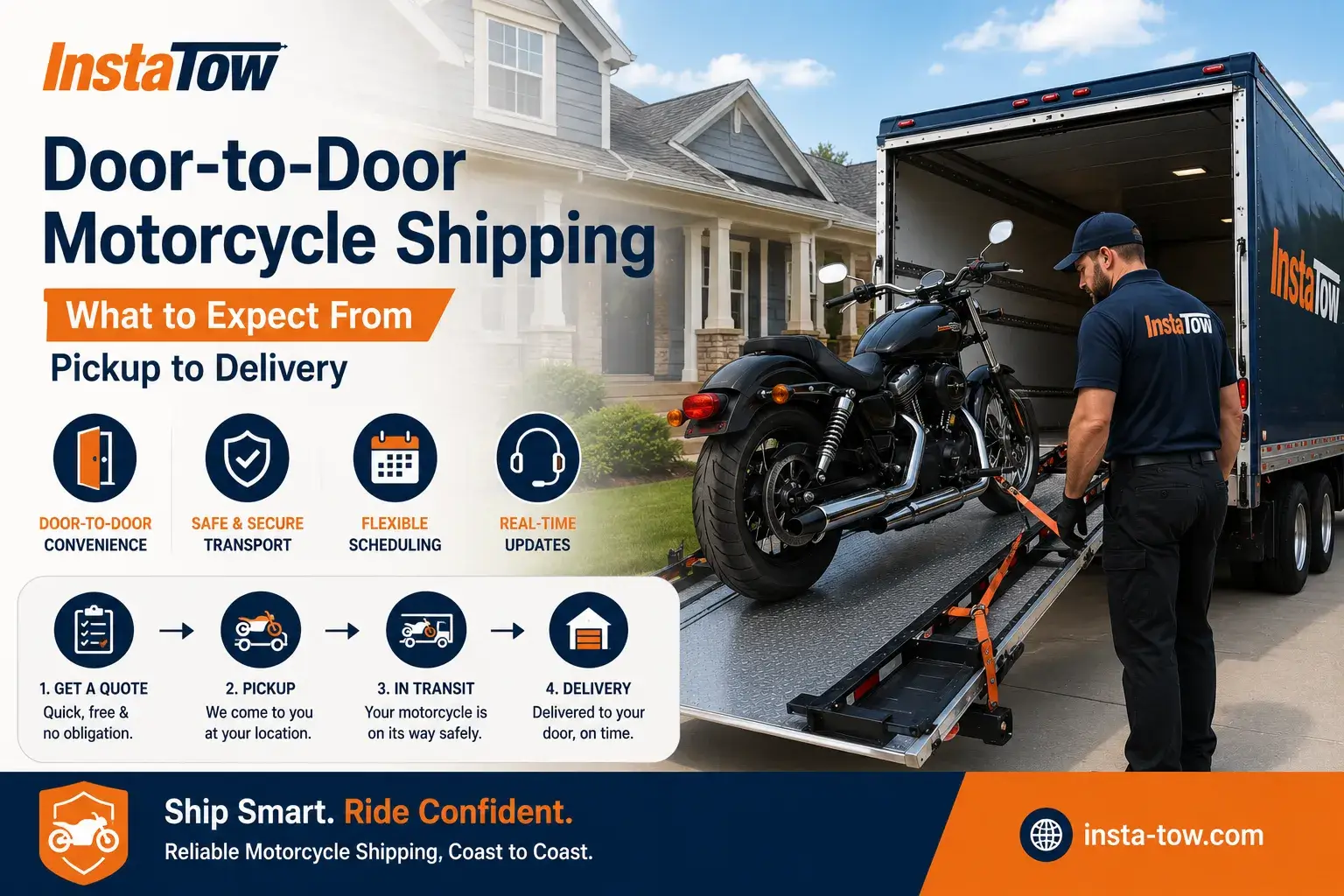
Many riders searching for door to door motorcycle shipping often wonder if the transport truck will literally pull up to their specific driveway.
The reality is that while this service offers the highest level of convenience, successful execution depends entirely on whether the transport carrier can physically access your location safely.
Marketing materials often simplify this concept, but at Instatow, we prioritize transparency regarding the actual logistics process.
This guide provides a factual breakdown of what to expect from the moment we accept your route to the final delivery, moving beyond generic definitions to explain how motorcycle transport services function in real-world scenarios.
What Is Door-to-Door Motorcycle Shipping?
Door to door motorcycle shipping describes a logistics model where the transport carrier aims to collect and deliver your motorcycle at your specified residence or business address.
It is distinct from terminal-to-terminal shipping, which requires you to drop off and pick up your bike at a centralized hub.
However, the term does not always guarantee a driveway-to-driveway experience, as operational limits dictate exactly how close a transport vehicle can get to your home.
The Reality of Accessibility
In practice, the success of door to door motorcycle shipping hinges on motorcycle carrier accessibility.
While drivers aim to arrive as close as possible to the requested address, they are operating large, heavy trucks, often tractor-trailers that require significant turning radii and vertical clearance.
If your location is in a tight residential zone or an area with specific truck restrictions, the carrier may request a nearby, accessible meeting point to load or unload the motorcycle.
Key Service Distinctions
The following table outlines the operational difference between the marketing promise of door-to-door services and the physical reality of transport:
When a Meeting Point Is Necessary
It is important to understand that a nearby meeting point is not a service failure; it is a safety protocol.
Carriers often choose alternative locations for the following reasons:
Roadway Width: Narrow streets where a trailer cannot safely maneuver or turn around.
Weight Restrictions: Residential areas that prohibit heavy commercial vehicles.
Overhead Clearance: Low-hanging power lines or tree branches that threaten the truck or the motorcycle.
Safe Stopping Zones: Situations where the local road lacks a legal, safe, and stable shoulder for the loading ramp to operate.
By confirming your residential motorcycle pickup potential before booking, you ensure the process remains efficient and stress-free, rather than encountering unexpected logistical hurdles on the day of transport.
How Does Door-to-Door Motorcycle Shipping Work?
The process for door to door motorcycle shipping involves five primary phases designed to ensure the safe, efficient transit of your bike from origin to destination.
It begins with the initial quote, proceeds through logistical verification of addresses, manages the timing of the pickup window, requires thorough documentation of the vehicle's condition, and concludes with professional loading and securing procedures.
1. Request a Route-Based Shipping Quote
A quote for door to door motorcycle shipping is not a flat rate based solely on distance; it is a calculated estimate derived from several specific variables.
When you request a quote, the pricing engine accounts for the following factors:
Pickup and Delivery Locations: Proximity to major transport corridors and local accessibility.
Motorcycle Specifications: The make, model, and overall size of the unit.
Condition: Whether the bike is running or non-running, as non-running units require specific equipment like winches or lift gates.
Service Speed: Your required timeline for delivery.
Accessibility: Specific site limitations at either end of the route.
2. Confirm the Pickup and Delivery Details
Before confirming your booking, you must verify that both your pickup and delivery locations are compatible with commercial transport equipment.
This step often referred to as a Pre-Booking Address Check prevents significant delays or the need for last-minute alternative meeting points.
When preparing your location details, ensure you have:
Accurate Address Data: Full zip codes and precise street numbers.
Contact Availability: A reliable phone number for someone authorized to be present.
Site Inspection: Confirmation that the area allows for a large truck to pull over safely.
Space Requirements: Sufficient turning and unloading room for the carrier’s trailer.
3. Prepare for the Pickup Window
Professional carriers operate on a pickup window rather than an exact appointment time due to the complexities of long-haul logistics and traffic.
You should not expect the driver to arrive at a specific, minute-perfect hour; instead, prepare for a window of time where the driver will coordinate with you directly.
If the driver experiences unexpected delays, you should:
Maintain Communication: Keep your phone accessible during the scheduled window.
Request Updates: If the window passes, contact the carrier for a revised ETA.
Confirm Requirements: Re-verify the pickup address and any specific site access instructions.
4. Inspect and Document the Motorcycle
Thorough motorcycle transport preparation requires you to document the exact condition of your bike before the driver arrives.
This documentation serves as your primary defense during any potential insurance valuation or claim process, as it provides a baseline for comparing the vehicle's state before and after transit.
Your pre-loading inspection checklist should include:
Exterior Examination: Note all existing scratches, dents, or paint chips.
Photographic Evidence: Capture high-resolution images of the bike from all angles.
Fluid Check: Document any leaks or mechanical issues.
Comparison: Use these photos to verify the bike’s condition upon delivery.
5. Load and Secure the Motorcycle for Transport
The loading phase is where professional carriers employ specific equipment to maintain the safety of your motorcycle.
You should inquire about the loading method to ensure it aligns with your expectations and the specific needs of your bike.
When discussing this with your provider, ask:
Equipment: Are hydraulic lift gates or dedicated motorcycle ramps used?
Securing: How many soft-tie straps are used to prevent movement?
Protection: Are sensitive parts protected from pressure-related damage during the tie-down process?
Isolation: Will the motorcycle be braced separately from other general cargo?
Does Door-to-Door Mean Delivery to Your Exact Front Door?
No, door to door motorcycle shipping does not guarantee that a transport truck can pull up to your specific front door or driveway in every scenario.
While this service aims for maximum convenience, the physical size of the transport equipment often mandates that the carrier remains on wider, more accessible roads to avoid safety hazards or legal restrictions.
When Can a Truck Reach the Exact Address?
A transport carrier can typically reach your exact address if the location supports the footprint of a large commercial vehicle.
You can generally expect direct access if your location features:
Road Width: Wide streets that allow for turning and maneuvering.
Stable Surfaces: Paved, flat areas suitable for lowering ramps and offloading.
Clearance: No low-hanging power lines, tree limbs, or tight overhead restrictions.
Zoning: Residential or commercial areas without weight or vehicle-length bans.
When Might a Nearby Meeting Point Be Needed?
If your address does not accommodate a large truck, the driver will often propose a nearby, safe meeting point.
This is a common industry practice to protect both your motorcycle and the truck itself.
Common scenarios requiring an alternative location include:
Narrow Residential Streets: Roads where a trailer cannot legally or safely turn.
Unpaved Terrain: Gravel or dirt roads that may cause the heavy truck to become stuck.
High-Traffic Zones: Areas where stopping a large truck would create significant safety risks.
Legal Restrictions: Neighborhoods with explicit No Commercial Trucking ordinances.
Who Chooses the Alternative Delivery Location?
The choice of an alternative meeting point is a collaborative decision between you and the driver, prioritized by safety and convenience.
The carrier will look for a location that is:
Proximity-Based: As close to your original address as physically possible.
Safe and Legal: A location where a truck can park for the duration of the loading or unloading process without violating traffic laws.
Efficient: A space that allows for the quick and safe transfer of the motorcycle.
By planning for the possibility of an alternative meeting point, you ensure that the logistics of your door to door motorcycle shipping remain fluid and protected from unforeseen site-access complications.
The Door-to-Door Shipping Details You Should Confirm Before Booking
Verifying specific logistics parameters before finalizing your reservation is the most effective way to prevent surprises and ensure your door to door motorcycle shipping experience goes according to plan.
By clarifying these points during the booking phase, you align your expectations with the carrier’s operational capabilities, effectively eliminating potential friction on the day of transit.
Confirm These 8 Details Before You Book
Use this checklist to ensure you have covered all necessary variables with your transport provider.
Reviewing these items protects both your budget and your schedule.
Beyond these checklist items, it is vital to secure written confirmation of any verbal agreements made during the booking process.
If you were promised specific handling for a vintage or custom bike, ensure that the scope of the enclosed motorcycle shipping or open transport service is clearly documented in your final booking contract.
This ensures that every logistical detail is accounted for before the truck departs, giving you peace of mind throughout the transit period.
What Can Delay Door-to-Door Motorcycle Shipping?
Delays in door to door motorcycle shipping generally stem from unforeseen site-access issues, inaccurate documentation, or failures in communication regarding the motorcycle's mechanical condition.
While professional carriers strive for efficiency, logistical variables such as weather, road restrictions, or incomplete site assessments can impact the timeline of your shipment.
Common Factors That Cause Delays
Understanding the variables that disrupt schedules helps you anticipate potential issues.
The most frequent causes include:
Accessibility Hurdles: The truck cannot reach the designated address due to low-hanging wires, narrow roads, or weight restrictions.
Logistical Communication Gaps: No designated person is present to meet the driver, or the provided phone number is unreachable.
Documentation Errors: Inaccurate address information causing the driver to navigate to the wrong location.
External Conditions: Severe weather events or unexpected road closures that halt commercial transport routes.
Operational Shifts: Seasonal surges in demand that impact driver availability or route timing.
Condition Discrepancies: The motorcycle is non-running, but it was booked as a running unit, requiring different loading equipment.
How to Reduce the Risk of Pickup or Delivery Delays
You can significantly minimize the probability of delays by proactively managing the information you provide to your carrier.
Implementing the following steps ensures your shipment remains on schedule:
Provide Precise Data: Double-check your pickup and delivery addresses, including gate codes or specific suite numbers.
Disclose Access Constraints: Explicitly tell the carrier about any street-level restrictions (e.g., sharp turns, dead ends, or neighborhood vehicle bans).
Ensure Availability: Always have an authorized person on-site during the agreed-upon window to sign for the bike.
Keep Lines Open: Ensure your contact phone number is active and that you are monitoring it closely as the pickup/delivery date approaches.
Be Honest About Condition: If your bike does not start, notify the dispatcher immediately so they can send the correct equipment.
Proactive Reporting: If you know of construction or neighborhood events that might block road access, inform your driver as soon as you find out.
By addressing these factors early, you turn potential obstacles into managed logistics, keeping your door to door motorcycle shipping process moving forward without unnecessary interruptions.
You can also read: How to Ship a Motorcycle to Another State: Easy Process Explained for Hassle-Free Shipping
How Much Does Door-to-Door Motorcycle Shipping Cost?
The final price for door to door motorcycle shipping is variable, determined primarily by the total distance, the specific route's accessibility, and the type of equipment required to secure your bike.
While there is no single standard rate, understanding these cost drivers helps you evaluate the value provided by professional transport services.
What Determines the Cost?
Several core factors influence your total shipping quote.
These elements are assessed by logistics professionals to calculate the risk, time, and fuel required for your specific transport:
Distance: Longer routes inherently cost more due to fuel and driver time.
Motorcycle Size and Type: Larger, heavier bikes (like cruisers or touring models) require more space on the trailer.
Pickup and Delivery Locations: Routes in major urban hubs are often cheaper than those in remote or mountainous areas.
Shipping Speed: Expedited delivery options come at a premium.
Seasonality: Peak riding season often sees higher demand and higher rates compared to winter months.
Condition: Non-running bikes require lift-gate trucks, which increases the operational cost.
Accessibility: Complex residential pickups requiring specialized equipment or smaller shuttle trucks add to the price.
Why Two Similar Routes Can Have Different Prices
Two shipments covering an identical distance do not necessarily cost the same.
This discrepancy often confuses customers, but it is driven by operational realities:
Transport Density: If a carrier already has other shipments along your route, they may offer a lower price.
Route Availability: Major interstates are more cost-effective to travel than secondary rural highways.
Address Accessibility: A home located on a wide, suburban street is easier (and cheaper) to access than a residence located on a narrow, dead-end road requiring a shuttle service.
Market Demand: High demand for specific transport corridors can cause price fluctuations.
How to Compare Quotes Correctly
Do not base your decision solely on the bottom-line dollar figure.
Use this table to compare quotes from different carriers to ensure you are comparing apples to apples:
Door-to-Door vs. Terminal-to-Terminal Motorcycle Shipping
The core difference between door to door motorcycle shipping and terminal-to-terminal shipping lies in the trade-off between total convenience and financial cost.
Door-to-door services minimize your personal effort by bringing the transport vehicle to you, whereas terminal shipping shifts the logistics burden back to the owner.
Choose Door-to-Door If:
You prioritize convenience and want to avoid the hassle of hauling your bike to a depot.
You are shipping a high-value or vintage motorcycle and want to minimize handling.
Your time is limited, and you cannot accommodate the schedule of a terminal drop-off.
Your residence is easily accessible by a standard car hauler.
Choose Terminal Shipping If:
You are looking for the absolute lowest price and are willing to perform the extra labor.
You live near a major transport terminal, making the drop-off convenient for you.
You have a truck and trailer capable of hauling your bike to the designated facility.
You require flexible delivery windows that go beyond standard trucking availability.
The Hybrid Option Many Riders Overlook
Many people assume they must choose between a binary set of options, but a Mix-and-Match shipping strategy is often available.
You can combine these services to optimize for both cost and convenience.
Terminal Pickup + Door-to-Door Delivery: If you have an accessible terminal near the origin but live in a remote area, you might deliver the bike yourself to save money on the pickup, then pay for door-to-door delivery to your home for maximum comfort.
Door-to-Door Pickup + Terminal Delivery: If you want the carrier to handle the initial, often difficult loading process at your home, but are happy to pick up the bike at a local terminal to save on the final delivery fee, this hybrid approach works effectively.
Discussing these options with your transport provider allows you to create a custom logistics plan that fits your budget without forcing you into an all or nothing service model.
How to Prepare Your Motorcycle for Door-to-Door Shipping
Preparing your bike for door to door motorcycle shipping is a vital step that protects your investment and ensures the carrier has accurate documentation for liability and insurance purposes.
When your motorcycle is properly prepped, it reduces the risk of transit damage and streamlines the loading process, ensuring the driver can focus entirely on securing the vehicle safely.
What to Do Before Pickup
Execute this checklist prior to the arrival of the transport carrier to ensure a smooth transition from your property to the transport vehicle.
These steps facilitate efficient motorcycle transport preparation:
Remove Personal Belongings: Clear all loose items, GPS mounts, or accessories from the bike that could vibrate loose or be damaged during transit.
Document Condition: Take dated, high-resolution photographs of the motorcycle from every angle, highlighting any existing scratches or dents.
Prepare Keys: Ensure the keys are accessible and handed to the driver if required for maneuvering or security.
Check Battery: Ensure the battery is charged and the bike is in a state where it can be started if necessary (or verify that it is fully non-operational).
Notify of Mechanical Issues: Explicitly inform the company if the bike has leaks, won't start, or has unique handling requirements.
Clear Protective Gear: Remove or secure any delicate parts, such as windshields or mirrors, if they are susceptible to damage.
What You Should Not Assume
Misconceptions about the shipping process often lead to preventable errors.
Avoid making the following assumptions:
Assumption of Exact Timing: Do not assume the driver will arrive at a minute-perfect appointment time; always expect a pickup window.
Universal Truck Access: Never assume your specific driveway or residential street is suitable for a large commercial trailer.
Implicit Non-Running Support: Do not assume a carrier can load a non-running bike unless you have specified its condition beforehand, as specialized equipment is required.
Insurance Coverage for Personal Effects: Never assume that personal items left on the bike are covered by the carrier's vehicle shipping insurance or that they are allowed to remain on the motorcycle.
Damage Assumption: Do not assume that any pre-existing damage is automatically recorded; always verify the inspection report provided by the driver.
Topics that might interest you: Ship Motorcycle to Florida Easily - Affordable Rates & Quick Booking Online
What Happens If Your Motorcycle Is Not Running?
Yes, you can utilize door to door motorcycle shipping even if your bike is not running, provided you inform the transport provider well in advance.
Shipping a non-operational motorcycle requires specialized equipment, such as a lift gate or a hydraulic winch system, to move the vehicle safely onto the trailer without needing it to roll under its own power.
Why Prior Notification Is Mandatory
Failing to disclose a non-running condition is one of the most common causes of pickup delays.
Carriers must dispatch specific trucks equipped for this task.
If a driver arrives at your door expecting a running bike and finds one that doesn't start, they may be forced to leave the motorcycle behind, leading to re-scheduling fees and wasted time.
The Link Between Condition and Accessibility
A non-running motorcycle significantly limits your options for motorcycle carrier accessibility.
Because the bike cannot be pushed easily, the carrier must be able to get their lift-equipped truck or winch-ready trailer as close to the bike as possible.
Increased Equipment Needs: Expect the carrier to use ramps, dollies, or heavy-duty winches.
Clearance Requirements: The pickup area must be even more accessible than it would be for a running bike, as there is less room for maneuverability during the loading phase.
Potential Cost Impacts: Because non-running bikes take more time and require specific technical resources to load, you should expect a higher service quote compared to a standard, running motorcycle.
By notifying your shipping company of your motorcycle's status, you allow them to send the correct personnel and equipment, ensuring your door to door motorcycle shipping process remains seamless despite the mechanical challenges.
How to Handle Motorcycle Delivery Day
Handling the delivery day for door to door motorcycle shipping effectively ensures that your asset arrives in the expected condition and allows you to resolve any discrepancies immediately.
The most critical aspect of delivery day is the visual inspection process, which serves as the final check to confirm that no damage occurred during transit and that your vehicle shipping insurance coverage remains valid for any potential claims.
Checklist: Before the Driver Arrives
Preparation doesn't stop once the truck is on the road; you must set the stage for a smooth handover at the destination address.
Confirm Accessibility: Ensure the drop-off site is clear of obstructions, allowing the driver to maneuver safely.
Prepare Documentation: Have your copy of the initial bill of lading and the original inspection photos ready for quick comparison.
Assign Authority: If you cannot be there personally, ensure an authorized adult is present to inspect the bike and sign the paperwork.
Clear the Path: If the delivery is a residential motorcycle pickup (or drop-off), move any parked vehicles or debris that might block the path to your garage or driveway.
Checklist: During Delivery
When the driver arrives, prioritize a methodical inspection before signing any final documents.
Walk-Around Inspection: Compare the bike's current state against the photos taken during motorcycle transport preparation.
Functional Check: Briefly check for any new leaks, loose parts, or electronic issues that were not present at pickup.
Verify Damage: If you notice new scratches or dents, document them immediately on the delivery receipt and have the driver sign off on the findings.
Sign-Off: Only sign the paperwork once you are satisfied with the inspection; note any exceptions clearly if discrepancies are found.
Why This Matters
This process acts as your protection.
If you sign the delivery document without noting damage, you may have little recourse later when filing a claim with the insurance provider.
By following a structured approach, you ensure that the responsibility for the bike’s condition is clear from the moment it leaves the transport vehicle until it enters your garage.
Is Door-to-Door Motorcycle Shipping Worth It?
Whether door to door motorcycle shipping is worth the investment depends entirely on how you value your time, the effort required to handle logistics personally, and the level of risk you are willing to assume.
For most riders, the convenience of having a professional carrier manage the entire transit process outweighs the cost savings associated with terminal-to-terminal alternatives.
Door-to-Door is Usually Worth It If:
Time Efficiency is Key: You have a busy schedule and cannot afford the hours required to transport your bike to and from a terminal.
Lack of Resources: You do not own a truck or trailer capable of hauling a motorcycle safely.
Complexity Reduction: You want to minimize the number of touchpoints your bike undergoes, reducing the overall handling risk.
Remote Location: You live in an area where local terminals are inconvenient or non-existent, making terminal-to-terminal shipping prohibitively difficult.
It May Not Be the Best Option If:
Budget is the Primary Driver: You are looking for the absolute lowest possible price and don't mind performing the extra work of hauling the bike yourself.
Proximity to Terminals: You reside within a short drive of a major shipping hub, making terminal drop-off a simple and inexpensive errand.
You Enjoy Logistics: You are comfortable coordinating multiple steps of the transport process and have the appropriate equipment to do so safely.
The Bottom Line
The true value of door to door motorcycle shipping isn't just in the transport itself; it’s in the professional service and coordination that handles the logistics for you.
While it may carry a higher price tag than terminal options, the return on investment comes in the form of saved time, reduced physical labor, and the peace of mind that comes from handing the job over to experts who specialize in motorcycle transport services.
Door-to-Door Motorcycle Shipping: A Pre-Booking Checklist
Executing a final review of your logistics plan using a standardized checklist is the best way to guarantee a smooth door to door motorcycle shipping experience.
This pre-booking phase allows you to identify potential accessibility or documentation gaps before the transport is officially scheduled, preventing costly last-minute adjustments.
Confirm These 10 Details Before You Book
Before finalizing your contract, ensure you have addressed each of the following points.
This list acts as a final safeguard to align your expectations with the carrier’s capabilities.
Pickup Address Confirmed: Verify that the origin address is accurate and allows for legal truck parking.
Delivery Address Confirmed: Ensure the destination is correctly listed and accessible for a commercial vehicle.
Truck Accessibility Checked: Confirm that the carrier is aware of any specific street-level or neighborhood constraints.
Motorcycle Condition Disclosed: Clearly state whether the bike is running or non-running to secure the right equipment.
Pickup Window Understood: Acknowledge that the carrier operates within a window, not a fixed, minute-specific appointment.
Delivery Expectations Understood: Clarify that door-to-door is subject to physical truck access requirements.
Coverage Details Reviewed: Read the vehicle shipping insurance or valuation coverage policy to understand exactly what is protected.
Extra Fees Confirmed: Ensure you have a breakdown of any potential residential service or fuel surcharges.
Contact Person Available: Designate a reliable person who will be physically present for both pickup and delivery.
Existing Damage Documented: Create a photographic record of the motorcycle's current state to establish a baseline.
By walking through this checklist, you transform the complex task of shipping your bike into a manageable, transparent process.
This level of diligence ensures that both you and the carrier are prepared for every step, significantly reducing the likelihood of delays or misunderstandings during the transit of your motorcycle.
Get a Door-to-Door Motorcycle Shipping Quote
To receive an accurate and competitive door to door motorcycle shipping quote, you need to provide specific information that reflects the unique requirements of your route and vehicle.
At Instatow, we prioritize precision in our pricing; the more detailed the information you provide, the more reliable your estimate will be.
Our logistics team assesses each request individually, accounting for equipment needs, fuel costs, and route accessibility to ensure your quote is comprehensive.
Request Your Tailored Shipping Quote
Avoid generic estimates that don't account for your specific needs.
When requesting your door to door motorcycle shipping quote, ensure you have the following details ready:
Pickup ZIP Code: Allows us to calculate the distance and assess local regional transport hubs.
Delivery ZIP Code: Enables us to determine the accessibility of the destination and route planning.
Motorcycle Make and Model: Helps our team identify size, weight, and any specialized handling requirements.
Running Condition: Crucial for determining if we need to dispatch a lift-gate truck or winch-equipped vehicle.
Preferred Shipping Speed: Let us know your timeline so we can provide options ranging from standard transport to expedited services.
Ready to move your bike?
Get a Door-to-Door Motorcycle Shipping Quote Based on Your Route
Frequently Asked Questions About Door-to-Door Motorcycle Shipping
Understanding the nuances of professional transport can be difficult, but most common concerns regarding door to door motorcycle shipping have straightforward, practical answers.
The following FAQs address the most critical aspects of the service to help you make an informed decision.
How does door to door motorcycle shipping work?
It is a service where the carrier picks up your bike from your specified location and delivers it to your destination address.
The driver utilizes commercial trailers to move your motorcycle securely, aiming to get as close to your driveway as safely and legally possible, depending on local road and accessibility conditions.
Does door to door motorcycle shipping mean delivery directly to my front door?
Not always. While the goal is to reach your exact address, motorcycle carrier accessibility dictates the actual stopping point.
If your street is too narrow, has low-hanging wires, or prohibits commercial traffic, the driver will coordinate a safe, nearby meeting point to complete the loading or unloading process.
How much does door to door motorcycle shipping cost?
Pricing is dynamic and based on distance, the motorcycle’s type and running condition, the specific route, and current fuel and labor market rates.
You should request customized motorcycle shipping quotes to get an accurate assessment for your specific route and vehicle.
Can a motorcycle be picked up from a residential address?
Yes, residential motorcycle pickup is a standard component of door-to-door services.
As long as the residential area allows for the maneuverability of the carrier’s truck, the driver will come to your home to collect the bike.
What happens if the shipping truck cannot reach my address?
If the truck cannot reach your specific address, the driver will contact you to arrange a safe, legal, and accessible alternative meeting point nearby.
This is a standard safety procedure, not a service failure, designed to protect your motorcycle and the transit vehicle.
Can I ship a non-running motorcycle door-to-door?
Yes, but you must disclose this when booking.
Shipping a non-running bike requires specialized equipment like lift gates or winches.
Failing to inform the carrier of the bike's condition can lead to delays on the day of pickup.
Is door to door motorcycle shipping safer than terminal shipping?
Safety depends more on the carrier’s handling protocols than the method itself.
However, door-to-door service is often considered safer because it reduces the number of times the motorcycle is handled and transferred compared to terminal-to-terminal shipping, which often involves multiple points of contact.
How long does door to door motorcycle shipping take?
Transit times vary based on the total distance of the route, weather conditions, and the carrier's schedule.
During the booking process, your provider will give you an estimated timeframe, though external factors like traffic or road closures can impact the final arrival date.
Can I combine terminal pickup with door-to-door delivery?
Yes, many carriers offer hybrid logistics solutions.
You can choose to drop the bike off at a terminal to save on costs and request that the company deliver it directly to your home at the destination, providing a blend of affordability and convenience.
What should I check before signing for my motorcycle?
Before signing the delivery receipt, conduct a thorough inspection.
Compare the bike’s condition to your pre-shipment photos, check for any new damage or leaks, and ensure all parts are accounted for.
Note any discrepancies on the paperwork before signing to protect your rights for any insurance claims.