
When you need to move a vehicle across the country, safety, efficiency, and convenience are your top priorities.
At Instatow, we understand that your vehicle is more than just a set of wheels; it is a vital asset that requires careful handling.
Choosing the right method for your needs is crucial, and that is where door to door auto transport becomes the gold standard for most vehicle owners.
Many people find themselves overwhelmed by the sheer number of car shipping services available today.
Navigating the logistics can be stressful, especially when you are balancing a relocation or a long-distance purchase.
By opting for a direct pickup and delivery service, you eliminate the hassle of dealing with transit terminals and ensure your vehicle arrives as close to your residence as legally and safely possible.
This guide will walk you through everything you need to know about door to door auto transport to ensure a successful shipment.
What Is Door to Door Auto Transport and How It Works
For many vehicle owners, moving a car across the country is a source of significant stress.
Whether you are relocating for a new job or purchasing a classic car online, the logistics can feel overwhelming.
Door to door auto transport has emerged as the premier solution for those seeking a balance between convenience and security.
At Instatow, we prioritize a seamless experience that removes the complexities of traditional shipping methods, ensuring your vehicle reaches its destination without unnecessary transit headaches.
Simple Definition of Door to Door Car Shipping
Door to door auto transport is the most convenient method for moving vehicles across the United States.
Unlike other methods that may require you to drive your car to a designated drop-off point, this service involves a carrier coming directly to your specified location to pick up your vehicle and delivering it directly to your destination.
It effectively bridges the gap between your front door and the truck.
Reputable auto transport companies utilize this method to provide a seamless experience, minimizing the amount of extra driving or logistical planning you need to perform.
It eliminates the need to visit transit terminals.
It provides direct pickup from residential or business locations.
It ensures your vehicle remains on the same trailer for the duration of the trip.
It offers a personalized shipping experience tailored to your specific schedule.
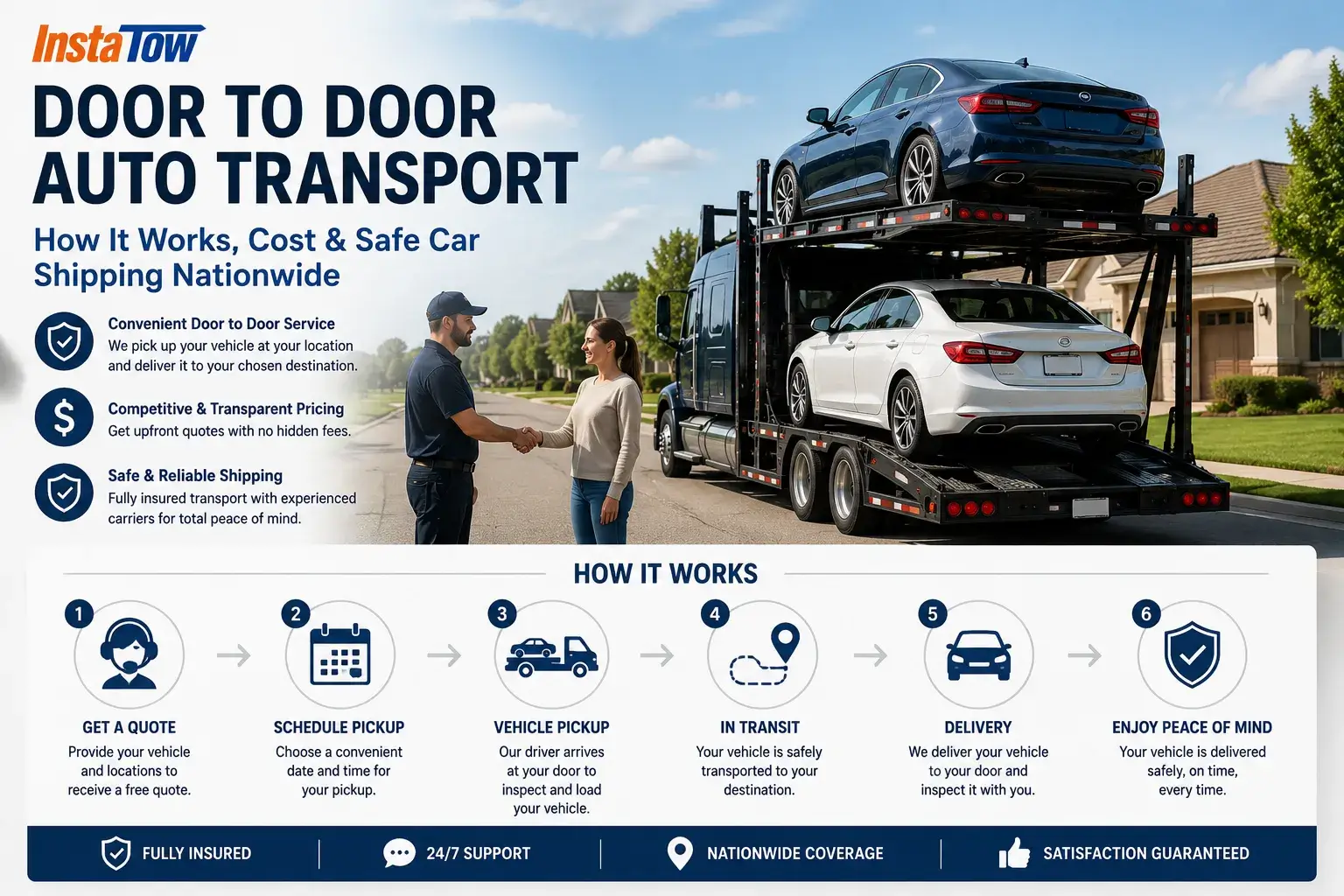
Step-by-Step Process Explained
The process is designed to be as straightforward as possible to ensure your peace of mind.
When you choose Instatow, we prioritize transparency at every stage of the journey.
Here is how the operation typically unfolds when you book door to door auto transport:
Request a Quote: Determine pricing based on your specific route, vehicle type, and preferred timeline.
Carrier Assignment: A professional carrier is assigned to your order, and a pickup window is finalized.
Pickup and Inspection: The driver arrives at your pickup location to perform an initial inspection and load the vehicle securely.
Transit: Your vehicle is transported directly to the destination address provided.
Delivery and Final Check: The final inspection is performed upon arrival at the destination, and the vehicle is handed over to you.
Why It Is the Most Popular Auto Transport Method in the U.S.
There is a reason why door to door auto transport consistently ranks as the preferred choice for Americans moving across the country.
In today’s fast-paced environment, time is a finite resource.
This method offers unparalleled flexibility, allowing you to focus on other aspects of your move while professionals handle the logistics of the transit.
Furthermore, it reduces the risk profile associated with your vehicle.
By minimizing the number of times your car is loaded and unloaded or left sitting at a transit yard you significantly lower the chances of accidental damage or exposure to external elements.
Whether you are a busy professional or a family relocating for a new opportunity, the convenience of having your vehicle delivered directly to your doorstep is simply unmatched in the industry.
Door to Door Auto Transport Cost in the United States
Determining the exact vehicle shipping cost can be complex because it depends on several dynamic variables unique to every shipment.
While there is no one-size-fits-all price tag, understanding the market averages provides a solid baseline for your budget.
At Instatow, we believe in transparency, ensuring you know exactly what you are paying for when you choose our door to door auto transport services.
Average Cost per Mile (Open vs Enclosed)
Pricing is typically calculated on a per-mile basis, which decreases as the distance increases.
However, the type of carrier you choose significantly influences the final quote.
Open Carrier Transport: Generally the most cost-effective option, perfect for standard passenger vehicles.
Enclosed Auto Transport: A premium choice that provides maximum protection from road debris and weather, typically costing 30% to 50% more than open transport.
The industry average for open transport usually fluctuates between $0.50 and $1.50 per mile for short distances, while longer, cross-country trips often scale down significantly on a per-mile basis.
You can also read: Benefits of Enclosed Classic Car Transport
Pricing Breakdown by Distance
The total cost is largely dictated by how far the vehicle must travel.
Below is a general guide to how distance impacts your final quote:
Short Distance (1-200 miles): Often higher per-mile rates due to fixed operational costs like driver time and fuel.
Medium Distance (201-1,000 miles): Rates begin to stabilize as the efficiency of long-haul trucking increases.
Long Distance (1,000+ miles): The most economical per-mile rate, though the total invoice will naturally be higher due to the sheer mileage involved.
Key Factors That Affect Pricing
Several logistical elements can cause your quote to fluctuate.
Being aware of these helps you better prepare for your door to door auto transport experience:
Distance: The primary driver of the final price.
Vehicle Type: Heavier, oversized vehicles require more space and fuel, increasing the cost.
Season: High-demand seasons (like snowbird season in winter) can drive up market rates.
Location Accessibility: Delivery to remote or urban areas with narrow streets may require specialized handling.
Transport Type: Choosing enclosed over open carriers will always impact your total investment.
How to Reduce Car Shipping Costs
Managing your budget effectively is possible with a few strategic decisions.
You do not always have to sacrifice quality to save on your vehicle shipping cost.
Book in Advance: Last-minute bookings often come with premium pricing to secure a spot.
Be Flexible with Dates: If you can adjust your pickup or delivery windows, carriers may offer better rates.
Choose Terminal-to-Terminal: If you have access to a hub, this can be cheaper, though it lacks the convenience of door to door auto transport.
Consider Open Transport: Unless you are shipping a luxury or vintage car, open carrier transport is usually sufficient and budget-friendly.
How Long Does Door to Door Car Shipping Take?
When you choose door to door auto transport, you are prioritizing convenience, but it is essential to understand the logistics of timing.
Several variables influence how quickly your vehicle travels from pickup to drop-off.
Generally, most domestic shipments are completed within one to two weeks, depending on the distance, but Instatow always strives for the most efficient routing to minimize your wait time.
Delivery Time Based on Distance
The duration of your shipment is almost exclusively determined by mileage.
Short-haul shipments (under 500 miles) can often be completed in 1-3 days, as these routes are shorter for the driver to navigate.
Conversely, long-haul shipments require more time for the truck to traverse the country and make multiple stops.
Short Distance (1-500 miles): 1 to 3 days.
Medium Distance (501-1,500 miles): 3 to 7 days.
Long Distance (1,501+ miles): 7 to 14 days.
These estimates are averages and can shift based on traffic, road conditions, and the specific route chosen by the carrier.
Coast-to-Coast Shipping Example
For a cross-country trip, such as moving from Los Angeles to New York, the transit time typically ranges between 7 and 10 days.
During this period, reliable auto transport companies will provide updates so you can monitor the progress of your shipment.
While waiting for a vehicle to traverse the entire United States, you can utilize car carrier tracking tools provided by your logistics partner to stay informed about the truck's general location and estimated arrival window.
What Can Delay Auto Transport?
While we always plan for the most direct route, external factors can occasionally impact the schedule.
Being aware of these common delays helps manage expectations when using door to door auto transport.
Inclement Weather: Severe storms, snow, or flooding can force drivers to take detours or pause operations for safety.
Mechanical Issues: Unexpected truck repairs can lead to temporary holds until the vehicle is roadworthy again.
Driver Regulations: Federal hours-of-service regulations strictly limit how many hours a driver can be on the road per day.
Route Complexity: Deliveries to rural or hard-to-reach locations may take slightly longer due to the navigation required for large transport trucks.
Door to Door vs Terminal to Terminal Auto Transport
Selecting the right shipping method is a critical decision that balances your budget against your need for convenience.
While door to door auto transport remains the most popular choice for individual vehicle owners, understanding how it compares to terminal to terminal shipping ensures you make an informed choice based on your specific requirements.

Key Differences Explained
The primary difference lies in the location of the pickup and drop-off.
With door to door service, the driver aims to get as close to your residence as possible.
In contrast, terminal to terminal shipping requires you to deliver your car to a centralized facility (often a large parking lot or warehouse) and pick it up from another designated facility at the destination.
While terminal-to-terminal can sometimes be slightly cheaper, it adds the burden of you having to arrange your own transportation to and from the facility, which can negate the financial savings.
Comparison Table (Cost, Time, Convenience, Risk)
Which Option Is Best for You? (Decision Guide)
Choosing between these two methods depends on your priorities and schedule.
Choose Door to Door Auto Transport if: You value your time, you are shipping a daily driver, or you have limited access to transportation for dropping off or picking up your vehicle. It is the ideal choice for busy professionals and families.
Choose Terminal to Terminal Shipping if: You are on an extremely tight budget, you are located in a very remote area where trucks cannot easily navigate, or you have convenient access to major shipping hubs.
Ultimately, for most customers, the added security and reduced handling associated with door to door auto transport outweigh the marginal savings of terminal-based options.
Open Transport vs Enclosed Transport
When arranging your door to door auto transport, selecting the right trailer type is crucial for your vehicle's safety and your budget.
Carriers typically offer two primary methods: open and enclosed.
Each serves a specific purpose, and understanding the nuances helps you align your choice with your vehicle’s specific needs.
What Is Open Transport?
Open transport is the standard for the majority of the shipping industry.
It involves using an open carrier transport trailer that is exposed to the elements.
While this may sound like a disadvantage, it is the most efficient and widely available method for standard daily drivers and used vehicles.
Because these trucks can accommodate multiple vehicles at once, they offer a highly cost-effective solution for most customers.
Cost-Efficiency: Significantly lower pricing compared to enclosed alternatives.
Availability: Faster pickup times due to the higher volume of these trucks on the road.
Visibility: Allows the driver to easily inspect the vehicle during transit stops.
What Is Enclosed Transport?
For high-value, luxury, or vintage automobiles, enclosed auto transport is the industry-recommended standard.
This method involves a fully covered trailer that shields your vehicle from road debris, rain, snow, and other environmental factors.
It offers an extra layer of security and is the preferred choice for collectors, car shows, and high-end vehicle owners who require maximum protection throughout the shipping process.
Environmental Protection: Total shielding from wind, road salt, and harsh weather.
Security: Added layer of protection against theft or vandalism.
Peace of Mind: Essential for pristine or highly customized vehicle finishes.
Which One Should You Choose?
Your decision should rely on the value and condition of your vehicle.
If you are shipping a standard, everyday vehicle, open carrier transport is almost always the logical choice.
However, if your vehicle has a high financial value or sentimental importance, investing in an enclosed option is worth the premium.
Most auto transport companies will advise you based on your vehicle's specific attributes to ensure you do not overspend on protection you may not strictly need.
Open vs Enclosed Car Shipping: Costs, Risks & Which Option Is Right for You
When Should You Choose Door to Door Auto Transport?
While terminal-to-terminal shipping exists as a budget alternative, door to door auto transport is widely considered the superior option for most individuals.
It is designed to remove the logistical burden from the customer, ensuring the most straightforward shipping experience possible.
However, understanding when this service provides the most value will help you decide if it aligns with your specific move.

Best Scenarios for Door to Door Shipping
This service shines when your time and vehicle safety are the top priorities.
It is the preferred method for anyone who cannot spare the time to drive a vehicle to a terminal or who needs the car waiting for them upon arrival at their new destination.
Relocation: Perfect for families moving to a new state who need their vehicle ready for daily use immediately.
Long Distance Moves: When driving the vehicle yourself would be exhausting or logistically impossible.
Car Purchases: Ideal for buying a vehicle online where you need it delivered directly to your driveway.
Busy Professionals: For those who cannot take time off work to manage complex logistics at shipping depots.
When It May NOT Be the Best Option
Despite its many advantages, there are specific situations where door to door auto transport might encounter hurdles.
It is important to be realistic about your location and vehicle accessibility.
Restricted Access: If you live in an area with narrow streets, low-hanging trees, or gated communities that prevent large trucks from entering, the driver may need to meet you at a nearby parking lot.
Extreme Budget Constraints: If every dollar counts and you have the time to drive to a nearby terminal, saving on the final vehicle shipping cost might take priority over the convenience of door-to-door delivery.
Tight Turnaround Times: In very rare cases, if you need a vehicle moved extremely quickly, the route optimization required for door-to-door delivery might be slower than a standardized terminal route.
Safety, Insurance, and Regulations
When you entrust your vehicle to door to door auto transport professionals, peace of mind is just as important as the logistics themselves.
Reputable auto transport companies operate under strict oversight, and knowing your vehicle is in safe hands begins with understanding the regulatory landscape that governs the industry.
FMCSA Licensing Requirements Explained
In the United States, all legitimate vehicle shipping providers must be registered with the Federal Motor Carrier Safety Administration (FMCSA).
This agency enforces safety regulations for commercial transport, ensuring that every carrier on the road meets specific standards for vehicle maintenance, driver training, and operational safety.
When you book with Instatow, you are choosing a provider that prioritizes these legal requirements, ensuring that your vehicle is moved by compliant, licensed, and insured professionals.
What Auto Transport Insurance Covers
Understanding vehicle transport insurance is vital before your car ever leaves your driveway.
Most carriers carry two types of coverage: cargo insurance and liability insurance.
Cargo Insurance: Covers damage to the vehicle during transit, such as accidents or environmental damage.
Liability Insurance: Covers damage the carrier might cause to other property or persons during the operation of their truck.
It is important to note that this insurance covers the vehicle itself, but rarely covers personal items left inside the car.
Always confirm the policy details with your transport provider to understand the deductible and coverage limits.
What Happens If Your Car Gets Damaged?
While damage is rare, it is a possibility that requires a clear protocol.
If you notice any damage upon delivery, the first step is to document it immediately.
You must note any discrepancies on the Bill of Lading (BOL) before signing off on the delivery.
Take clear photographs of the affected area and compare them with the inspection report created at pickup.
Reporting the issue promptly to your transport provider initiates the claims process, allowing them to rectify the situation in accordance with their insurance terms.
Step-by-Step Booking Process
The beauty of door to door auto transport lies in its simplicity.
We have streamlined the booking process to ensure that securing your shipment is quick and hassle-free, whether you are moving across town or across the country.
Getting a Quote
The process begins with an accurate assessment of your needs.
When you request a quote, you provide details such as the pickup and delivery locations, the vehicle make and model, and your preferred dates.
This allows us to calculate an accurate vehicle shipping cost based on current market trends and distance, providing you with a transparent price without hidden fees.
Carrier Assignment Process
Once you approve the quote and book the service, the carrier assignment phase begins.
We utilize a vast network of vetted drivers to find the best match for your specific route and vehicle.
This phase involves matching your timeline with available trucks, ensuring your vehicle is picked up within your requested window.
Pickup and Inspection
On the day of pickup, the driver arrives at your location to perform a thorough inspection of the vehicle.
This is a critical step in the door to door auto transport workflow.
Visual Walk-around: The driver inspects the exterior for pre-existing scratches, dents, or chips.
Documentation: All findings are recorded on the Bill of Lading (BOL), which serves as your legal contract and condition report.
Loading: The vehicle is securely loaded onto the truck using ramps and specialized tie-down equipment.
Verification: You review and sign the BOL, keeping a copy for your records to ensure transparency throughout the move.
Delivery and Final Check
Upon arrival at your final destination, the process is reversed.
The driver will contact you to confirm the delivery time and location.
You will conduct a final inspection of your vehicle, comparing its current state against the initial BOL from pickup.
Once you verify that the car arrived in the same condition as when it departed, you sign the final delivery paperwork, completing the service.
Benefits of Door to Door Car Shipping
When evaluating your logistics options, it is clear why door to door auto transport has become the preferred choice for modern vehicle owners.
By removing the need for intermediary storage, you gain a level of control and ease that alternative methods simply cannot match.
Leveraging professional car shipping services allows you to focus on your relocation or schedule, knowing your vehicle is being handled by experts.
Maximum Convenience
The primary benefit is the absolute convenience provided by doorstep service.
You avoid the logistical nightmare of driving your vehicle to a terminal, securing alternative transportation back home, and repeating the process at the destination.
With door to door auto transport, the carrier comes to you, which is particularly beneficial for those moving to new cities where they are unfamiliar with the layout or lack local transportation.
Saves significant time and travel expenses.
Simplifies coordination for busy families and professionals.
Eliminates the need for multiple drop-offs or pickups.
Reduced Handling Risk
Every time a vehicle is loaded or unloaded from a transport truck, there is a minor risk of incidental contact or cosmetic issues.
By opting for a direct route with door to door auto transport, you minimize the number of times your car is handled.
Fewer loading cycles mean a reduced chance of errors during the transition, ensuring your vehicle arrives in the exact state it left.
Time Saving Advantage
Time is a non-renewable resource, and the time required to manage terminal-based shipping often exceeds the cost savings.
By delegating the transit to professional drivers, you effectively outsource the entire logistics chain.
This allows you to focus your energy on other aspects of your move, such as coordinating your household goods or settling into your new residence.
Doorstep Delivery Experience
There is a distinct peace of mind that comes with seeing your vehicle arrive right at your driveway.
This personalized delivery is the hallmark of premium car shipping services.
Whether you are waiting for a classic restoration project or a daily commuter, the ability to inspect the vehicle immediately upon delivery at your home ensures a satisfying conclusion to the transport process.
Common Mistakes to Avoid
Even with the best planning, common pitfalls can complicate your experience with door to door auto transport.
Being aware of these errors allows you to navigate the shipping process proactively, ensuring that your experience with reputable auto transport companies remains smooth and stress-free.
Choosing the Cheapest Option Only
In the logistics industry, an unrealistically low price is often a red flag.
Some providers may bait customers with low quotes only to increase the price later or prioritize your shipment last.
Always balance price with reputation.
Ensure the auto transport companies you consider have a track record of reliability and transparency, even if it costs slightly more than the lowest available bid.
Look for customer reviews and industry ratings.
Verify FMCSA licensing to ensure the company is legitimate.
Ask for a comprehensive breakdown of all potential fees.
Not Checking Insurance Coverage
A common oversight is failing to confirm the specifics of the carrier's insurance policy.
Never assume that the basic carrier liability is sufficient for your specific vehicle value.
Always request a copy of the certificate of insurance and clarify the deductible, as this is a crucial step in protecting your asset during transit.
Poor Vehicle Preparation
Neglecting to prepare your vehicle can lead to delays or issues during the inspection process.
If you leave personal items in the car, add excessive fuel, or fail to disable alarms, the driver may refuse to load the vehicle.
Proper preparation facilitates a smooth pickup.
Remove all personal belongings, including toll tags and garage remotes.
Ensure the vehicle is clean to allow for accurate inspection of the paint.
Check that the battery is charged and the car is in running condition unless specified otherwise.
Last Minute Booking
Waiting until the last minute to book your transport significantly limits your options and can drive up your total vehicle shipping cost.
Carriers prefer advanced notice to optimize their routes.
Booking at least two weeks in advance provides you with better pricing and greater flexibility in scheduling your preferred pickup and delivery windows.
Car Shipping Preparation Checklist
Preparing your vehicle effectively is a critical step that ensures the safety of your asset and the efficiency of your door to door auto transport experience.
Drivers are strictly regulated by weight limits and safety protocols, meaning a well-prepared car facilitates a faster, smoother pickup.
Following this checklist demonstrates responsibility and allows the driver to focus on the technical aspects of the loading process.
Clean and Inspect Vehicle
Before the carrier arrives, wash your car thoroughly.
This is not purely for aesthetic reasons; a clean vehicle allows for a much more accurate inspection of the paint and bodywork.
Any pre-existing scratches, dents, or chips must be visible to both you and the driver so they can be documented accurately on the inspection report.
Failure to clean the car can lead to disputes regarding new versus old damage upon delivery.
Remove Personal Items
It is a common misconception that you can use your vehicle as a moving container.
Most auto transport companies prohibit the transport of personal items inside the vehicle because these items are not covered by the carrier's vehicle transport insurance and can cause damage to the interior during transit.
Remove all loose items: GPS units, toll tags, garage remotes, and aftermarket electronics.
Clear out the glove box and center console.
Do not leave heavy items in the trunk that could shift and damage the interior lining.
Fuel and Mechanical Check
Your vehicle should not have a full tank of gas when it is loaded onto the truck.
Aim for a fuel level of approximately one-quarter tank.
This reduces the total weight of the vehicle, which is safer for the transport equipment, and prevents any potential safety hazards from fuel leaks.
Additionally, ensure the car is in running condition.
If the vehicle is non-operational, you must inform the provider during the booking phase, as it will require specialized equipment for loading.
Disable Alarm Systems
An active alarm system can be a major nuisance for a driver.
If the alarm triggers during transport, it can drain the battery or cause confusion and delay.
Ensure that all security alarms are deactivated or set to valet mode before handing over the keys.
Keys and Documentation
You will need to provide the driver with a set of keys for the ignition and any other necessary access points (like a trunk or glove box).
Keep your registration, insurance documents, and the Bill of Lading (BOL) easily accessible.
The BOL acts as the master record of your door to door auto transport service; keep your signed copy safe, as it is the primary document used to resolve any potential insurance claims.
Real-World Car Shipping Scenarios
The versatility of door to door auto transport makes it a solution for a wide range of situations beyond just a standard household move.
Whether you are navigating a complex lifestyle transition or managing a business inventory, professional logistics providers like Instatow tailor the service to fit specific operational requirements.
Cross-Country Relocation Example
Consider a professional moving from a major city like New York to Los Angeles.
Driving the vehicle cross-country takes roughly 40 to 50 hours of pure driving time, not accounting for rest, meals, and overnight stays.
By choosing door to door auto transport, the individual bypasses the physical strain of a multi-day road trip.
They can fly to their new destination and have their vehicle waiting for them at their new residence, effectively reclaiming nearly a week of their time.
Student Car Shipping Case
Many university students require their vehicles to get to campus but face the challenge of attending institutions thousands of miles from home.
For parents, coordinating this move can be stressful.
We frequently facilitate transport for students returning for the semester, ensuring the vehicle is picked up from their home and delivered directly to their off-campus housing or dormitory parking area.
This service provides parents with peace of mind, knowing their child has reliable transportation without the risks associated with long-distance solo driving.
Dealership Vehicle Transport Scenario
Dealerships often need to move inventory between locations or deliver a sold vehicle to a remote customer.
Utilizing a professional carrier is standard practice to maintain the vehicle's pristine condition.
Because dealerships value the appearance of their inventory, they often opt for enclosed auto transport to ensure the exterior remains showroom-ready.
For a dealership, door to door auto transport is not just a convenience; it is a vital part of their customer service promise, ensuring that the buyer receives their vehicle exactly as expected, without the mileage and wear of a traditional delivery drive.
Final Thoughts
Making the decision to move a vehicle requires trust and clarity.
We have explored the mechanics, costs, and benefits of choosing door to door auto transport to ensure your vehicle reaches its destination securely and efficiently.
By working with experienced professionals and understanding the variables from selecting the right open carrier transport or enclosed auto transport to preparing your vehicle properly you can mitigate the stress of relocation.
Is Door to Door Auto Transport Worth It?
Ultimately, the value of this service is found in the time and energy you save.
When you compare the convenience of a direct, door-to-door delivery against the logistical complexity of terminal to terminal shipping, the choice becomes clear for those who prioritize their schedule.
Choosing a professional partner like Instatow ensures that you are not just booking a service, but securing a reliable, transparent, and high-end experience.
Whether you are a student moving to campus, a professional relocating for work, or a dealership managing inventory, door to door auto transport is the smartest, most efficient path forward for your vehicle shipping needs.
Frequently Asked Questions
Navigating the logistics of moving a vehicle can bring up several questions.
To ensure you feel fully informed and confident when choosing door to door auto transport, we have compiled the most common inquiries our team receives at Instatow.
Is door to door auto transport safe?
Yes, it is widely considered one of the safest methods available.
Because the vehicle is handled only during the initial loading and final unloading process, the risk of accidental damage is significantly lower compared to methods that require multiple transfers.
Reputable auto transport companies also perform thorough inspections at every touchpoint to ensure safety.
How much does it cost on average?
The vehicle shipping cost varies based on the distance, the size of your vehicle, and the time of year.
While prices fluctuate, most coast-to-coast moves range between $1,000 and $2,000.
For accurate, transparent pricing, it is best to request a customized quote based on your specific route.
How long does it take?
The timeline depends heavily on the distance between the pickup and delivery points.
Short hauls can take 1-3 days, while cross-country shipments typically require 7-14 days.
Factors like seasonal demand and weather conditions can also impact the final delivery window.
Can I put personal items in my car?
We generally advise against placing personal items inside your vehicle during transit.
Most carriers prohibit it because these items are not covered by the standard vehicle transport insurance and can create safety risks for the driver.
Can the truck reach my exact address?
In most cases, yes.
However, if you live in a gated community, on a narrow street, or in an area with low-hanging trees or weight restrictions, the truck driver may ask to meet you at a nearby, accessible parking lot to ensure safe loading and unloading.
Is insurance included?
Yes, all professional auto transport companies are required to carry cargo insurance that covers your vehicle while it is in their possession.
We recommend reviewing the policy details during your booking process to understand the specific coverage limits and deductible.
Can I track my vehicle during transport?
Modern logistics technology allows for consistent updates.
Many providers offer car carrier tracking, providing you with visibility into your vehicle’s general location and status as it travels across the country.