
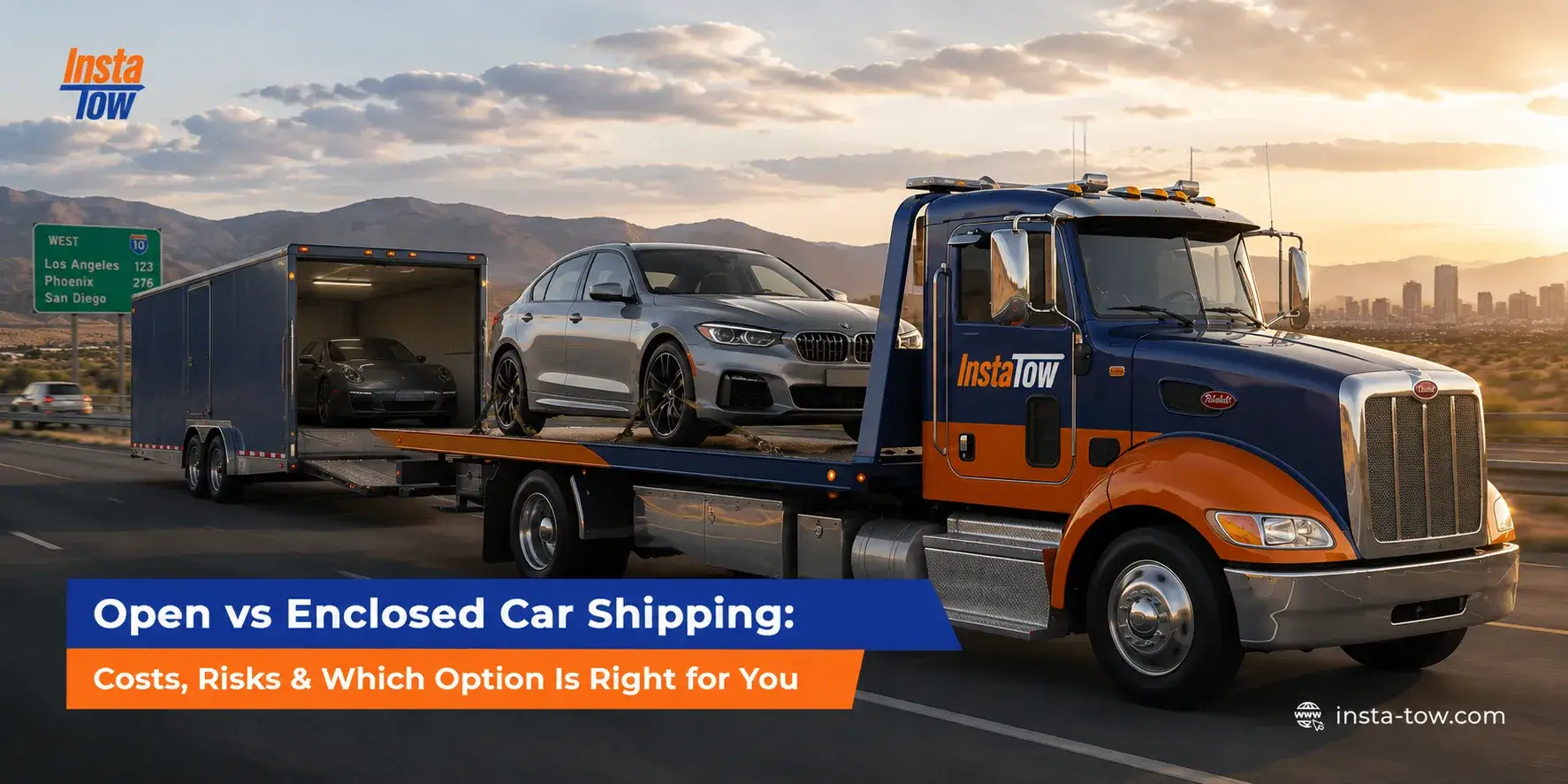
Shipping a vehicle across the country is a significant logistical decision that often boils down to a single choice: maximum protection or maximum value?
Whether you are relocating for a job, purchasing a vehicle from an out-of-state auction, or moving a prized classic to a summer home, understanding the nuances of open vs enclosed car shipping is essential for a stress-free experience.
While both methods offer reliable door-to-door vehicle delivery, the differences in equipment, insurance limits, and exposure levels can impact both your budget and your peace of mind.
At Instatow, we believe that an informed customer is a satisfied one, which is why we’ve broken down every technical and financial aspect of these two primary transport methods.
Open vs Enclosed Car Shipping - Quick Comparison (Side-by-Side Table)
For many shippers, the decision comes down to how quickly they need the vehicle moved and the level of road debris and weather exposure they are willing to tolerate.
Open transport is the industry standard for daily drivers, utilizing multi-car carrier trailers seen frequently on U.S. highways.
Conversely, enclosed shipping provides a white-glove environment, shielding the vehicle from every external element.
To help you decide at a glance, refer to the comparison table below which highlights the key performance indicators of each service.
Speed: Open carriers are more numerous, meaning shorter wait times for pickup.
Security: Enclosed trailers offer a physical barrier against theft and prying eyes.
Budget: Open shipping remains the most cost-effective method for long-distance hauls.
Specialty Needs: Only enclosed trailers typically offer specialized equipment like ground clearance and liftgates for modified vehicles.
What Is Open Car Shipping?
Open car shipping is the most prevalent and cost-effective method of vehicle relocation in the United States.
In this setup, vehicles are secured onto a trailer that is open to the external environment.
If you have ever seen a large truck carrying two levels of cars on the interstate, you have seen open transport in action.
Because these carriers can hold a high volume of vehicles simultaneously, the operational costs are distributed, making it the go-to choice for dealerships, manufacturers, and private owners of daily driver vehicles.
How Open Auto Transport Works
The process begins with the carrier arriving as close to your location as legally and safely possible for door-to-door vehicle delivery.
The driver utilizes specialized ramps to load the vehicle onto the trailer.
Once positioned, the car is secured using an industrial-grade four-point tie-down system-typically heavy-duty nylon straps or chains attached to the vehicle's frame or tires.
This ensures the car remains stationary despite vibrations or sudden stops during transit.
Because the trailer lacks walls and a roof, the driver has 360-degree visibility to inspect the load at every rest stop, ensuring all straps remain tight and the cargo is secure.
Types of Open Car Carriers (Single vs Multi-Car Trailers)
Not all open carriers are the same; the equipment used often depends on the distance of the haul and the specific route.
Multi-Car Trailers: These are the massive, double-decker 10-car haulers seen on major highways. They are highly efficient for long-distance, cross-country routes because they maximize fuel economy by carrying up to 10 vehicles.
Single-Level Multi-Car Haulers: Typically carrying 3 to 5 vehicles, these are often used for shorter regional trips or routes through narrower suburban streets where a full-size hauler cannot maneuver.
Single-Car Trailers (Dually Pickups): Often called hotshot trailers, these are pulled by heavy-duty trucks and carry only one vehicle. These are excellent for expedited short-distance deliveries or reaching remote locations.
When Open Transport Is the Smart Choice
For the vast majority of consumers, open transport provides the best balance of safety and price.
It is the smart choice when:
Budget is the Priority: It is significantly cheaper than enclosed alternatives, often by several hundred dollars.
You Have a Standard Vehicle: Sedans, SUVs, and standard trucks are built to withstand outdoor elements like rain and sun, making the exposure of an open trailer a non-issue.
Timeline is Tight: Since open carriers make up roughly 90% of the transport fleet, it is much easier to secure a pickup window on short notice.
Common Misconceptions About Open Shipping Safety
Many first-time shippers worry that their car will arrive covered in dents or damaged by weather, but these fears are largely unfounded.
One major misconception is that road debris and weather exposure will inevitably lead to damage.
In reality, cars are positioned in a way that the trailer’s frame and the vehicles around them provide a level of aerodynamic shielding.
Statistics show that the vast majority of open-transported vehicles arrive in the exact same condition they were picked up.
Another myth is that open shipping is uninsured.
At Instatow, every open carrier we dispatch must maintain rigorous auto transport insurance coverage, protecting your vehicle against major transit-related incidents.
What Is Enclosed Car Shipping?
Enclosed car shipping is the premium first-class tier of the auto transport industry.
Unlike open trailers, enclosed carriers feature a fully structured trailer with a roof and four walls, creating a sealed mobile garage.
This method is specifically designed to eliminate the risks associated with the environment, road hazards, and even prying eyes.
While the car shipping cost per mile is higher for this service, the level of specialized equipment and protection provided is unmatched, making it a mandatory choice for certain high-value automotive assets.
How Enclosed Auto Transport Works
Enclosed transport operates with a focus on precision and white-glove handling.
Because these trailers often carry vehicles with low ground clearance and liftgates are frequently required, the loading process is much slower and more deliberate than open transport.
Once inside, the vehicle is protected from wind-whipped dust, hail, snow, and UV rays.
Furthermore, many enclosed carriers utilize soft-tie systems-using only high-strength nylon straps around the wheels-to ensure that no metal ever touches the car's frame or suspension, preventing even the slightest scratches.
Hard-Sided vs Soft-Sided Enclosed Trailers
If you opt for enclosed shipping, you may encounter two different trailer designs:
Hard-Sided Enclosed: These trailers feature solid metal or composite walls. They offer the maximum level of exotic vehicle protection, acting as a literal vault. They are superior for preventing damage from heavy storms or flying debris on the highway.
Soft-Sided (Curtain-Sided): These have a solid roof and frame but use heavy-duty, reinforced vinyl curtains for the sides. While they offer excellent protection from rain and sun, they are slightly less theft-proof than hard-sided trailers but are often more available and slightly more affordable.
Liftgate vs Ramp Loading (For Low Clearance Vehicles)
A critical distinction in enclosed shipping is the loading mechanism.
Ramp Loading: Similar to open trailers, but usually at a shallower angle. This works for most classic cars.
Hydraulic Liftgates: This is a specialized elevator system. The car is driven onto a level platform that remains horizontal while being lifted into the trailer. This is essential for low-profile supercars or modified vehicles where a traditional ramp would cause the front bumper or undercarriage to scrape.
Single-Car Enclosed Transport Explained
For the ultimate in exclusivity, single-car enclosed transport involves a smaller trailer dedicated solely to one vehicle.
This is the preferred method for high-stakes auction deliveries or celebrity vehicle moves. The primary benefit here is the lack of co-loading.
Since there are no other cars being loaded or unloaded along the route, the risk of accidental bumps during the loading of other vehicles is reduced to zero, and the transit time is often faster because there are no other stops.
When Enclosed Shipping Is Worth the Extra Cost
While more expensive, enclosed shipping is an investment in asset preservation. It is worth the cost if:
The Vehicle is an Investment: If you own a classic or exotic car whose value is tied to its pristine showroom condition.
Custom Paint or Finishes: Vehicles with matte wraps or delicate vintage paint cannot be easily buffed if a small pebble causes a nick on an open trailer.
Extreme Weather Routes: If you are shipping through the Midwest during hail season or the Northeast in winter where road salt exposure is a concern.
Open vs Enclosed Car Shipping Costs (With Real Price Ranges)
Determining the exact cost of auto transport involves several variables, but distance remains the most influential factor.
Generally, the car shipping cost per mile decreases as the total distance increases, though the overall price will naturally be higher for cross-country hauls.
In 2026, the industry has seen a stabilization in fuel surcharges, yet the gap between open and enclosed services remains significant due to the specialized equipment and lower trailer capacity of enclosed units.
Fixed Costs: Loading, unloading, and dispatching fees apply regardless of distance.
Carrier Density: Routes between major hubs (e.g., New York to Los Angeles) often feature more competitive pricing.
Fuel Efficiency: Open carriers distribute fuel costs across more vehicles, lowering the individual price point.
Average Cost by Distance (500, 1,000, 2,000+ Miles)
To help you budget accurately, consider these specific distance benchmarks.
For a 500-mile trip, you might pay roughly $1.40 per mile on an open carrier.
However, on a 2,000-mile journey, that rate often drops toward $0.60 per mile.
Enclosed shipping typically commands a 30% to 60% premium over these rates.
500 Miles: $600 (Open) vs. $950 (Enclosed)
1,000 Miles: $950 (Open) vs. $1,500 (Enclosed)
2,000+ Miles: $1,400 (Open) vs. $2,200 (Enclosed)
Cost Differences by Vehicle Type (SUV, Truck, EV, Luxury)
The physical characteristics of your vehicle play a major role in the final quote.
Larger vehicles take up more slots on a trailer and increase fuel consumption due to weight.
Sedans: The baseline for all quotes; easiest to load and transport.
SUVs & Minivans: Typically add $100-$250 to the base price due to height and weight.
Pickup Trucks: Full-size or dually trucks can increase costs by 30% or more as they may require specialized spots on the trailer.
Electric Vehicles (EVs): Often incur a small surcharge because their battery packs make them significantly heavier than internal combustion engine (ICE) counterparts.
Seasonal Pricing Trends in the U.S.
The time of year you choose to ship can be just as impactful as the distance.
The U.S. market follows predictable seasonal cycles that affect carrier availability and pricing.
Winter (Snowbird Season): Routes from the Northeast and Midwest to FL, AZ, and CA see massive demand spikes in late fall and early winter, driving prices up significantly on those specific lanes.
Summer Peak: June through August is the busiest time for household moves, leading to high demand and peak season surcharges across all routes.
Midwest & Northeast Weather: Winter storms can shut down major interstates (like I-80 or I-95), causing backlogs that temporarily inflate prices as carriers wait for safe driving conditions.
Why Enclosed Shipping Costs 30-60% More
The price gap isn't just about the walls of the trailer.
Enclosed transport is a more expensive operation for the carrier for several reasons.
First, an enclosed trailer typically carries only 2 to 6 cars, whereas an open hauler carries up to 10.
This means the overhead (fuel, driver salary, insurance) is divided among fewer customers.
Additionally, enclosed drivers often have specialized training for high-value vehicle handling and carry much higher auto transport insurance coverage limits to protect the rare assets they move.
Risk Comparison: Weather, Road Debris & Damage Rates
When evaluating open vs enclosed car shipping, it’s vital to distinguish between perceived risk and statistical risk.
Every form of transportation carries some level of uncertainty, but the types of threats vary between the two methods.
While one protects against the environment, the other relies on industry-standard security measures that have been refined over decades of logistical operations.
Is Open Car Shipping Safe for Long Distances?
Yes, open car shipping is remarkably safe.
Millions of vehicles, including brand-new inventory for dealerships, are moved via open trailers every year with a damage claim rate of less than 5%.
On long-distance hauls, the primary risks are cosmetic-dust, rain, and minor road grime.
Vetting: We only work with carriers who have high safety ratings and verified insurance.
Security: Vehicles are strapped at four points to prevent any shifting during cross-country transit.
Visibility: Drivers can easily inspect vehicles during breaks to ensure everything remains secure.
Does Enclosed Shipping Completely Prevent Damage?
While enclosed shipping provides the highest level of exotic vehicle protection, no method is 100% risk-free.
Damage can still occur during the loading or unloading phases if not handled by an expert.
However, enclosed transport does effectively eliminate 99% of risks related to road debris and weather exposure.
By choosing an enclosed carrier, you are essentially paying to remove external variables from the equation, ensuring the car arrives in the same state of cleanliness and physical integrity as it started.
Regional Weather Risks in the U.S.
The where and when of your shipment should influence your risk assessment. Different regions of the U.S. present unique challenges:
Northeast & Midwest: Road salt and brine used during winter can be corrosive if left on a vehicle's undercarriage; enclosed shipping prevents this exposure.
Midwest & South: Hail season (spring/summer) poses a legitimate threat to vehicles on open trailers.
Southwest: Extreme heat and blowing sand/dust can act like sandpaper on delicate custom paint jobs over long hauls.
Coastal Areas: High humidity and salt air are less of a concern for short trips but can affect classic cars with exposed metal during longer durations.
Realistic Risk Assessment by Vehicle Value [Decision Model]
To simplify your choice, Instatow recommends using a value-based framework.
This helps you determine if the added protection of an enclosed trailer is a logical financial investment or an unnecessary expense.
Under $30,000 vehicle value: Open is typically sufficient. The cost of enclosed shipping may represent a disproportionate percentage of the car's total value.
$30,000-$75,000: Depends on condition. If it's a brand-new luxury SUV or a perfectly restored vintage car, enclosed is a strong consideration. If it’s a high-mileage daily driver, open is fine.
$75,000+ or Collectible: Enclosed recommended. At this price point, even a small rock chip can result in a significant loss of resale value, making the enclosed premium a form of equity insurance.
Insurance Differences: What’s Actually Covered?
One of the most critical aspects of open vs enclosed car shipping is the insurance structure.
While many customers assume their personal policy handles everything, the reality is that the carrier's auto transport insurance coverage is the primary shield during transit.
However, the limits and types of protection vary significantly between open and enclosed methods, often reflecting the value of the vehicles they are designed to carry.
Typical Cargo Insurance Limits (Open vs Enclosed)
In 2026, industry standards for cargo insurance have scaled to meet rising vehicle valuations.
Open Carriers: Typically carry between $100,000 and $250,000 in total cargo insurance. Since these trailers hold up to 10 cars, the coverage per vehicle averages about $25,000. This is generally sufficient for standard daily drivers.
Enclosed Carriers: Because they specialize in exotic vehicle protection, these carriers maintain much higher limits, often ranging from $500,000 to $2,000,000. This ensures that even a trailer full of high-end supercars is fully protected in the event of a total loss.
What Cargo Insurance Does NOT Cover
It is a common misconception that full coverage means everything is protected regardless of the cause.
Carrier insurance is liability-based, meaning it covers damage caused by the carrier’s negligence or equipment failure.
It typically does not cover:
Personal Belongings: Items left inside the vehicle (luggage, electronics, or spare parts) are not covered and can even void the carrier's insurance if they cause interior damage.
Acts of God: Natural disasters like floods, hurricanes, or earthquakes are often excluded from standard cargo policies.
Mechanical Failure: If your car's engine or battery fails during transit without a direct impact or accident, the carrier is not held responsible.
Pre-existing Damage: Any scratches or dents not documented during the initial inspection are excluded.
Does Your Personal Auto Insurance Apply?
In most cases, your personal auto insurance acts as a secondary layer.
While some comprehensive policies may offer off-premise coverage that applies during transport, many insurers specifically exclude commercial haulers from their standard terms.
We recommend calling your agent to ask if your policy covers transit or if they offer a low-cost gap rider for the duration of the trip.
This can provide extra peace of mind, especially if you are shipping a vehicle with a value that exceeds the carrier's per-car limit.
How the Claims Process Works (Step-by-Step)
If you discover damage upon delivery, acting quickly is the only way to ensure a successful claim.
At Instatow, we guide our clients through this professional protocol:
Notation: You must note the specific damage on the Bill of Lading (BOL) before the driver leaves. If it isn't on the BOL, the insurance company will likely claim it happened after delivery.
Evidence: Take clear, high-resolution photos of the damage alongside the photos you took at pickup for comparison.
Contact: Notify Instatow and the carrier’s insurance company immediately-most policies require a claim to be filed within 24 to 48 hours.
Estimates: Obtain two independent repair estimates to submit with your claim documentation.
How to Verify Carrier Insurance Before Pickup
Never take a carrier’s word for granted.
You have the right to verify coverage independently.
In 2026, the FMCSA’s modernized Motus platform allows for real-time verification of a carrier's USDOT number and active insurance filings.
You can also request a Certificate of Insurance (COI) directly from the carrier.
A legitimate COI will list the insurance agent’s contact information, the policy number, and the expiration date.
If a carrier hesitates to provide this, it is a significant red flag.
Special Cases: EVs, Luxury, Classic & Modified Vehicles
Standard transport rules often change when dealing with specialized automotive technology or vintage engineering.
These special cases require a deeper understanding of vehicle physics and modern regulations to ensure a safe delivery.
Should You Use Enclosed Shipping for an Electric Vehicle?
Electric Vehicles (EVs) present unique challenges in the open vs enclosed car shipping debate.
While they don't necessarily require enclosed transport, there are two major factors to consider:
Battery Weight Considerations: EVs are significantly heavier than gas cars. This extra weight can push a multi-car trailer over legal limits, sometimes resulting in a heavy vehicle surcharge.
2026 SoC Regulations: New 2026 safety standards require that EV batteries be at a 30% State of Charge (SoC) or lower during transport to minimize thermal risks.
Ground Clearance: Many EVs, like Teslas or Lucids, have aerodynamic underbodies with low clearance. If your EV is lowered, the ground clearance and liftgates of an enclosed trailer are often safer than the steep ramps of an open carrier.
Classic & Antique Car Transport Considerations
Shipping a classic is about more than just moving a car; it’s about moving a piece of history.
For these vehicles, enclosed transport is the industry standard.
Weather Sealing: Older cars often have original rubber seals that are no longer watertight. An open trailer could lead to interior water damage or mold during a rainstorm.
Exposed Components: Antique cars often have more chrome and delicate trim that is susceptible to pitting from road salt or sand.
Limited Parts: Since parts for classics are harder to find, preventing even minor cosmetic damage is a financial necessity.
Lowered or Modified Vehicles
If you have a vehicle with aftermarket suspension, body kits, or low-profile tires, a standard open carrier can be dangerous.
The break-over angle on a standard ramp can scrape the undercarriage or tear off a front splitter.
Liftgate Necessity: You should specifically request an enclosed carrier equipped with a hydraulic liftgate. This allows the car to remain perfectly level while being raised into the trailer, eliminating the risk of ramp-related damage.
Soft-Tie Straps: Ensure the carrier uses over-the-tire straps rather than frame hooks, which can damage specialized aftermarket wheels or tuned suspension components.
Dealership & Auction Vehicle Shipping
Shipping from an auction (like BaT or Copart) or a dealership requires extra coordination.
Auctions often have strict gate pass requirements and limited windows for pickup.
Verification: Ensure the carrier knows they are picking up from an auction, as they may need to provide specific IDs or documentation.
Inoperable Vehicles: Many auction cars are non-runners. In this case, the carrier must have a winch to pull the vehicle onto the trailer-a feature found on both open and enclosed trailers, but one that must be requested in advance.
Transit Time & Availability: Which Ships Faster?
When deciding between open vs enclosed car shipping, timing is often the deciding factor for those on a tight deadline.
While the trucks move at the same speed on the highway, the logistical backend of scheduling and carrier density creates a noticeable difference in how quickly your vehicle actually hits the road.
Carrier Availability Differences
The primary reason open transport is faster is pure volume.
Approximately 90% of the active auto transport fleet in the U.S. consists of open, multi-car carrier trailers.
Open Carriers: With thousands of trucks moving along major interstate corridors daily, finding a driver with an available slot is relatively easy. This high density means carriers are constantly competing for loads, keeping the market fluid.
Enclosed Carriers: These trailers are a specialty fleet. Because there are fewer enclosed units on the road, they may only service certain high-volume routes (like Los Angeles to Miami) a few times a week. If you are in a rural area, you may have to wait for an enclosed carrier to deadhead (travel empty) to your location.
Dispatch & Pickup Time Expectations
The shipping clock doesn't start the moment you book; it starts when a carrier is dispatched to your location.
Standard Dispatch: Most vehicles are picked up within 1 to 3 business days of the first available date.
Open Shipping: Usually leans toward the 1-2 day mark due to the abundance of trucks.
Enclosed Shipping: Often requires a 3 to 5-day pickup window. Because enclosed trailers hold fewer cars, drivers are more selective about their routes to ensure the trailer stays full and profitable.
Expedited Shipping Options
If you cannot wait for the standard dispatch window, most providers-including Instatow-offer expedited services for a premium.
Priority Pickup: This typically guarantees pickup within 24 to 48 hours.
Cost Impact: Expect to pay an additional $200 to $500 for this service.
Strategy: While the truck doesn't drive faster (due to federal ELD regulations), expedited means the broker pays a higher rate to the carrier to prioritize your vehicle over others on the same route.
Cross-Country vs Short-Distance Differences
Distance plays a predictable role in transit time, but the per-mile efficiency improves on longer hauls.
Short Distance (<500 miles): Usually delivered within 1 to 3 days. These are often handled by regional hotshot drivers.
Mid-Distance (500-1,500 miles): Typically takes 3 to 5 days.
Long Distance (1,500+ miles): Cross-country hauls generally take 7 to 10 days.
Federal Limits: Federal law mandates that drivers can only travel about 400-500 miles per day. This is why a 2,500-mile trip cannot physically happen in 3 days, regardless of the transport method chosen.
Other topics that might interest you: Car Shipping Process Step by Step: Complete 2026 Guide
Open vs Enclosed Car Shipping - Which Should You Choose?
The choice between open and enclosed transport isn't about which service is better in a vacuum-it's about which service provides the necessary level of utility for your specific vehicle and budget.
For a daily-use sedan, the better choice is the one that saves you $600.
For a $200,000 vintage Porsche, the better choice is the one that guarantees it won't arrive with a cracked windshield from a stray pebble.
Choose Open Car Shipping If:
Open transport is the backbone of the industry for a reason.
It is the practical choice for the majority of American drivers.
Your car is a daily driver: If the car already sits in a driveway or faces the elements daily, an open trailer won't expose it to anything it isn't already used to.
You want the most affordable option: When moving house, every dollar counts. Open shipping provides reliable door-to-door vehicle delivery at the lowest possible price point.
Minor exposure risk is acceptable: You understand that while the car might arrive with some road dust (similar to a long road trip), the structural and mechanical safety of the vehicle is fully maintained.
Choose Enclosed Car Shipping If:
Enclosed shipping is a specialized service for owners who view their vehicle as a high-value asset or a piece of art.
Your vehicle is luxury, exotic, or classic: These cars represent a significant financial investment where even minor cosmetic blemishes can drastically lower the resale value.
You want maximum protection: You want to eliminate the variables of hail, snow, road salt, and debris entirely.
Your car has custom paint or low clearance: If you have spent thousands on a custom wrap or have a vehicle that requires ground clearance and liftgates to safely load, enclosed is the only viable option.
To finalize your decision, follow this logical flow used by our logistics experts:
Is the vehicle worth more than $75,000?
Yes → Choose Enclosed.
No → Move to Step 2.
Does the vehicle have less than 4 inches of ground clearance?
Yes → Choose Enclosed (for the liftgate).
No → Move to Step 3.
Is the vehicle’s paint irreplaceable or custom (e.g., matte or vintage)?
Yes → Choose Enclosed.
No → Move to Step 4.
Are you shipping through a region with active hail or heavy winter salt?
Yes → Consider Enclosed.
No → Choose Open (Best Value).
You can also read: Benefits of Enclosed Classic Car Transport
How to Prepare Your Car for Shipping (Open or Enclosed)
Proper preparation is the most effective way to ensure a smooth transition regardless of the transport method you choose.
Whether you have opted for the value of an open carrier or the exotic vehicle protection of an enclosed trailer, following a standardized protocol prevents delays and simplifies the insurance process.
Pre-Transport Inspection Checklist
A successful shipment starts with a clean slate.
You should perform a thorough inspection of your vehicle 24 hours before the carrier is scheduled to arrive for door-to-door vehicle delivery.
Clean the Exterior: A clean car is essential for an accurate inspection. Dirt and grime can hide small scratches or dings that need to be documented on the Bill of Lading.
Check Fluids and Battery: Ensure the car is in good running condition (unless shipping as a non-runner). Check for leaks; a car leaking oil on an open multi-car carrier trailer can damage the vehicles loaded beneath it.
Quarter-Tank of Fuel: Do not fill the tank. To minimize weight and maintain safety standards, keep the fuel level at approximately one-quarter (25%) of a tank.
Disable Alarms: Turn off any aftermarket alarm systems to prevent the battery from draining if the alarm is triggered by the motion of the trailer.
Removing Personal Items
Per Department of Transportation (DOT) regulations, auto carriers are not licensed to transport household goods.
Clear the Cabin: Remove all personal electronics, loose change, and sunglasses.
External Accessories: Remove or retract non-permanent fixtures like bike racks, luggage racks, and custom antennas.
Toll Tags and GPS: Remove E-ZPass or other toll tags to avoid being charged as the truck passes through toll gantries during transit.
Photo Documentation Best Practices
In the rare event of a damage claim, high-quality photos are your strongest evidence.
The 360-Degree Rule: Take clear photos of all four sides of the car, the roof, and the undercarriage (if possible).
Close-Ups: Document any existing chips or scratches.
Date Stamping: Ensure your camera or smartphone has the date and time stamp enabled.
Interior Photos: While most damage occurs on the exterior, taking a photo of the odometer and the dashboard ensures no unauthorized miles were driven.
Pickup & Delivery Walkthrough
The hand-off is the most critical phase of the process.
The Bill of Lading (BOL): This is your contract of carriage. During pickup, you and the driver will walk around the car and mark any existing damage on this form.
Key Exchange: Provide the driver with one set of keys (keep your spares).
The Delivery Inspection: Upon arrival, perform the same walkthrough. If you see new damage, note it on the BOL immediately. This is the only way to successfully trigger the carrier's auto transport insurance coverage.
Get an Instant Open or Enclosed Car Shipping Quote from Instatow
Choosing the right transport method is the first step toward a successful move.
At Instatow, we specialize in matching your specific vehicle needs with the highest-rated carriers in the United States.
Whether you need the budget-friendly efficiency of open transport or the white-glove security of an enclosed trailer, our team is here to manage every detail.
Why Choose Instatow for Auto Transport?
Fully Vetted Carriers: We only work with drivers who maintain a 95% or higher safety rating.
Verified Insurance: We pull real-time insurance data for every carrier we dispatch to ensure your investment is protected.
Transparent Pricing: No hidden fees or bait-and-switch quotes. The price we provide is the price you pay.
Nationwide U.S. Coverage: From the coastal humidity of Florida to the rugged terrain of Alaska, we cover all 50 states.
Get Your Free Quote in Minutes
Ready to get started? Visit our online quote calculator or speak with one of our logistics specialists today.
We will provide you with a side-by-side comparison of open vs enclosed car shipping rates for your specific route, helping you make the best decision for your vehicle and your wallet.
Open vs Enclosed Car Shipping FAQs
How much more expensive is enclosed shipping?
On average, enclosed shipping costs 30% to 60% more than open transport.
This premium covers the specialized equipment, higher insurance limits, and the fact that the driver is carrying fewer vehicles, which increases the per-car overhead.
Is open car transport safe in winter?
Yes, it is safe, but your car will be exposed to the same elements it would face if you were driving it-including snow and road salt.
If you are shipping a classic or a vehicle with a delicate finish during a Northeast winter, enclosed transport is often recommended to avoid corrosive salt spray.
Can road debris damage my car on an open carrier?
While statistically rare, it is possible for small pebbles or road debris to kick up and cause minor nicks, just as it would during a normal highway drive.
Enclosed shipping completely eliminates this risk by surrounding the car with protective walls.
Can I ship personal belongings in my vehicle?
Generally, no.
Most carriers prohibit personal items because they are not covered by the carrier’s insurance and can lead to overweight fines at weigh stations.
Some carriers allow up to 100 lbs in the trunk, but this must be cleared in advance.
What’s the difference between a broker and a carrier?
A broker (like Instatow) manages the logistics, vets the drivers, and ensures the auto transport insurance coverage is valid.
The carrier is the actual company that owns the truck and performs the physical transport.
Using a reputable broker gives you access to a larger network and an extra layer of consumer protection.
Is enclosed shipping worth it for a $50,000 car?
This depends on your personal tolerance for risk.
For a brand-new $50,000 luxury car, the $300-$500 premium for enclosed shipping is often seen as a small price to pay for perfect delivery.
For a high-mileage SUV of the same value, open shipping is usually the more logical financial choice.