
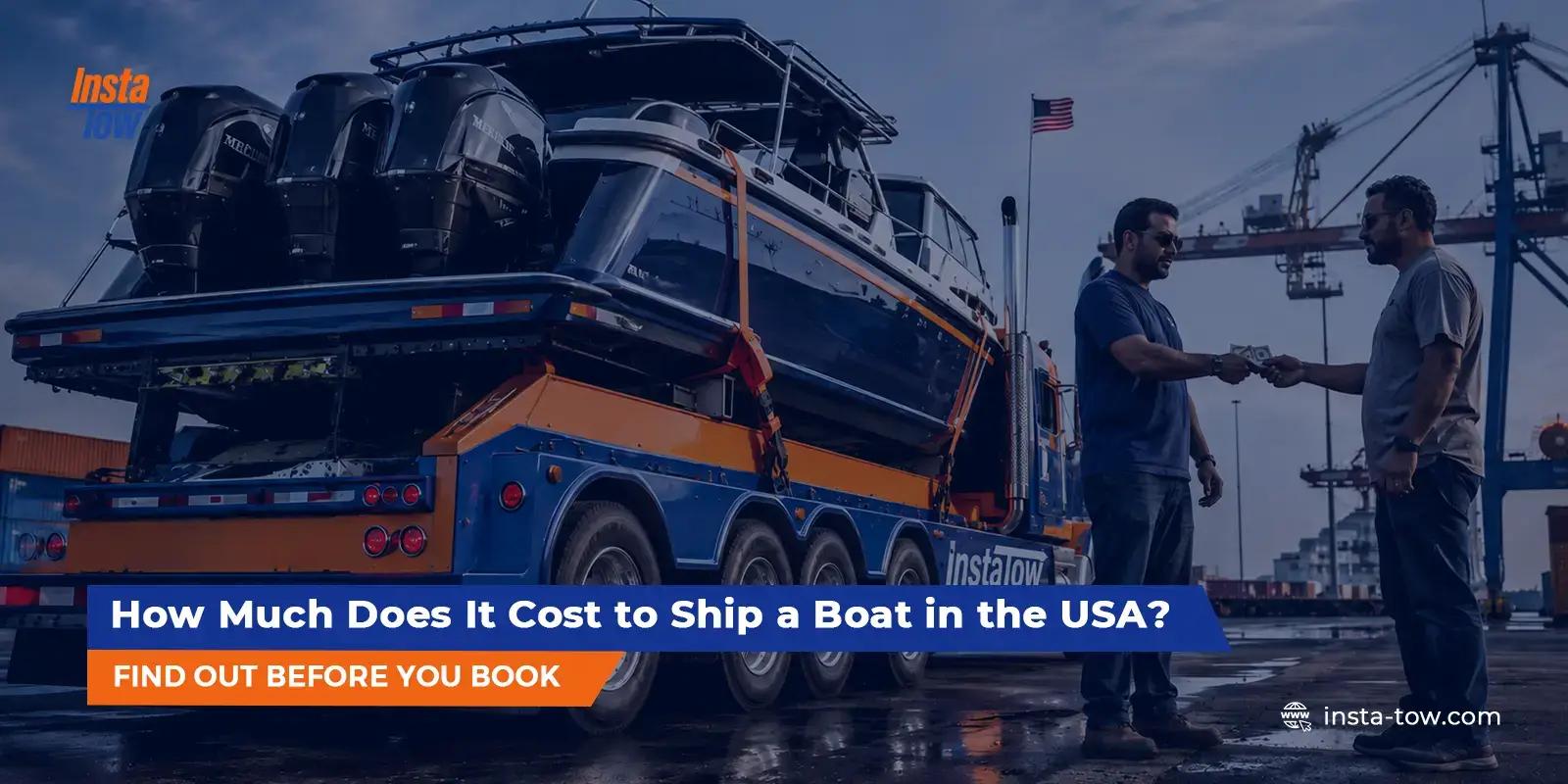
When you begin the process of moving your vessel, it is easy to view the task as a simple logistics request.
However, treating it as a standard shipment can lead to unexpected complications and costs.
Whether you are relocating a yacht, a fishing boat, or a personal watercraft, understanding the variables is critical to a successful experience.
Instead of focusing solely on the price tag, owners should look at the total scope of the transport, from the initial pickup at the marina to the final delivery at your destination.
Asking yourself how much does it cost to ship a boat is the right starting point, but the answer is rarely a static figure.
It is a dynamic calculation based on safety requirements, route complexity, and the specific needs of your vessel.
Before You Get a Quote: What Boat Shipping Cost Actually Includes
Many boat owners assume that the quoted price covers the entire journey from point A to point B.
In reality, reliable boat transport services must account for several moving parts that go beyond simple mileage.
When you request a boat shipping quote, you are paying for the expertise to handle your asset securely, legal compliance with state regulations, and the logistics of coordinating specialized equipment.
Why the Final Price Is More Than Just Transportation
When evaluating the cost, it is essential to consider the operational requirements that support the movement of your boat.
Professional carriers do not simply hook up a trailer and drive; they manage a complex operation that ensures your boat arrives in the same condition it left.
Factors contributing to the total cost include:
Insurance Coverage: Premium carriers maintain high-level insurance to protect your vessel throughout the transit.
Labor and Expertise: Experienced drivers who specialize in marine transport charge for their specific skill set in maneuvering oversized or delicate loads.
Fuel and Maintenance: The operational overhead of heavy-duty trucks and specialized trailers is significant, especially over long distances.
Logistics Coordination: The effort required to plan routes, secure permits, and manage schedules is built into the final price.
The Difference Between Base Rate and Total Landed Cost
It is common for initial estimates to fluctuate, which can be confusing for owners.
The Base Rate usually covers the basic transportation fees based on boat size and route distance.
However, the Total Landed Cost includes additional requirements that may only become clear once the carrier assesses your vessel.
By understanding the distinction, you avoid sticker shock when final invoices arrive.
Transparent boat hauling companies will break down these costs clearly, ensuring you know exactly what you are paying for before you commit to the move.
Always look for clarity in your boat moving estimates regarding potential surcharges for equipment, special permits, or loading assistance.
The Real Price Range of Shipping a Boat in the USA (What People Actually Pay)
Rather than looking at static price lists, it is more practical to view costs through route behavior.
How a carrier charges for a local move is fundamentally different from how they approach a transcontinental haul.
The following ranges reflect typical market realities for safe boat transport in the United States today.
Short Distance Transport (Local / Same State Moves)
For local moves, pricing is often driven by a minimum load fee rather than a per-mile rate.
Because the carrier incurs significant setup time regardless of whether they are moving the boat five miles or fifty these costs are generally higher on a per-mile basis.
Estimated Range: $500 - $1,500
Key Drivers: Loading time, marina gate access, and the necessity of a pilot car for wider loads.
Mid-Distance Routes (Cross-State Transport)
Cross-state transport typically transitions to a standard per-mile rate.
This is where economies of scale begin to take effect.
If you are shipping a boat across country for a shorter duration or crossing several state lines, fuel efficiency and route optimization become the primary factors in controlling the cost.
Estimated Range: $1,500 - $4,000
Key Drivers: Route directness, fuel surcharges, and state-specific permit requirements for oversized boat transport.
Long-Distance Cross-Country Shipping
When moving a boat from coast to coast, carriers optimize for backhaul opportunities essentially trying to pair your shipment with other loads to maximize truck efficiency.
This is often the most cost-effective way to move a boat, despite the higher total price.
Estimated Range: $4,000 - $10,000+
Key Drivers: Total mileage, seasonal demand, and the complexity of transporting a boat by trailer across diverse terrains (e.g., mountainous regions vs. flat plains).
Note: These ranges serve as a guide.
When researching how much does it cost to ship a boat, remember that specific vessel dimensions, specifically height and beam width are the ultimate determinants of the final rate.
What Actually Drives the Cost Up or Down? (Not Just Size)
While many owners fixate on the length and weight of their vessel, professional logistics providers analyze a broader array of variables.
When you inquire about how much does it cost to ship a boat, remember that every transport is a unique operation.
The price is often dictated by the complexity factor of your specific load and the logistics required to move it from the origin to the destination.
Boat Readiness and Loading Difficulty
Your preparation directly impacts the efficiency of the loading process.
If a carrier arrives and the boat is not transport-ready meaning antennas are not lowered, canvas covers are not secured, or personal items are not removed you may face additional labor charges.
A vessel that requires minimal handling at the marina is always more cost-effective.
Route Restrictions and Permit Requirements
State-by-state regulations often dictate the path a carrier must take.
If your route involves low bridges, narrow lanes, or specific weight-restricted zones, the driver may be forced to take a longer, indirect path.
Permit Fees: Vary by state and size.
Pilot Cars: Required for oversized boat transport in many jurisdictions.
Routing Times: Restrictions on nighttime driving often increase transit time.
Season, Fuel Prices, and Carrier Availability
The market for boat transport services is highly seasonal.
During peak spring and fall periods, carrier availability tightens, naturally driving prices up.
Conversely, shipping during the off-season can sometimes unlock better rates.
Fuel surcharges are also a standard component of any boat shipping quote, fluctuating with national diesel prices.
Pickup & Drop-Off Accessibility (Marina vs Inland Location)
The accessibility of your pickup and drop-off points is a major factor.
A marina with a professional launch ramp and wide, open access roads is significantly cheaper to service than a private residence on a narrow, winding country road.
If a large truck cannot reach your location, you may need a shuttle service or a crane, which adds to the total.
When assessing how much does it cost to ship a boat, always confirm the accessibility of your specific locations early in the planning phase.
Boat Transport Methods in the USA (And How Each One Affects Price)
The method of transport selected is often the single most significant factor in the final invoice.
Whether you are shipping a boat across country or moving it between local lakes, the equipment used must align with the size and fragility of your vessel.
When you research how much does it cost to ship a boat, ensure you understand which category your vessel falls into to get an accurate estimate.
Standard Trailer Transport (Most Common Option)
This is the most cost-effective solution for boats that fit within standard legal width and height limits.
If your boat is already on its own trailer, and that trailer is road-worthy, it can often be towed by a specialized truck.
This avoids the need for specialized trailers and reduces the overall equipment costs.
Oversized Load Transport with Escort Vehicles
If your vessel exceeds standard width (usually over 8.5 feet) or height limits, it is classified as an oversized load.
This changes the logistics entirely.
You will need special permits for every state the transport crosses, and in many cases, you must hire pilot cars (escort vehicles) to travel ahead and behind the transport to ensure safety.
This level of safe boat transport is necessary but inevitably comes with higher costs due to permit fees and escort labor.
Hydraulic Trailer and Specialized Heavy Haul Equipment
For large yachts or complex vessels, standard trailers are insufficient.
Hydraulic trailers allow the driver to lower the boat closer to the ground, increasing bridge clearance and stability.
Capabilities: Adjustable to fit the hull shape perfectly.
Use Case: Ideal for larger powerboats or sailboats with complex keels.
Investment: These trailers are specialized assets, making them more expensive to operate than standard equipment.
By understanding these methods, you gain clarity on how much does it cost to ship a boat and why your specific quote reflects the equipment required.
Ensuring your vessel is matched to the right equipment is the most effective way to avoid safety risks and unnecessary expenses.
You can also read: Professional Boat Hauling Services for Boats of All Sizes
Cost Breakdown by Real-World Scenarios (Not Just Boat Types)
When you are assessing how much does it cost to ship a boat, it is rarely as simple as checking the length of the hull.
Industry professionals typically segment costs by load complexity rather than the boat type itself.
This classification method provides a far more accurate financial picture, as it accounts for the actual labor hours required to prepare, secure, and transport your specific vessel.
Easy Load Boats (Lightweight & Trailer-Ready)
These vessels are the most streamlined to handle.
If your boat is already secured to a road-worthy trailer that has working lights, functional brakes, and tires in good condition, the transport process is straightforward.
Carriers prefer these loads because they minimize dwell time at pickup.
Ideal Profile: Smaller fishing boats, personal watercraft, or day cruisers under 25 feet.
Cost Factor: Minimal; you are paying primarily for fuel and mileage.
Medium Complexity Transport (Requires Preparation or Partial Disassembly)
This category covers vessels that cannot simply be hooked up and driven away.
If your boat requires the removal of radar arches, Bimini tops, or extended swim platforms to meet height restrictions, the cost will climb.
The driver must factor in the time spent physically working on your boat before they can even depart.
Common Requirements: Lowering towers, shrinking wrapping, or securing loose cabin items.
Cost Factor: Moderate; you are paying for the driver's extra time and potential tool usage.
High Complexity Moves (Oversized or Non-Standard Boats)
These moves often involve vessels that exceed 10 feet in beam width or have non-standard hull shapes that do not sit flush on a standard trailer.
These transports frequently require specialized equipment and careful route planning to navigate around infrastructure.
When calculating how much does it cost to ship a boat in this class, remember that you are paying for an operation that requires precision engineering and constant oversight.
Technical Challenges: Using cranes for lifting, complex blocking, and specialized hydraulic trailers.
Cost Factor: Higher; reflects the specialized assets and the expertise needed for oversized boat transport.
Hidden Charges That Most Boat Owners Don’t Expect
Transparency is vital when moving a high-value asset.
While every professional boat shipping quote should be itemized, some costs are occasionally overlooked until the final invoice arrives.
Being aware of these potential surcharges upfront prevents unpleasant surprises and allows you to budget more accurately for the total project.
Permit Fees for Oversized Loads
If your vessel requires specialized road permits, these fees are almost always passed directly to the customer.
States charge varying amounts for the privilege of hauling wide or tall loads on public roadways, and these permits often need to be purchased per state.
Important Note: Permits are non-negotiable. If a carrier quotes you without mentioning permits, it is a red flag that they may not be operating with full legal compliance.
Storage or Delay Charges at Pickup/Delivery Points
Time is money in the logistics world.
If the transport driver arrives at a marina and the boat is not ready, or if the destination lacks a clear path for the truck, the carrier may charge layover or wait time fees.
Avoidance Strategy: Ensure your marina and your destination are ready to receive the shipment exactly at the scheduled time.
Extra Handling for Cranes or Special Loading Equipment
Not every marina has a travel lift or a ramp suitable for a large commercial transport truck.
If your boat needs to be launched or hauled via an external crane service, this is an out-of-pocket expense that usually falls outside the standard trucking fee.
Always verify who is responsible for the lift fees, the trucking company or the marina.
Insurance Coverage Upgrades During Transit
Basic cargo insurance is standard, but if your boat has an exceptionally high value, you may need to purchase an insurance rider.
Most professional boat transport services carry adequate coverage, but for high-end yachts, the liability limits might need to be increased.
Checklist for Owners:
Request the carrier's Certificate of Insurance (COI).
Confirm the cargo coverage limit matches your boat’s current market value.
Ask if the policy includes in-transit damage protection.
By accounting for these variables, you will have a much clearer understanding of how much does it cost to ship a boat safely from one location to another.
Preparing for these potential line items is the hallmark of a smart, well-planned shipment.
How to Reduce Your Boat Shipping Cost Without Compromising Safety
Smart planning is the most effective tool in your arsenal to lower expenses.
While you never want to sacrifice quality for a lower rate, there are legitimate ways to streamline the logistics.
By focusing on the efficiency of the pick-up and drop-off, you can often negotiate better terms with boat hauling companies.
Preparing Your Boat the Right Way Before Pickup
The driver's time is a significant component of your final bill.
If a carrier arrives and finds a boat that requires hours of preparation such as stripping a tower, removing canvas, or securing interior cabin items you will be charged for that labor.
Clear the Deck: Remove all loose gear, cushions, and electronics that could be damaged or lost during transit.
Fluid Management: Drain fuel tanks and water systems to reduce weight, which can sometimes help keep the total load within standard weight limits, avoiding surcharges.
Documentation: Have all necessary paperwork, including title and proof of ownership, ready for the driver.
Choosing Flexible Pickup Windows
In the world of logistics, rigidity is expensive.
If you demand a specific day and time for pickup, you may be forcing a carrier to alter their established route, which incurs a special request fee.
By offering a wider window, perhaps a 3-4 day span, you allow providers to integrate your boat into an existing route, which is almost always cheaper.
Avoiding Last-Minute Route Changes or Rush Orders
A rushed request is rarely a budget-friendly one.
When you book transporting a boat by trailer at the last minute, you lose the ability to leverage backhaul opportunities.
Carriers who are already booked or need to divert from their primary lanes charge a premium for the disruption.
Planning your move 2-4 weeks in advance is the single best way to ensure you aren't overpaying for urgency.
If you are still curious about how much does it cost to ship a boat on a budget, early booking is the answer.
When Boat Shipping Gets Expensive (And How to Plan Around It)
Certain market conditions create unavoidable price spikes.
Recognizing these scenarios allows you to plan your move during more favorable times, potentially saving you a significant portion of your total budget.
Knowing how much does it cost to ship a boat during these periods of high demand is essential for setting realistic expectations.
Peak Season Demand Surges
The boating season follows a predictable pattern.
Spring (when boats are moving to the water) and late fall (when they are moving to storage) are the busiest times for the entire industry.
During these windows, capacity is low, and prices are at their highest.
Strategy: If your move is not time-sensitive, consider relocating your vessel mid-summer or deep into the winter. Carriers are often looking for work during these shoulder months and may offer more competitive boat moving estimates.
Oversized Transport Restrictions by State
Different states have different regulations regarding daylight travel, pilot cars, and permit processing times for oversized boat transport.
If your route crosses several states with complex regulations, the administrative cost of the move rises.
Pro-Tip: Check if your destination or origin can be accessed via routes that bypass states with notoriously difficult permitting processes or high fuel taxes.
Long Rural or Hard-to-Reach Pickup Locations
If your boat is located in a remote area, the deadhead miles the distance a truck must travel empty to reach your boat are built into your price.
The Reality: The further a carrier has to travel to get to you, the higher the cost.
The Solution: If you have the ability to move your boat on your own trailer to a more accessible commercial marina or a major highway hub, you can significantly reduce the difficult access surcharge.
By understanding the factors that inflate the cost of shipping a boat across country, you are better positioned to make informed decisions that save money without compromising the integrity of your vessel's journey.
Always keep in mind that how much does it cost to ship a boat is ultimately a reflection of the labor, risk, and logistical hurdles involved.
Why Instatow Is a Smarter Way to Ship Boats in the USA
Navigating the logistics of moving a vessel requires more than just a truck and a trailer; it requires a deep understanding of marine transit standards and a reliable network of vetted professionals.
At Instatow, we have streamlined this complex process, turning a typically stressful logistical challenge into a straightforward, transparent experience.
If you are tired of wondering how much does it cost to ship a boat without getting a clear answer, Instatow changes the game by prioritizing accuracy and simplicity from the start.
Accurate Pricing Based on Real Transport Conditions
Our platform utilizes a proprietary pricing algorithm that accounts for real-time market data, rather than relying on generic, outdated estimates.
We understand that every boat, route, and season is unique.
By analyzing factors like your boat’s specific dimensions, the loading requirements, and current fuel trends, we provide pricing that reflects the true labor and overhead involved in your specific haul.
Nationwide Carrier Network for Faster Scheduling
We have cultivated a vast, nationwide network of verified carriers who specialize in marine transport.
This scale allows us to source the right equipment for your specific vessel whether it requires a standard trailer or specialized heavy-haul gear much faster than a local provider could.
Because our network spans the entire country, we are often able to secure backhaul opportunities, which significantly reduces the cost of your transit while increasing scheduling flexibility.
Safe Handling from Pickup to Delivery
Safety is the cornerstone of our operations.
We ensure that every carrier within our network meets rigorous insurance requirements and possesses the specific expertise needed to handle high-value watercraft.
From proper blocking and securing techniques to navigating potential route obstacles, our partners are committed to ensuring your boat arrives at its destination in the same condition it left.
Verified Expertise: Every carrier is vetted for marine-specific hauling experience.
Safety First: Mandatory compliance with all state and federal oversized load regulations.
Total Transparency: Clear communication regarding your boat's status throughout the journey.
Get Your Exact Boat Shipping Cost in Minutes with Instatow
Getting an accurate answer to how much does it cost to ship a boat should not require hours of phone calls, endless emails, or vague quotes that change at the last minute.
We believe in providing instant, actionable data so you can make informed decisions about your transport needs immediately.
Our goal is to remove the uncertainty from the equation, giving you a firm, transparent price that allows you to budget and plan with total confidence.
Whether you are relocating a yacht, a fishing boat, or a personal watercraft, our platform is designed to provide you with a comprehensive, professional quote in a matter of minutes.
Ready to start your move? Follow these steps to secure your transport:
Submit Your Details: Provide the pickup and delivery locations, along with your boat's make, model, and dimensions.
Review Your Options: Receive a competitive, transparent quote tailored to your specific logistical needs.
Book with Confidence: Secure your transport date and receive confirmation of your scheduled pickup.
Don't let the logistics of transport delay your next adventure on the water.
By choosing a partner who understands the nuances of US marine transport, you ensure a smoother, more efficient experience from start to finish.
Request your quote today and take the first step toward getting your boat where it needs to be, safely and affordably.
Frequently Asked Questions
How much does it cost to ship a boat in the USA?
Costs vary widely based on the distance, the vessel’s dimensions (specifically beam width and height), and the complexity of the route.
While short-distance moves might range from $500 to $1,500, transcontinental shipping can exceed $10,000.
For an accurate number, you must obtain a custom quote that accounts for your specific pickup and delivery locations.
What is the cheapest way to transport a boat?
The most economical method is typically using your own road-worthy trailer if your vessel is small enough.
If you don't have a trailer, look for carriers who offer backhaul options.
This happens when a carrier has an empty truck returning from a delivery and is willing to offer a discounted rate to fill the space.
Flexibility with your pickup and delivery windows is the single best way to access these lower rates.
Do I need permits to ship a large boat?
Yes. Any vessel that exceeds standard legal road limits (typically 8.5 feet in width or 13.5 to 14 feet in height) is classified as an oversized load.
Moving such a vessel requires specific state-issued permits, which often vary by state, as well as pilot cars in many jurisdictions.
Your carrier handles this compliance, but the costs for these permits will be reflected in your final invoice.
How long does boat transport take within the USA?
Local transport is often completed in a single day.
Cross-country shipping typically takes anywhere from 7 to 14 days, depending on the route, weather conditions, and the carrier's schedule.
During peak seasons, availability may be tighter, which can extend the timeline, so scheduling at least two to three weeks in advance is highly recommended.