
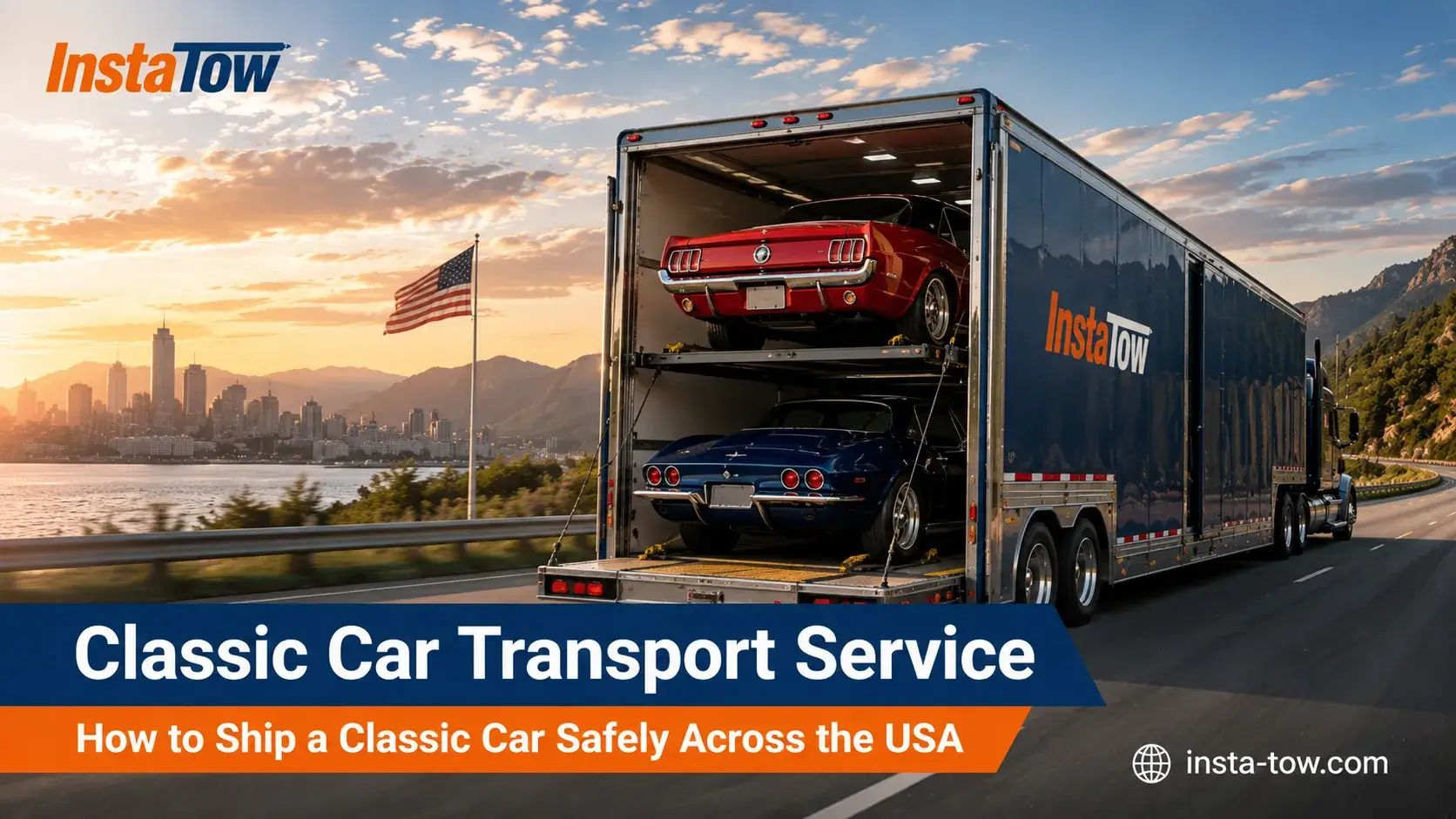
Handing over the keys to your vintage automobile is not a decision taken lightly by any collector.
Whether you own a fully restored 1969 Ford Mustang or a rare European sports car, preserving its pristine condition during transit is an absolute priority.
Utilizing a specialized classic car transport service ensures that your high-value vehicle reaches its destination without accumulating miles, road damage, or unnecessary wear and tear.
At Instatow, we understand the emotional and financial investment behind these automotive masterpieces, which is why we approach every shipment with meticulous care.
To help you navigate this complex process, this guide covers the most critical aspects of shipping a vintage vehicle nationwide.
You will learn exactly what to expect and how to prepare for a flawless transit experience.
Our comprehensive breakdown includes:
The unique vulnerabilities of vintage automobiles during transit.
A direct comparison of carrier methods to suit your specific vehicle.
The professional safeguards that protect your investment on the road.
A step-by-step walkthrough of the entire shipping and delivery process.
Why Shipping a Classic Car Requires a Different Approach
Moving a modern daily driver is a straightforward logistical task, but transporting a vintage automobile demands an entirely different level of precision.
Standard commuter vehicles are built to withstand modern highway conditions, whereas collector cars are irreplaceable artifacts that require customized care.
A professional classic car transport service recognizes that these vehicles cannot simply be driven onto a standard ramp and strapped down like a conventional sedan.
From specialized equipment to highly trained operators, every element of the journey must be tailored to the vehicle’s specific structural and mechanical needs.
What Makes Classic Cars More Vulnerable During Transport
Older vehicles were manufactured using materials and engineering standards that differ vastly from today's automotive industry.
Original paint jobs, fragile chrome trim, and aging fiberglass bodies are highly susceptible to minor impacts that a modern car would easily shrug off.
Furthermore, the structural integrity of vintage chassis can be compromised if inappropriate tie-down methods are used during loading.
Ensuring proper vehicle transit safety means utilizing soft-tie straps and wheel nets rather than traditional chain hooks that can bend axles or scratch custom finishes.
The Hidden Risks Owners Often Overlook
Even when a vehicle is secured properly, the open road presents a variety of invisible threats that can diminish a collector car's value.
Many owners focus entirely on the threat of major accidents while ignoring the slow degradation caused by prolonged exposure to transit conditions.
These subtle but damaging factors make specialized handling non-negotiable for serious collectors.
The most common overlooked risks include:
Micro-abrasions: Fine dust and sand whipped up at highway speeds can act like sandpaper on vintage clear coats.
Fluid shifts: Older gaskets and seals are prone to leaking when subjected to the continuous vibration of a long-haul trailer.
Climate fluctuations: Extreme temperature swings across different state lines can cause condensation, leading to flash rust on exposed metal parts.
Exhaust fumes: Soot from the transport truck or surrounding traffic can settle deeply into convertible tops or unsealed cabins.
When Driving the Car Yourself Becomes the Wrong Choice
The romantic notion of driving your newly purchased vintage car across the country often clashes with the harsh reality of cross-state road trips.
Classic engines, cooling systems, and transmissions are rarely conditioned for days of continuous, high-speed highway driving without facing mechanical failures.
A breakdown in an unfamiliar location leaves you stranded and forces you to rely on local, unspecialized towing companies that might cause further damage to the undercarriage.
By opting for a dedicated classic car relocation strategy, you completely eliminate the risk of catastrophic engine wear, preserve your precise odometer reading, and keep your investment perfectly intact.
Choosing the Right Transport Method for Your Classic Car
Selecting the appropriate trailer type is the most consequential decision you will make when booking a classic car transport service.
Not all vintage vehicles require identical levels of protection, and understanding the differences between carrier options prevents you from overpaying or under-protecting your asset.
The decision ultimately comes down to balancing your budget against the replacement cost of the vehicle's exterior components.
Open Transport: When It Makes Sense
While it might seem counterintuitive to place a vintage car on an exposed trailer, open carrier transport is a highly viable option for specific situations.
If you are shipping a project car that is destined for a full frame-off restoration, paying a premium to protect its current exterior is usually an unnecessary expense.
It is also a cost-effective choice for robust, daily-driven classics that already have minor cosmetic imperfections and are frequently exposed to the elements.
However, owners must accept that the vehicle will be subjected to the same weather, dust, and road debris it would encounter if it were being driven.
Enclosed Transport: The Preferred Choice for Collectors
For investment-grade vehicles, pristine restorations, and rare exotics, enclosed auto shipping is the absolute industry standard.
These specialized trailers act as mobile garages, featuring hard-sided walls and hydraulic lift gates that keep the vehicle completely isolated from rain, snow, hail, and flying highway gravel.
Using an enclosed classic car transport service guarantees that the car arrives in the exact condition it was loaded, without a single speck of dust from the journey.
This method also provides an essential layer of security, keeping the high-value asset hidden from public view during overnight stops.
Single-Car vs Multi-Car Enclosed Trailers
Once you decide on enclosed shipping, you must choose between a single-car trailer or a multi-car transporter.
Multi-car enclosed trailers typically hold between four to six vehicles and are the most common and economical choice for high-end transport.
Single-car enclosed trailers, often referred to as hotshot carriers, offer dedicated, non-stop transit directly to your door without the delays of other customers' drop-offs.
While significantly faster and more personalized, single-car transport commands a premium price tag and is usually reserved for museum-quality showpieces heading to time-sensitive events.
Which Option Best Fits Your Vehicle's Value?
Before reaching out to a classic car transport service for a quote, it is crucial to honestly evaluate your vehicle's current status and your logistical priorities.
Use the assessment table below to determine which shipping method aligns perfectly with your investment level and transport goals.
How Professional Classic Car Transport Protects Your Investment
Professional transport providers understand that a classic car is far more than just a means of getting from point A to point B.
For the collector, the vehicle represents a significant financial stake, historical preservation, and often a deep personal passion.
By hiring a specialized classic car transport service, you are paying for risk mitigation, technical expertise, and operational security that standard towing companies simply cannot replicate.
Our teams at Instatow utilize specific protocols to ensure your asset is handled with the same reverence you would give it yourself.
Protection From Weather and Road Debris
The primary advantage of professional shipping lies in the environment the vehicle occupies during transit.
When a car is transported on an open hauler, it is exposed to harsh UV rays, torrential rain, heavy snow, and the constant barrage of highway grit.
Professional enclosed trailers eliminate these environmental variables entirely, creating a climate-controlled sanctuary that shields delicate exterior components.
This layer of protection prevents:
Corrosion: Prevention of oxidation on chrome and unsealed metal trim caused by road salt and moisture.
Paint Damage: Complete avoidance of rock chips, gravel strikes, and debris-induced micro-scratches.
UV Degradation: Shielding of leather interiors and plastic components from sun-induced cracking and fading.
Special Handling for Low-Clearance Vehicles
Vintage sports cars and customs often feature aggressive styling, lowered suspensions, or modified ground effects that make loading them onto standard trailers a recipe for disaster.
Professional transporters utilize specialized equipment designed for these unique geometries, such as hydraulic lift gates and extended, low-angle loading ramps.
These tools ensure that the vehicle’s undercarriage, front bumper, and rocker panels never make contact with the trailer surface.
The following table outlines the specialized equipment used to maintain vehicle clearance:
Safe Loading and Securement Techniques
The integrity of your classic car’s frame and suspension is paramount during the transition from the ground to the trailer.
Professional carriers employ a four-point tie-down system that attaches directly to the wheels or the frame’s reinforced points, ensuring the vehicle remains stationary regardless of road vibrations.
Unlike standard tow trucks that might use aggressive chain hooks, our securement methods are designed to:
Maintain the specific alignment of vintage suspension geometry.
Prevent unnecessary tension on fragile steering or drivetrain components.
Allow the vehicle’s own suspension to absorb minor road shocks naturally.
Ensure that no abrasive metal-on-metal contact occurs between the tie-downs and the vehicle's finish.
Insurance and Peace of Mind
True professional classic car transport includes comprehensive insurance coverage that goes well beyond standard freight liability.
Because vintage vehicles are irreplaceable, our shipping protocols prioritize the documentation of the car's condition before and after transit.
This includes detailed condition reports and photographic evidence to guarantee complete transparency.
When you partner with a service that specializes in collector vehicles, you benefit from:
Specialized Coverage: Insurance policies specifically written for the high-replacement value of classic and exotic cars.
Risk Documentation: Pre-shipment inspections that catalog every existing imperfection to ensure accountability.
Transit Updates: Constant communication regarding the location and safety status of your vehicle.
Verified Expertise: Operators with extensive experience specifically in the high-stakes world of collector vehicle logistics.
Common Situations Where Owners Use Classic Car Transport Services
Understanding when to utilize a professional carrier is key to preserving your vehicle's long-term value.
Whether you are expanding your collection or managing the logistics of an existing one, professional transport acts as a vital tool for maintaining your investment.
Buying a Classic Car From Another State
The collector market is nationwide, and your next prized vehicle may be located hundreds or even thousands of miles away.
Driving a car home from a remote location introduces significant variables, including potential mechanical reliability issues that you may not be fully aware of yet.
A professional classic car transport service provides a secure, predictable bridge between the seller's location and your garage. This prevents:
Unexpected Mechanical Failures: Avoiding the risk of being stranded in a rural or unfamiliar area.
Mileage Accumulation: Keeping your odometer reading as low as possible for long-term value retention.
Logistical Complexity: Eliminating the need to arrange travel, lodging, and fuel stops across state lines.
Transporting a Vehicle to Auctions
Auctions are high-pressure environments where the visual condition of your vehicle is directly tied to its final sale price.
Arriving with a car that has been exposed to highway dust or rain can significantly impact its presentation and, subsequently, your profit.
By utilizing enclosed, professional logistics, you ensure that your vehicle arrives in auction-ready condition.
Collectors rely on this level of service to:
Maintain a competitive edge through impeccable presentation.
Ensure the vehicle is ready for immediate display upon arrival.
Coordinate arrival times with auction house schedules to avoid late fees.
Moving a Collector Car to Shows and Events
Attending national car shows or local community events is a primary reason to own a classic, but the journey to these events can be just as difficult as the show itself.
Professional carriers facilitate the movement of vehicles to high-profile events like the Pebble Beach Concours d'Elegance or local meet-ups.
This service allows owners to:
Preserve the vehicle's show-quality paint and chrome through the entire travel process.
Avoid the fatigue of long-distance driving, allowing for more enjoyment at the destination.
Synchronize the transport of multiple vehicles for large-scale displays.
Relocation Without Adding Mileage
If you are moving to a new state or a different residence, your classic car is one of the most critical items to manage.
Putting significant mileage on a collector vehicle just for the sake of relocation is generally considered detrimental to its historical value.
Professional transport provides a seamless solution to keep the car stored safely during your transition, ensuring it arrives at your new home in its original, preserved state.
Seasonal Storage Transportation
Many collectors move their vehicles between seasonal homes, such as taking a classic from a snowy northern state to a sunny southern climate for the winter.
This seasonal rotation is a standard practice for many automotive enthusiasts.
Using a dedicated classic car transport service for these recurring trips offers:
Reliability: Predictable schedules that match your travel plans.
Professional Care: Ensuring the vehicle is stored and transported safely regardless of the distance.
Customization: Tailoring the transport to the specific climate requirements of the vehicle's storage location.
The Complete Classic Car Shipping Process
Managing the logistics of a high-value vehicle requires a disciplined, step-by-step approach.
At Instatow, we have refined our operational workflow to ensure that every stage of the transit from the initial inquiry to the final delivery is transparent, documented, and secure.
Understanding this process helps you coordinate your schedule effectively and ensures that no detail is overlooked during the transport of your vehicle.
Requesting a Quote
The journey begins with receiving an accurate, transparent auto transport quote.
Rather than offering instant low-ball estimates that often lead to hidden surcharges, we evaluate your specific route, vehicle dimensions, and trailer requirements.
Providing accurate information regarding your vehicle’s running condition and modifications allows us to plan the most efficient logistical path.
Vehicle Inspection Before Pickup
Before the vehicle ever touches our trailer, a comprehensive inspection is conducted.
This stage is critical for establishing a baseline for the vehicle’s condition.
Our team will:
Document the exterior, interior, and undercarriage with high-resolution photography.
Note any pre-existing blemishes, scratches, or mechanical quirks.
Confirm the presence of all loose accessories or special documentation.
Create a signed condition report that protects both the owner and the carrier.
Pickup and Loading
Loading a classic vehicle is an art that requires patience and precision.
Using hydraulic lifts or low-angle trailers, our operators ensure the vehicle is secured without risking the chassis or bodywork.
We avoid aggressive maneuvers, instead using soft-touch straps to fasten the vehicle to the deck.
This process is strictly supervised to ensure that ground-level clearance is maintained at all times.
Tracking During Transit
Modern technology provides peace of mind throughout the transit journey.
Our live shipment tracking system allows owners to monitor their vehicle’s progress across the country.
You are never left wondering about the status of your investment; instead, you receive consistent updates and direct communication from our support team, ensuring that you are informed of any changes to the expected arrival window due to weather or traffic.
Final Delivery and Inspection
Upon arrival, the delivery process mirrors the pickup inspection.
We perform a final walkthrough with the owner to verify that the vehicle arrived in the exact same condition it was loaded.
This final check ensures that all expectations were met and that the vehicle is ready for its intended use whether it is heading to a garage, a show, or a new owner.
How Much Does Classic Car Transport Cost?
Determining the cost of moving a classic car involves several variable factors.
It is essential to understand that premium services prioritize the safety and integrity of your vehicle over the fastest or cheapest possible price.
The following factors primarily dictate the final investment required for professional logistics.
Distance and Route
The most significant factor in your shipping cost is the total mileage and the nature of the route.
Shipping between major metropolitan hubs is generally more efficient and cost-effective than arranging transport to or from remote, rural locations.
Routes that are well-traveled by our carriers are easier to schedule, while off-path destinations may require specialized planning and potentially higher rates.
Vehicle Size and Weight
While often overlooked, the physical dimensions of your classic car play a substantial role in transport logistics.
Larger vehicles, such as classic trucks, full-size luxury sedans, or SUVs, consume more space on a trailer than a compact sports car.
Since enclosed trailers have limited capacity, a larger vehicle may displace multiple smaller vehicles, which directly influences the overall pricing structure.
Open vs Enclosed Shipping
The choice between open and enclosed transport remains the most visible price differentiator.
Open transport is the most economical method, utilizing standard, large-capacity trailers. Enclosed transport, however, requires specialized, higher-cost equipment and carries fewer vehicles per trip.
This specialized, protective service commands a higher premium because it offers a significantly higher level of security and climate control for your vehicle.
Seasonal Demand
Like the broader logistics industry, the classic car transport market experiences seasonal fluctuations.
Prices typically increase during peak show season (spring and summer) and during peak winter migration periods when snowbirds are moving their vehicles south.
Scheduling your transport during off-peak times or providing a flexible delivery window can often result in more favorable pricing.
Expedited Transport Requests
If you require your vehicle by a specific date, expedited shipping is the necessary solution.
This service moves your car to the front of the scheduling queue and often involves dedicated, non-stop driving by our operators.
Because expedited shipping bypasses the standard consolidation process, it represents the highest tier of service cost, but it provides the ultimate guarantee of reliability and speed.
For more information: How Much Does It Cost to Transport a Car in 2026? (Complete U.S. Pricing Guide)
How to Prepare a Classic Car Before Shipping
Proper preparation is the most effective way to ensure a smooth transit and protect your investment against unnecessary damage.
A well-prepared vehicle is easier to load, easier to inspect, and far less likely to suffer issues during long-distance hauling.
When you follow these steps, you provide your transport team with the best possible environment to maintain the vehicle's integrity.
Document the Vehicle's Condition
Before the transport arrives, perform a thorough, top-to-bottom inspection in a well-lit area.
Documenting the car’s current state is essential for peace of mind and accountability.
Photograph everything: Take high-resolution photos of every panel, the interior, and the wheels.
Note pre-existing issues: Record any chips, scratches, or dents in a written log.
Video evidence: A quick video walkaround can highlight the car’s condition more effectively than static photos.
Check Fluids, Battery, and Tire Pressure
A classic car must be in a state that allows for safe loading and unloading.
While it does not need to be in show condition, it must be mechanically stable for the journey.
Check for leaks: Ensure there are no major oil, transmission, or coolant leaks that could damage the trailer or other vehicles.
Maintain battery charge: Keep the battery charged so the car can be driven or winched onto the carrier easily.
Proper tire pressure: Ensure all tires are properly inflated to facilitate smooth loading and securement on the trailer deck.
Remove Loose Items and Accessories
Transport trailers are not storage units, and loose objects pose a significant risk during transit.
Anything left inside the cabin or trunk can become a projectile or damage the interior upholstery due to vibrations.
Clear the interior: Remove all personal belongings, aftermarket electronics, and decorative items.
Secure loose parts: If the car has removable parts like hardtops or specialized trim, ensure they are professionally crated or secured separately.
Lock it up: Ensure the trunk and doors are securely latched to prevent them from opening during transit.
Prepare Important Documentation
Having your paperwork organized prevents delays during pickup and delivery, especially if you are not present during the handoff.
Title and registration: Have copies readily available for the carrier to verify.
Contact details: Provide the driver with the contact information for both the pickup and delivery points.
Special instructions: If your vehicle has a hidden master switch or a unique ignition sequence, provide clear, written instructions to the operator.
How to Choose a Reliable Classic Car Transport Company
Not all logistics companies are built to handle the delicate requirements of the collector market.
The difference between a positive experience and a frustrating one often comes down to the vetting process you perform before booking.
Use the following criteria to ensure you are entrusting your vehicle to a professional classic car transport service.
Licensing and FMCSA Compliance
Safety starts with legitimacy.
Any reputable transport company must be registered with the Federal Motor Carrier Safety Administration (FMCSA).
Verify the MC Number: Ask for their Motor Carrier (MC) number and verify it on the official FMCSA website.
Check safety ratings: Review their safety record and compliance history to ensure they follow federal regulations.
Insurance minimums: Confirm they carry the required cargo insurance to protect your vehicle in the event of an incident.
Experience With Collector Vehicles
General freight haulers often lack the training required for vintage automobiles.
You should specifically look for carriers that maintain a dedicated fleet for classic and exotic transport.
Ask for references: A company proud of its work will often provide references from other collectors.
Inquire about trailer types: Ensure they have access to modern enclosed equipment, not just basic open haulers.
Operator expertise: Ask how long their drivers have been specifically handling high-value vintage cars.
Insurance Verification
Never take a company’s word regarding their insurance coverage.
Request a current Certificate of Insurance (COI) that names your vehicle or demonstrates comprehensive cargo coverage.
Coverage limits: Ensure the policy limits exceed the value of your classic car.
Deductibles: Understand how their insurance handles claims and who is responsible for the deductible.
Exclusions: Ask if there are any specific exclusions for vintage cars or long-distance cross-country transit.
Customer Reviews and Communication
The way a company communicates during the quote process is often a reflection of how they will communicate during the actual shipment.
Read independent reviews: Look for feedback on third-party platforms rather than just the testimonials on their website.
Responsiveness: Does the company answer your technical questions thoroughly and quickly?
Transparency: Do they clearly explain their processes, or are they vague about how your car will be handled?
Questions to Ask Before Booking
To gain full clarity, ask these targeted questions before committing:
Do you use soft-tie straps for securement, or do you use chains?
Is the cargo insurance primary or secondary?
Will my vehicle be transferred between trucks, or is it direct transport?
What is the procedure if the vehicle is damaged during transit?
Can you provide a contact person for live updates during the shipment?
You can also read: Shipping Car From Florida to New York: Book Reliable Transport
Why Classic Car Owners Choose Instatow
Entrusting your vehicle to a service provider goes beyond simple transportation; it is about finding a partner who values your automotive legacy as much as you do.
At Instatow, we have built our reputation on the specific needs of the collector community.
We bridge the gap between complex logistical requirements and the personalized, white-glove service that high-value vehicles demand.
By choosing our team, you gain more than just a truck, you gain a dedicated ally in the preservation of your collection.
Nationwide Door-to-Door Service
Geography should never limit your ability to acquire or display your vehicles.
Our network spans the entire United States, providing seamless door-to-door car shipping that eliminates the need for you to coordinate with multiple terminals or local towing services.
Whether your classic car is located in a rural barn or a city-center garage, our operators are equipped to navigate any environment to ensure your vehicle is collected and delivered with maximum efficiency.
Open and Enclosed Transport Options
Flexibility is a cornerstone of our service model.
We recognize that not every classic vehicle requires the same level of environmental shielding, which is why we offer both high-capacity open carrier transport and premium enclosed auto shipping.
By providing a menu of transport options, we allow you to prioritize your budget and vehicle needs without compromising on the quality of our professional oversight or securement protocols.
Live Shipment Tracking
Information is the ultimate antidote to the anxiety of shipping a precious asset.
Our commitment to transparency includes real-time, live shipment tracking that keeps you connected to your vehicle's journey from pickup to arrival.
You can monitor the location and status of your transport at your convenience, ensuring that you are always informed and in control of your asset's transit experience.
Dedicated Support Throughout Transport
The Instatow support team acts as your primary point of contact during every mile of the journey.
We pride ourselves on proactive communication, ensuring that you receive regular updates and professional guidance from the moment you request your auto transport quote until the final inspection is completed.
You will never feel like just another number in a shipping queue; instead, you receive personalized support tailored to your vehicle's specific requirements.
Safe Handling for High-Value Vehicles
The technical foundation of our service is the specialized handling of classic, exotic, and antique automobiles.
From our soft-tie securement systems that protect sensitive undercarriages to our hydraulic loading equipment designed for low-clearance chassis, every procedure is built to mitigate risk.
We treat your car with the same technical precision and care that you would expect from the most meticulous restoration shop.
Get a Free Classic Car Transport Quote
Ready to move your vehicle with the professionals?
Contact Instatow today to receive a comprehensive, transparent, and obligation-free quote tailored to your specific vehicle and route.
Our team is standing by to provide the logistical expertise you need to get your classic car on the road securely, safely, and efficiently.
Frequently Asked Questions
Is enclosed transport worth the extra cost for a classic car?
Yes, for investment-grade, restored, or high-value vehicles, enclosed transport is the industry standard.
It offers complete protection from road debris, weather, and theft, which far outweighs the additional cost for significant assets.
Can you ship a non-running classic vehicle?
Absolutely. Our equipment is specifically designed to handle non-operational vehicles.
Please ensure you inform us during the quote process, as the use of a winch or specialized loading gear may be required.
How far in advance should I schedule transport?
We recommend scheduling at least two weeks in advance.
While we do our best to accommodate urgent requests, booking early ensures your preferred dates and transport type are locked in.
Is my classic car insured during shipping?
Yes. All vehicles transported by Instatow are covered by comprehensive cargo insurance.
We encourage you to review our coverage documents during the quoting phase to understand our specific liability terms.
How long does cross-country classic car transport take?
Transit times vary based on the distance and route.
Typically, cross-country shipments take between 5 to 10 days, though we offer expedited options for those requiring faster delivery.
Can classic cars be shipped year-round in the USA?
Yes, our nationwide logistics network operates year-round.
While seasonal demand can impact pricing and scheduling, we are fully capable of transporting your vehicle through all weather conditions safely.