
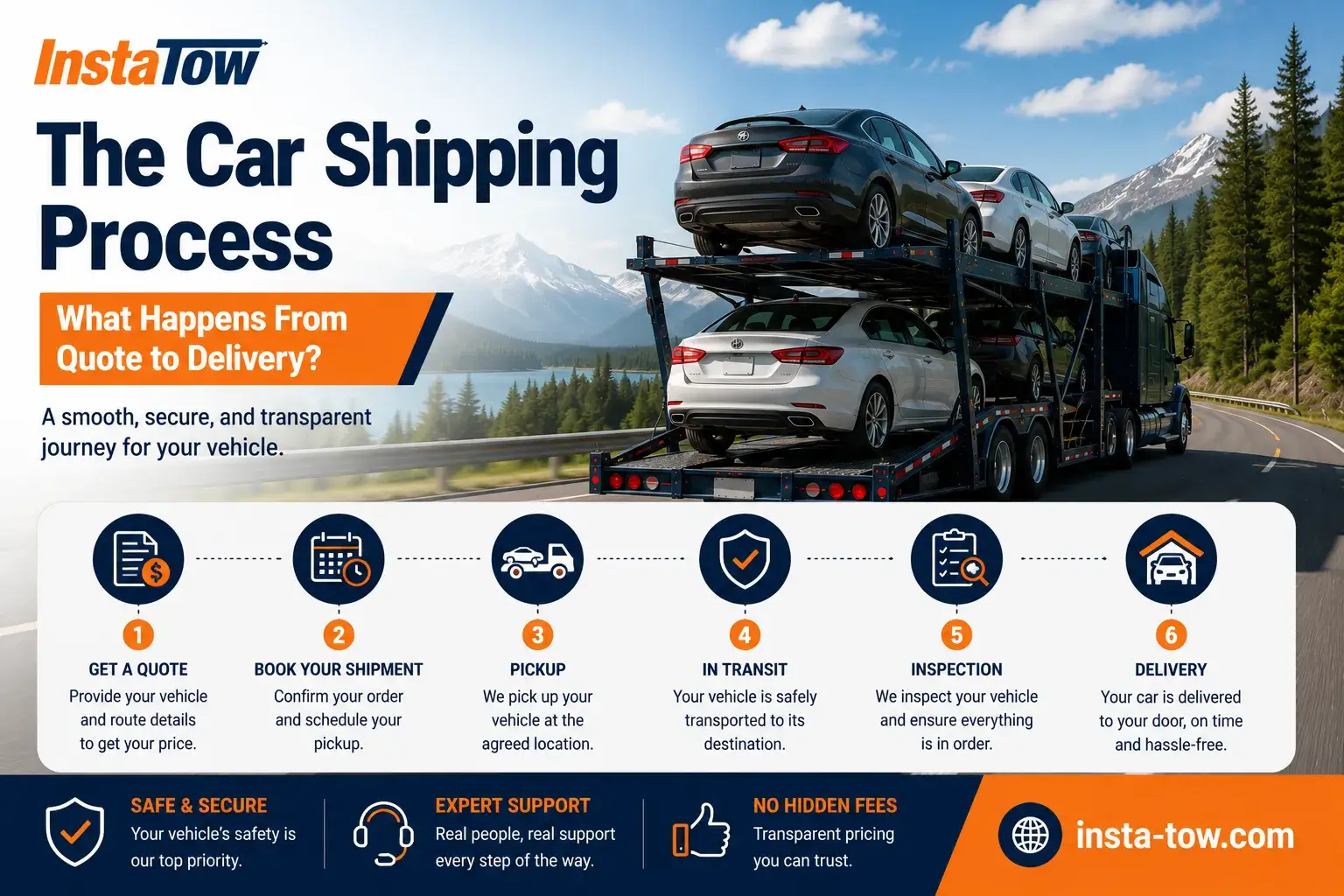
Most vehicle owners assume the car shipping process wraps up neatly the moment they secure a booking with an auto transport company.
In reality, the phase that triggers the highest level of uncertainty and confusion begins immediately after that initial confirmation.
Customers often wonder: Who is actually driving the truck? When will the carrier be assigned? Why is pickup scheduled within a window rather than an exact hour? What happens to the vehicle while it travels across states, and how do you handle unexpected delays?
Understanding the complete end-to-end journey clears away the ambiguity.
This guide breaks down every single phase, outlining who is responsible for each step, what you can realistically expect, where potential changes or delays can pop up, and what crucial decisions you need to make before booking.
At Instatow, we believe that transparency is key to a smooth relocation experience, ensuring you know not just what happens, but who does what, when it happens, and how to stay in control.
Car Shipping Process at a Glance: The 7 Stages
The entire auto transport journey moves through seven distinct operational phases from initial planning to final handover.
Reviewing this roadmap helps you visualize the flow before diving into the specifics of each stage.
Stage 1: Define Your Shipment - Gathering accurate vehicle specs, locations, and timing requirements.
Stage 2: Compare Quotes and Service Options - Evaluating pricing structures, service tiers, and carrier types.
Stage 3: Book the Shipment - Confirming service details and locking in initial scheduling parameters.
Stage 4: Carrier Assignment and Dispatch - Matching your vehicle with an available truck and driver on your route.
Stage 5: Pickup Coordination - Connecting with the driver to inspect and load the vehicle.
Stage 6: Transit and Shipment Updates - Monitoring the journey and tracking geographical progress.
Stage 7: Delivery and Final Handover - Inspecting the vehicle upon arrival and closing out documentation.
1. Define Your Shipment
Defining your shipment involves compiling all core logistical parameters required to establish an accurate service plan.
Before requesting an estimate, you must clearly outline your pickup location, delivery destination, vehicle make, model, year, and operational status.
Knowing whether your car runs under its own power or requires a winch dictates the equipment needed.
Pinpointing your desired timing ensures that logistics planners can align carrier availability with your schedule.
2. Compare Quotes and Service Options
Comparing quotes and service options requires evaluating what is included in the price rather than looking strictly at the bottom line.
This stage involves reviewing whether a provider offers open or enclosed transport, checking insurance coverage limits, and understanding payment structures.
Weighing these elements side-by-side ensures you choose a reliable service tier that matches your vehicle protection needs.
3. Book the Shipment
Booking the shipment officially locks in your transport parameters, routes, and agreed-upon service terms.
During this step, you confirm your vehicle details, establish an initial pickup window, review cancellation policies, and verify contact information.
Securing your booking initiates the logistics backend, transitioning your order into the active scheduling queue.
4. Carrier Assignment and Dispatch
Carrier assignment and dispatch is the critical operational link where your booked order is matched with a licensed, insured truck driver traveling your route.
While booking secures your place in the system, dispatching assigns the physical truck and driver responsible for moving your car.
Dispatch timelines vary based on regional lane popularity, seasonal demand, and weather conditions.
5. Pickup Coordination
Pickup coordination involves direct communication between you and the assigned driver to finalize the exact meeting spot and vehicle inspection protocol.
Once the driver is en route, you establish a safe, accessible roadside point to load the car onto the trailer.
For a detailed look at how to ready your car before the driver arrives, you can review our guide on Preparing Your Vehicle for Auto Transport.
6. Transit and Shipment Updates
Transit and shipment updates encompass the active travel phase where your vehicle is secured on a carrier moving across highway corridors.
During this period, you receive periodic status milestones regarding geographic progress and estimated arrival windows.
While most shipments proceed smoothly, variables like traffic, weather, and multi-stop logistics can influence total transit time.
7. Delivery and Final Handover
Delivery and final handover marks the completion of the transport journey when the carrier arrives at your destination.
In this stage, the driver unloads your vehicle, you conduct a final physical inspection alongside the initial bill of lading, and you complete the final paperwork to officially close out the transport order.
Stage 1: Define Your Shipment Before Requesting a Quote
Defining your shipment accurately before requesting an estimate ensures you receive precise pricing and avoid unexpected logistical adjustments later in the car shipping process.
Before asking how much it costs to move your vehicle, you must systematically inventory your logistics requirements to align with industry standards and carrier capabilities.
What Information Determines Your Shipment?
Determining your shipment requires gathering specific technical and geographical specifications about your vehicle and designated locations.
Providing precise data enables logistics coordinators to map the ideal route and secure the proper transport vehicle.
Origin and Destination: The exact zip codes or cities for pickup and drop-off.
Vehicle Make, Model, and Year: Essential for calculating accurate weight distribution and dimensions.
Vehicle Condition: Whether the car runs under its own power or requires a winch.
Vehicle Modifications: Lift kits, oversized tires, or custom body kits that alter standard trailer clearance.
Preferred Timing: Your target dates for pickup readiness and delivery deadlines.
Accessibility: Road constraints, bridge limits, or local regulations surrounding the pickup and delivery addresses.
Why Accurate Shipment Details Matter
Providing accurate shipment details directly safeguards your budget and timeline by preventing operational bottlenecks during the vehicle shipping process.
Inaccurate data can derail initial planning and cause severe complications.
Price Adjustments: Undisclosed modifications or inoperable status can trigger carrier upcharges upon arrival.
Equipment Requirements: Specialized hydraulic lifts or low-clearance trailers are necessary for modified vehicles.
Loading Feasibility: Unreported mechanical failures require winch-equipped trailers to safely load the car.
Pickup Schedules: Precise location data prevents dispatch delays caused by restricted truck access.
Stage 2: How Car Shipping Quotes Are Created
Car shipping quotes are generated by calculating baseline logistics variables, interstate distance, fuel expenditures, and equipment demands across specific regional corridors.
Understanding how pricing works helps you evaluate rates realistically when requesting an initial car transport quote.
What Factors Influence a Car Shipping Quote?
Pricing is determined by a combination of distance, route popularity, seasonal supply and demand fluctuations, and vehicle specifications.
Carriers balance these variables to ensure profitable operations across every highway mile.
Total Distance: Longer cross-country routes incur higher overall fuel, toll, and labor costs.
Route Demand: High-traffic corridors often feature competitive pricing, whereas remote rural areas cost more.
Seasonality: Peak moving seasons, such as summer and January, drive up transport demand and rates.
Vehicle Size and Weight: Heavier, larger vehicles consume more trailer capacity and fuel.
Transport Type: Choosing open and enclosed transport directly impacts the final rate based on protection levels.
Accessibility: Difficult pickup or drop-off points require extra maneuvering time for the driver.
Why Two Car Shipping Quotes Can Be Different
Variations between transport quotes stem from differences in operational scheduling, carrier availability, service tiers, and company overhead rather than arbitrary pricing practices.
A lower price does not automatically indicate a superior deal, nor does a higher price guarantee flawless service.
Timing Variations: Flexible pickup windows often allow brokers to secure lower spot market rates.
Carrier Network Access: Established agencies leverage direct carrier relationships to secure favorable rates.
Service Inclusions: Some quotes bundle comprehensive cargo insurance or guaranteed dispatch, while others are bare-minimum estimates.
Route Circumstances: Differing multi-stop logistics plans affect individual carrier pricing models.
How to Compare Quotes Beyond the Price
Effective evaluation involves looking beyond basic cost figures to analyze structural protections, service commitments, and operational terms.
Using a structured comparison matrix helps you weigh competing proposals objectively.
Stage 3: Booking Your Car Shipment
Booking your car shipment officially locks in your vehicle specifications, target dates, and financial terms within an auto transport company's active scheduling queue.
This phase transitions your initial inquiries into a formal service agreement, initiating the backend logistics required to move your vehicle safely across states.
What Happens When You Actually Book?
When you complete your booking, your logistics coordinator verifies all submitted data and enters your routing parameters into the dispatch system.
This internal action secures your service level and prepares your order for carrier matching.
Data Verification: Finalizing vehicle make, model, year, and operational status.
Route Mapping: Registering origin and destination zip codes into the scheduling software.
Service Locking: Securing your choice of open or enclosed transport parameters.
Terms Confirmation: Activating agreed-upon pricing, cancellation policies, and payment structures.
What You Should Confirm Before Booking?
Before finalizing your reservation, you must thoroughly review critical operational commitments to ensure complete alignment with your relocation timeline.
Verifying these details prevents misunderstandings once transport is underway.
Pickup and Delivery Locations: Ensuring trucks can legally and safely access your specified addresses.
Vehicle Details: Confirming accurate dimensions and modifications that affect trailer space.
Estimated Pickup Window: Understanding the timeframe during which the driver will arrive.
Total Price and Payment Structure: Verifying down payment requirements versus cash-on-delivery balances.
Cancellation Policy: Knowing your financial obligations if your schedule unexpectedly changes.
The Difference Between Booking a Shipment and Assigning a Carrier
Booking a shipment and assigning a carrier are distinct operational milestones that many customers mistakenly view as a single event.
Understanding this distinction clarifies why trucks do not show up immediately upon payment confirmation.
Booking the Reservation: Secures your order in the logistics pipeline and establishes contract terms.
Assigning the Carrier: The subsequent logistical step where a physical truck and licensed driver accept your specific route.
Pipeline Transition: Moving from administrative setup to active highway dispatching.
What Happens After You Book a Car Shipment?
Following your initial booking confirmation, your order enters the dispatch phase where logistics professionals actively coordinate with independent truck operators to secure trailer space for your vehicle.
This stage forms the backbone of the car shipping process, dictating how quickly your car transitions from stationary storage to active transport.
Carrier Assignment
Carrier assignment is the core logistical mechanism where a professional auto transport company matches your vehicle specifications with a licensed truck driver traversing your exact regional lane.
Logistics dispatchers evaluate carrier availability, route efficiency, and trailer capacity to secure the best match.
Driver Vetting: Verifying active motor carrier authority, safety ratings, and insurance verification.
Route Matching: Aligning your pickup and delivery cities with the driver's multi-stop manifest.
Capacity Management: Ensuring the trailer can accommodate your vehicle's weight and dimensions.
What Does Dispatch Mean in Auto Transport?
Dispatch refers to the active operational status where a carrier officially accepts your load assignment and incorporates your vehicle into their transit schedule.
Once a shipment is dispatched, you move closer to physical loading and transit milestones.
Load Acceptance: The driver commits to servicing your transport route.
Schedule Locking: Estimated pickup and delivery dates become finalized on the driver's manifest.
Contact Handover: Driver details and direct phone numbers are shared for coordination.
When Will the Driver Contact You?
The assigned truck driver typically contacts you 24 hours prior to arrival to coordinate exact logistics and establish a concrete meeting location.
Direct communication ensures both parties agree on safe, accessible roadside handoff points.
Advance Notice: Receiving a call or text message one day before pickup to confirm readiness.
Timing Alignment: Narrowing down the specific vehicle pickup window based on current traffic and road conditions.
Location Verification: Agreeing on a convenient, truck-accessible meeting spot if residential streets are too narrow.
What If a Carrier Is Not Assigned Immediately?
Temporary delays in carrier assignment are entirely normal, particularly during peak moving seasons, adverse weather events, or on less-frequented rural routes.
Understanding these dynamics prevents unnecessary anxiety during the car shipping steps.
Market Fluctuations: High demand can temporarily stretch available trailer capacity across popular corridors.
Pricing Adjustments: Extremely low initial quotes may linger in dispatch queues if carriers reject below-market rates.
Communication Protocols: Knowing when to request status updates from your broker if assignment stretches beyond initial estimates.
Understanding Your Pickup Window
The pickup window is a designated multi-hour or multi-day timeframe during which the assigned truck driver arrives to load your vehicle, differing fundamentally from an exact appointment time due to variable highway logistics.
Grasping this concept prevents scheduling frustration and aligns your expectations with how the broader car shipping process operates in real-world conditions.
Why Auto Transport Uses Pickup Windows
Auto transport relies on pickup windows because long-haul trucking involves managing unpredictable variables across multiple state lines and delivery stops.
Carriers cannot guarantee an exact minute of arrival due to operational constraints.
Traffic Congestion: Unexpected highway bottlenecks, accidents, and urban slowdowns alter transit schedules.
Weather Events: Severe storms, heavy fog, and winter weather safely slow down commercial truck speeds.
Route Changes: Dynamic rerouting occurs to accommodate changing highway conditions or mandatory rest breaks.
Prior Stops: Delays at preceding vehicle pickups or deliveries cascade down the driver's daily manifest.
Driver Hours: Federal regulations mandate strict rest limits for commercial drivers, restricting continuous operating hours.
What Happens Before the Driver Arrives?
Before the driver arrives at your designated location, you must complete final communications and verify site readiness to facilitate a smooth loading procedure.
Preparation ensures the transfer happens without logistical friction.
Advance Communication: The driver calls or texts to confirm your exact availability and narrow down the vehicle pickup window.
Location Agreement: You establish a safe, easily accessible roadside meeting point if residential streets present clearance challenges.
Vehicle Readiness: You ensure the car is operational, cleared of personal items, and ready for immediate inspection.
What If the Truck Cannot Reach Your Exact Address?
If an auto transport truck cannot safely reach your exact address due to physical constraints, the driver will coordinate an alternative nearby meeting spot in a commercial zone.
Large multi-car haulers require significant clearance space.
Narrow Roads: Residential streets lined with low-hanging tree branches or parked cars pose safety risks.
Local Restrictions: Municipal weight limits and HOA rules often prohibit commercial semi-trucks from entering neighborhoods.
Safe Alternatives: Large parking lots, grocery store spaces, or wide commercial avenues serve as ideal loading zones.
What Happens During the Pickup Appointment?
The pickup appointment is the physical handoff phase where the driver inspects the vehicle, verifies documentation, and loads your car securely onto the transport trailer.
This step marks the official transition of custody within the auto transport process.
The Driver Arrives and Confirms the Shipment
The driver arrives at the scheduled meeting point, introduces themselves, and cross-references your booking details with their manifest.
This initial confirmation ensures all vehicle specs match before physical handling begins.
Identity Verification: Confirming the driver's credentials and motor carrier affiliation.
Documentation Check: Reviewing order numbers, origin details, and destination addresses.
Initial Walkaround: Visually assessing the vehicle alongside the customer to note general exterior conditions.
The Vehicle Condition Is Documented
Documenting the vehicle condition involves meticulously recording any existing scratches, dents, or cosmetic flaws on a standardized inspection report.
This baseline record protects both parties by capturing pre-existing wear.
Scratch and Dent Logging: Marking all blemishes on the vehicle diagram.
Odometer Verification: Recording current mileage before transport begins.
Photographic Evidence: Taking timestamped photos of all four sides of the car for mutual verification.
The Bill of Lading Is Completed
The Bill of Lading serves as the official legal contract, receipt, and condition report that accompanies your vehicle throughout the entire journey.
Both you and the driver must sign this document at pickup and delivery.
Contractual Terms: Outlining liability limits, carrier responsibilities, and delivery expectations.
Condition Sign-Off: Securing customer agreement on the initial inspection notes.
Copy Distribution: Providing the customer with a physical or digital copy of the signed document.
The Vehicle Is Loaded
The vehicle is driven or winched carefully onto the open or enclosed trailer deck and secured into position by the professional driver.
Want to understand how vehicles are protected during transport? Read our guide to secure auto shipping.
Alignment Maneuvers: Guiding the car safely up the trailer ramps or hydraulic lift.
Secure Positioning: Parking the vehicle in its assigned bay on the multi-car carrier deck.
Final Securing: Setting the parking brake and verifying clearance from adjacent vehicles.
What Happens to Your Car While It Is in Transit?
While your car is in transit, it remains safely secured on a professional carrier trailer traveling along planned interstate highway routes, undergoing multi-stop logistics without being driven independently for personal use.
This active travel phase represents the core of the vehicle shipping process, where your vehicle is moved securely across hundreds or thousands of miles.
Is the Car Driven During Transport?
Your vehicle is never driven across the country under its own power during transport; instead, it remains stationary on the upper or lower deck of a multi-car trailer.
The only movement your car experiences is when it is carefully loaded at origin and unloaded upon reaching your destination.
Zero Road Miles Added: Odometer readings remain unchanged from pickup to delivery.
Protected Trailer Storage: Vehicles are immobilized using heavy-duty wheel straps or axle ties.
Professional Oversight: Licensed commercial drivers monitor vehicle stability during routine rest and fuel stops.
Why Can a Shipment Take Longer Than Expected?
Unforeseen transit delays typically stem from severe weather conditions, unexpected highway traffic congestion, mechanical equipment maintenance, or mandatory federal driver rest hours.
Long-distance transport involves multiple logistical variables that can slightly alter estimated arrival schedules.
Adverse Weather: Snowstorms, heavy rain, or high winds require drivers to reduce speeds for safety.
Highway Bottlenecks: Major accidents or construction zones force commercial haulers to take detour routes.
Regulatory Rest Breaks: Federal law mandates strict driving hour limits, requiring regular overnight stops for truck operators.
Why Your Car May Not Move in a Straight Line
Carriers rarely travel in a straight geographic line because multi-car haulers must balance multi-stop pickup and delivery manifests across various cities.
The shortest map distance between two points does not always match the actual commercial route of a shared trailer.
Multi-Vehicle Manifests: Trucks transport several cars simultaneously for different customers along a shared regional corridor.
Sequential Drop-offs: The driver must deliver vehicles in an optimized logistical sequence to ensure efficient unloading.
Route Deviations: Highway layouts and state weight limits dictate which interstate corridors commercial trucks are legally permitted to travel.
How Shipment Updates Usually Work
Shipment updates progress sequentially through predictable operational milestones managed by your auto transport company or direct driver communication.
Knowing these touchpoints helps you anticipate when status notifications will occur.
Pickup Confirmation: Verification that your car is loaded and securely fastened on the trailer.
In Transit Milestones: Periodic check-ins noting regional progress across state lines.
Estimated Delivery Window: Notice provided as the driver approaches your destination area.
Why a Delivery Date Is Often an Estimate
Delivery dates remain estimates because long-distance commercial transport is subject to changing highway variables, weather disruptions, and complex multi-vehicle drop-off schedules.
Understanding that dates are targets rather than absolute guarantees helps you plan your schedule with healthy operational buffers.
How to Track a Car During the Shipping Process
Tracking your car during the car shipping process involves monitoring status updates provided directly by your driver, dispatcher, or customer support team through text messages, phone calls, or digital tracking logs.
Unlike consumer package delivery, auto transport relies heavily on direct human communication rather than automated GPS pings on every commercial rig.
The Different Types of Shipment Updates
Transport tracking relies on a flexible mix of communication channels designed to keep you informed without disrupting the driver's focus on the highway.
Different companies offer varying levels of digital and direct reporting.
Phone Updates: Direct voice calls from the driver or your logistics coordinator.
Text Alerts: Automated or manual SMS notifications regarding major milestone changes.
Email Confirmations: Status summaries sent at critical junctures of the transport cycle.
Direct Driver Check-ins: Calling the truck operator directly once dispatched for real-time updates.
What Information Should You Ask For?
When requesting status updates from your provider, you should ask targeted questions to get accurate, actionable details about your vehicle's current location and schedule.
Direct inquiries yield much better clarity than vague check-ins.
Current Shipment Status: Is the vehicle loaded, on the highway, or nearing the destination hub?
Last Known Location: What city, state, or highway corridor is the truck currently traversing?
Estimated Delivery Window: What is the updated timeframe for final unloading?
Driver Contact Details: Can you speak directly with the operator handling your specific haul?
What Does No New Update Actually Mean?
A lack of continuous updates simply means the truck is actively moving along the highway without incident, rather than indicating a problem, delay, or lost vehicle.
Commercial drivers focus on safe operation rather than hourly check-ins, so silence is typically a positive sign that transport is proceeding smoothly.
The Delivery Stage: What Happens When Your Car Arrives?
The delivery stage represents the final milestone of the car shipping process, where the transport truck arrives at your destination, the vehicle is carefully unlatched and unloaded, and final condition sign-offs close out the contract.
This phase ensures your vehicle has completed its journey safely and transitions custody back to you.
The Driver Contacts You Before Delivery
The driver will call or text you several hours in advance of arrival to coordinate a safe, accessible meeting location near your final destination.
This direct communication allows both parties to sync schedules and choose a wide-street unloading zone if tight residential corners block a direct driveway approach.
Advance Arrival Notice: Expect a call anywhere from 2 to 24 hours prior depending on highway transit conditions.
Location Coordination: Selecting a nearby commercial parking lot if your street is restricted by low branches or narrow lanes.
Availability Check: Ensuring you or your designated representative are physically present to accept the keys and inspect the vehicle.
The Vehicle Is Unloaded
Unloading involves the driver lowering the hydraulic ramps or deck lifts to safely drive or winch your car down from the carrier trailer.
The driver handles all mechanical lowering steps while you observe the process from a safe designated standing zone.
Ramp Alignment: Positioning safety extensions to ensure smooth clearance for standard or low-profile bumpers.
Engine Startup: Starting the vehicle's engine and carefully navigating it down the multi-car deck.
Ground Placement: Parking the car safely along the curb or designated delivery lot.
The Final Condition Is Checked
The final condition check requires conducting a joint walkaround inspection with the driver to compare the car's current state against the original pickup notes.
This step verifies that no new dents, scratches, or transit impacts occurred along the highway.
Exterior Audit: Reviewing all body panels against initial inspection photographs.
Odometer Verification: Confirming that mileage matches expected baseline figures with zero added transport miles.
Immediate Reporting: Noting any discrepancies immediately before signing final paperwork.
The Delivery Documents Are Completed
Completing delivery documents involves updating the Bill of Lading to reflect the final inspection sign-off and settling any remaining balance owed to the carrier.
If you encounter any unexpected transport damage or insurance concerns, you can review our guide on secure auto shipping for detailed claims procedures.
Final Sign-Off: Both customer and driver sign the Bill of Lading to formally close the transport agreement.
Balance Settlement: Paying the remaining cash-on-delivery balance directly to the driver via approved methods.
Record Retention: Securing copies of all signed receipts and inspection logs for your personal records.
What If the Car Shipping Process Does Not Go as Planned?
When unexpected obstacles arise during the car shipping process, staying calm and following structured troubleshooting steps helps resolve logistical hurdles quickly.
Real-world shipping can occasionally encounter roadblocks, and knowing how to handle them keeps your relocation on track.
The Pickup Is Delayed
A delayed pickup typically stems from sudden regional weather shifts, unexpected traffic gridlock on the driver's prior route, or minor mechanical adjustments.
If your pickup window slips past the initial estimate, you should immediately contact your logistics coordinator for an updated arrival timeline.
Communication Check: Reach out to your auto transport company to verify driver status updates.
Schedule Flexibility: Keep your calendar adaptable by a 24-to-48-hour buffer during peak moving seasons.
Status Reassurance: Remember that minor scheduling shifts are standard in long-distance logistics.
The Carrier Cannot Reach the Address
If a transport truck cannot safely navigate your residential street, the driver will work with you to relocate the handoff to a nearby commercial parking lot.
Large multi-car haulers require wide turn radiuses and ample overhead clearance.
Alternative Meeting Spots: Choose spacious commercial zones like grocery store parking lots or wide industrial avenues.
Designated Representation: Send a trusted friend or family member if you cannot personally drive to the alternative pickup location.
Local Access Rules: Comply with municipal weight limits and residential truck bans seamlessly.
The Delivery Window Changes
Delivery windows can shift mid-journey due to multi-stop route adjustments, highway construction delays, or severe weather fronts crossing state lines.
Monitoring these updates helps you maintain realistic expectations for when your car will finally hit your local streets.
Route Variables: Multi-vehicle drop-offs naturally introduce small timing fluctuations.
Proactive Inquiries: Request regular status checks from your broker if transit stretches beyond initial estimates.
Buffer Planning: Avoid scheduling rigid mechanics' appointments or road trips immediately upon estimated arrival.
The Assigned Carrier Changes
An assigned carrier can occasionally change prior to pickup due to unforeseen mechanical breakdowns, driver illness, or sudden route restructuring by the logistics network.
Your broker will immediately reassign your load to another vetted, licensed carrier on the same corridor.
Seamless Reassignment: Instatow coordinates immediate re-dispatching to keep your vehicle moving without major delays.
Verification Protocols: Ensure all contract terms, pricing, and pickup windows remain identical under the new carrier assignment.
Direct Notice: Expect prompt communication regarding any change in truck operator details.
The Vehicle Arrives Later Than Expected
When a vehicle arrives later than expected, it is essential to distinguish between an estimated delivery date and a legally guaranteed delivery window.
Because commercial transport is subject to highway variables, understanding these timelines prevents unnecessary frustration.
Estimation vs. Guarantee: Most standard shipments operate on flexible windows rather than rigid calendar guarantees.
Weather and Traffic Factors: Interstate transit times fluctuate based on real-world road conditions.
Support Engagement: Contact your customer support team to trace the exact location and secure an updated delivery hour.
Who Is Responsible for Each Part of the Car Shipping Process?
Responsibility during the car shipping process is shared across three distinct entities: the customer, the broker or shipping company, and the carrier or driver, each managing specific operational tasks to ensure a successful transport.
Clear accountability eliminates confusion when questions or scheduling shifts arise during your vehicle relocation.
Understanding this division of labor ensures you know exactly who to contact at every operational phase:
Customer Responsibilities: Providing accurate vehicle specifications, preparing the car, meeting the driver, and conducting inspections.
Broker / Shipping Company Responsibilities: Managing order booking, coordinating logistics networks, and vetting licensed carriers.
Carrier / Driver Responsibilities: Operating the commercial truck, loading and securing the vehicle, executing transit, and handling safe delivery.
How Long Does the Car Shipping Process Take?
The total car shipping process typically spans anywhere from a few days to over two weeks, depending heavily on total distance, regional route demand, seasonal weather conditions, and carrier scheduling flexibility.
Setting realistic expectations prevents unnecessary stress and helps you align your personal calendar with professional transport timelines.
The Process Has Multiple Timelines
Total duration is broken down into distinct sequential stages, from initial quote generation and carrier assignment to highway transit and final delivery.
Each phase operates on its own unique timeframe rather than a single unified countdown.
Quote Generation: Minutes to hours for evaluating rates and service options.
Carrier Assignment: 1 to 5 days depending on route popularity and seasonal demand.
Pickup Window: A 1-to-3-day scheduling window when the driver arrives for loading.
Transit Time: Ranging from 1 to 9 days based on total interstate mileage.
Why Total Shipping Time Is Not the Same as Driving Time
Shipping a vehicle takes longer than driving it personally because commercial multi-car haulers manage shared routes, multiple vehicle pickups, and strict federal driver rest hours.
A commercial semi-truck cannot match the direct point-to-point speed of a single passenger car.
Multi-Vehicle Stops: Haulers must load and unload several cars at different stops along the highway corridor.
Regulatory Driving Limits: Federal safety laws mandate strict daily rest breaks for commercial truck operators.
Route Planning: Interstate commercial vehicles must navigate approved freight corridors and state weight restrictions.
What Can Make the Process Faster or Slower?
Transport speeds are accelerated by popular freight corridors and flexible scheduling, while remote rural locations, adverse weather events, and peak moving seasons slow down operations.
Understanding these variables lets you optimize your transport schedule proactively.
Route Demand: High-traffic interstates feature frequent carrier availability that speeds up dispatch.
Seasonality: Peak summer months and January introduce heavy shipping volume that can extend wait times.
Timing Flexibility: Open scheduling windows allow brokers to secure available carriers much faster.
The Best Way to Plan Your Car Shipping Timeline
Planning your car shipping timeline effectively requires working backward from your required delivery date to establish realistic operational buffers across every phase of the car shipping process.
Rather than booking blindly, adopting a structured backward-planning method ensures your vehicle arrives right when you need it without introducing unnecessary stress.
Start With Your Required Delivery Date
Initiating your schedule by identifying your absolute final deadline ensures that logistics providers can align carrier dispatching with your exact relocation milestones.
Pinpointing this target date forms the foundational anchor for your entire transport strategy.
Final Destination Deadlines: Knowing the exact day you need the vehicle ready for daily use.
Relocation Milestones: Aligning transport arrival with lease start dates or home closings.
Professional Commitments: Factoring in job start dates or school enrollment schedules.
Work Backward From That Date
Working backward from your delivery date involves subtracting estimated transit times, pickup windows, and carrier assignment durations to find your ideal booking date.
This step-by-step reverse calculation eliminates last-minute scheduling panics and provides clear calendar visibility.
Required Delivery Date
Delivery Window (1 to 3 days for regional drop-off)
Transit Time (1 to 9 days based on interstate mileage)
Pickup Window (1 to 3 days for loading coordination)
Carrier Assignment (1 to 5 days for dispatch matching)
Booking Date
Build a Buffer Into Your Schedule
Building a buffer into your schedule protects your relocation against unexpected highway delays, severe weather fronts, or seasonal dispatch fluctuations.
Adding extra days prevents severe logistical friction during major life transitions.
Real Estate Closings: Accounting for minor delays in home sales or lease signings.
Job Transitions: Providing a cushion when starting a new position in another state.
Interstate Travel: Ensuring your personal travel schedule matches the transport timeline.
Out-of-State Purchases: Coordinating delivery timing when buying a vehicle remotely.
Car Shipping Process by Shipment Scenario
Navigating the car shipping process varies significantly depending on your specific relocation scenario, whether you are moving across the country, purchasing an out-of-state vehicle, or transporting a vintage automobile.
Tailoring your transport strategy to your unique situation ensures you focus on the most critical operational priorities.
Moving to Another State
Moving to another state requires synchronizing your household moving truck timeline with your vehicle transport schedule to ensure seamless multi-vehicle logistics.
Managing these parallel schedules prevents arrival mismatches at your new residence.
Household Goods Coordination: Aligning household movers with auto transport pickup dates.
Regional Access Planning: Ensuring both moving vans and auto transport rigs can navigate neighborhood streets.
Arrival Window Synchronization: Planning your personal travel to receive both household goods and your car.
Buying a Car From Another State
Buying a car from another state involves coordinating directly with a dealership or private seller to ensure the vehicle is prepped and accessible for the assigned driver.
Verifying title documentation and operational status early prevents pickup delays.
Dealership Communication: Authorizing the shipping company to pick up the vehicle on your behalf.
Title and Paperwork Verification: Ensuring all purchase documentation is finalized before transport begins.
Remote Inspection Checks: Reviewing initial condition reports sent from the seller's location.
Shipping a Non-Running Vehicle
Shipping a non-running vehicle requires booking an auto transport company equipped with a functional winch and confirming that the car's steering and braking systems operate smoothly.
Specialized equipment ensures the car can be safely loaded onto the multi-car trailer.
Winch-Equipped Trailers: Ensuring the dispatched carrier has working winches for dead-battery or disabled cars.
Rolling Mobility Checks: Verifying that tires hold air and wheels turn freely for smooth loading ramps.
Battery Power Verification: Confirming electrical power is sufficient to disengage parking brakes when required.
Shipping a Classic or High-Value Vehicle
Shipping a classic or high-value vehicle calls for selecting specialized open and enclosed transport options to shield vintage paintwork and custom lowered body kits from road debris.
Enclosed trailers offer maximum protection against weather and environmental hazards.
Enclosed Trailer Selection: Shielding rare or antique models from rocks, weather, and road grime.
White-Glove Handling: Requesting experienced drivers specializing in vintage and luxury automotive care.
Specialized Ramps: Utilizing hydraulic lift gates to protect low-clearance custom bumpers during loading.
Military or Time-Sensitive Vehicle Transport
Military or time-sensitive vehicle transport demands strict adherence to official Permanent Change of Station (PCS) timelines or tight deployment windows.
Prioritizing flexible scheduling and expedited dispatch options ensures compliance with official relocation mandates.
PCS Orders Integration: Aligning transport dates with official military transfer deadlines.
Priority Dispatch Requests: Utilizing expedited carrier matching for urgent deployment schedules.
Strict Schedule Adherence: Minimizing delays to meet rigid destination arrival requirements.
Car Shipping Process Checklist
A structured process checklist keeps your vehicle relocation organized by breaking down critical milestones from initial booking to final delivery handoff.
Utilizing a systematic checklist ensures you never miss vital administrative or physical steps throughout the entire car shipping process.
Before Booking:
Confirm vehicle details, including exact make, model, year, and operational status.
Confirm pickup and delivery locations to ensure safe truck accessibility.
Define timing requirements and preferred delivery dates.
Compare quote terms, insurance limits, and cancellation policies.
After Booking:
Confirm shipment details and review service agreements.
Understand carrier assignment and dispatch timelines.
Save direct contact information for your logistics coordinator.
Confirm your estimated vehicle pickup window.
Before Pickup:
Confirm driver contact details 24 hours prior to loading.
Confirm the exact roadside meeting location if residential streets are restricted.
Complete vehicle preparation using a dedicated transport prep guide.
During Transit:
Monitor periodic shipment updates provided by your transport team.
Confirm the estimated delivery window as the truck approaches.
Communicate any schedule adjustments promptly.
At Delivery:
Confirm vehicle arrival at the destination meeting point.
Complete final documentation and joint inspection on the Bill of Lading.
Keep signed shipping records and receipts for your personal files.
Final Takeaway: A Successful Car Shipment Is About Managing Expectations
A truly successful car shipping process relies on much more than simply tracking down the lowest upfront price tag.
Navigating a seamless vehicle relocation requires fully understanding what happens at every operational stage, recognizing the distinct gap between booking a reservation and assigning a carrier, planning your schedule around flexible multi-day time windows, and knowing exactly who is responsible for each part of the journey.
By approaching transport with clear visibility into these mechanics, you transform a potentially stressful logistical hurdle into a predictable, well-managed experience.
Ready to start your car shipment?
Get a quote and let our team help you plan the process from pickup to delivery.
Frequently Asked Questions About the Car Shipping Process
How does the car shipping process work?
The car shipping process involves defining your transport needs, obtaining a car transport quote, booking a reservation, matching your vehicle with a carrier during dispatch, loading the car for interstate transit, and completing a final inspection upon delivery.
What happens after I book car shipping?
After you book your order, your details enter the logistics queue where an experienced auto transport company coordinates carrier assignment and dispatch scheduling to secure a licensed truck driver for your route.
How long does the car shipping process take?
Total duration varies based on distance, route demand, and weather, spanning anywhere from a few days for regional corridors to over two weeks for cross-country cross-state relocations.
Is the pickup date guaranteed?
Pickup dates operate within a flexible vehicle pickup window rather than an exact hour, accommodating real-world highway variables, traffic delays, and multi-stop logistics.
Why has my carrier not been assigned yet?
Temporary dispatch delays can occur due to seasonal demand surges, severe weather events, or less-frequented rural routes that require extra time for route optimization.
Can the carrier pick up my car from a different location?
If tight residential streets, low tree branches, or local weight restrictions prevent a large semi-truck from entering your neighborhood, the driver will coordinate an alternative nearby meeting spot in a wide commercial zone.
Can I change my pickup or delivery location after booking?
Modifying locations after booking is possible but can alter your car transport quote and logistics schedule, so you should notify your shipping coordinator as early as possible.
What happens if my delivery is delayed?
If transit experiences unexpected delays from weather or highway congestion, your logistics team will provide updated tracking milestones and keep you informed of the new arrival schedule.
How do I know who is responsible for my shipment?
Responsibility is divided across operational tiers: brokers coordinate bookings and carrier matching, while independent drivers handle physical transportation and safe delivery.
What should I do when my car arrives?
Upon arrival, conduct a thorough joint inspection with the driver, compare vehicle condition notes against the initial Bill of Lading, sign final documents, and settle the remaining balance.