
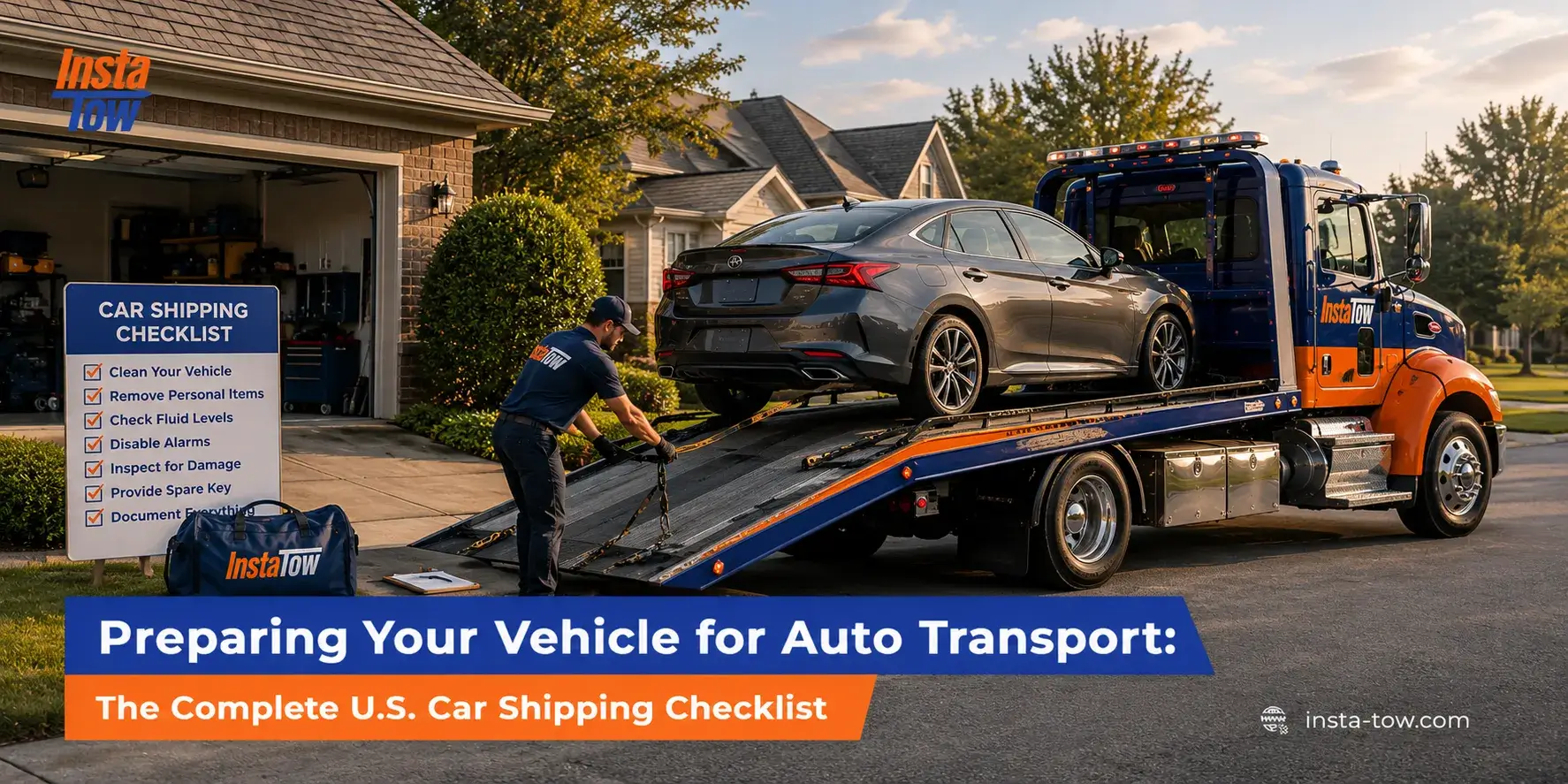
Shipping a vehicle across the country is a significant logistical undertaking that requires more than just handing over the keys to a carrier.
Whether you are moving for a new job, heading south for the winter, or purchasing a classic car from an out-of-state seller, preparing your vehicle for auto transport is the single most important factor in ensuring a smooth delivery.
A well-prepared car reduces the risk of transit damage, prevents unexpected delays during pickup, and ensures that your insurance coverage remains fully valid.
By following a structured car shipping checklist, you can transition from the planning phase to the open road with total confidence.
At Instatow, we prioritize transparency and safety above all else.
Understanding how to ship a car safely starts with a clear set of auto transport preparation steps that align with Department of Transportation (DOT) standards.
In this guide, we will break down every essential detail from documentation requirements to specialized EV handling to ensure your vehicle arrives at its destination exactly as it left your driveway.
Why Proper Vehicle Preparation Matters Before Auto Transport
The process of preparing your vehicle for auto transport serves as your first line of defense against logistical headaches and financial loss.
Many vehicle owners assume the carrier handles everything, but the owner is legally responsible for the internal condition and ship-readiness of the car.
Proper preparation is not just a recommendation; it is a critical component of the contract between you and the transport company.
Minimizes Liability: Clean vehicles allow for accurate inspections, ensuring any pre-existing issues are noted.
Ensures Safety: Securing loose parts prevents damage to your car and others on the trailer.
Legal Compliance: Adhering to weight and fuel regulations keeps the carrier within federal DOT limits.
Cost Efficiency: Avoiding last-minute issues prevents dry run fees if a carrier cannot legally load your vehicle.
How Preparation Protects You From Damage Claims
When you focus on preparing your vehicle for auto transport, you are essentially creating a paper trail for your protection.
A clean, well-documented car allows the driver to perform a precise vehicle inspection before shipping, which is recorded on the Bill of Lading.
If your car is dirty or cluttered, subtle dents or scratches might be missed during the initial pickup inspection, making it nearly impossible to prove that damage occurred during transit when filing an insurance claim later.
How Improper Prep Can Delay Pickup or Increase Costs
Carriers operate on tight, multi-car schedules where every minute counts.
If you haven't completed the necessary auto transport preparation steps, such as fixing a major fluid leak or reducing the fuel level, the driver may refuse to load the vehicle.
This can lead to:
Rescheduling Fees: You may be charged for the driver’s lost time and fuel.
Storage Costs: If you are on a deadline to move, you might have to pay for local terminal storage.
Winch Fees: If a car becomes inoperable due to a dead battery you failed to charge, extra equipment fees will apply.
DOT Regulations & Insurance Requirements in the U.S.
The Department of Transportation (DOT) enforces strict weight limits for multi-car carriers.
This is why preparing your vehicle for auto transport involves removing personal items; excessive weight can lead to heavy fines for the driver at highway weigh stations.
Furthermore, car shipping insurance coverage typically only applies to the vehicle itself and its factory-installed parts.
Personal belongings left inside are almost never insured and can even cause interior damage that the carrier will not be liable for.
What happens if you don’t prepare your car for shipping?
Failure to prepare your vehicle can result in denied insurance claims, additional inoperable fees, and significant transit delays.
Unsecured items may damage the interior or exterior, while excess fuel or personal weight can lead to DOT regulatory fines and potential refusal of service by the carrier.
Open vs. Enclosed Auto Transport: Does Preparation Differ?
When preparing your vehicle for auto transport, the type of carrier you choose significantly dictates your preparation strategy.
While the goal remains the same safe delivery the environmental variables of an open trailer versus a sealed, enclosed environment require different levels of foresight.
Open transport is the industry standard for efficiency and is perfectly suitable for daily drivers, but it leaves the vehicle's exterior exposed to the elements, much like driving on a highway.
Enclosed transport, conversely, offers a white-glove experience that shields the car from wind, rain, and road debris.
Open vs Enclosed Transport Preparation Differences
Exterior Protection Considerations
For those utilizing open enclosed vs open car transport, exterior prep is paramount.
Since your vehicle will be exposed to exhaust soot, insects, and varying weather patterns across shipping a car across state lines, applying a fresh coat of high-quality wax can act as a sacrificial barrier for the paint.
Additionally, ensure that convertible tops are securely latched and that any vinyl or canvas covers are removed, as the high-velocity wind during transit can cause loose fabric to whip against the paint, leading to buffing or surface abrasions.
Ground Clearance & Modified Vehicles
One of the most overlooked auto transport preparation steps involves measuring your vehicle's ground clearance.
Most open trailers use long ramps with a steep incline, which can be disastrous for cars with less than 4 inches of clearance, such as lowered sports cars or vehicles with aftermarket splitters.
If your vehicle is modified, you must disclose this during the quoting process.
For extremely low-profile cars, we recommend enclosed transport equipped with hydraulic liftgates, which keep the vehicle perfectly horizontal during the entire loading and unloading process.
Classic, Luxury & Exotic Car Special Requirements
Shipping a high-value asset requires a more clinical approach to preparing your vehicle for auto transport.
Beyond the standard checklist, owners of classic or exotic cars should document the mechanical state of the vehicle, including cold-start behavior and any quirks the driver should know.
If the vehicle features sensitive electronics or a specialized valet mode, ensure these are engaged or clearly explained to the carrier.
For these vehicles, car shipping insurance coverage should be verified to match the full appraisal value, as standard carrier limits may not suffice for rare or irreplaceable models.
Step-by-Step Checklist for Preparing Your Vehicle for Auto Transport
To ensure nothing is missed, we have synthesized years of logistical data into a definitive car shipping checklist.
Following these steps sequentially will not only speed up the pickup process but also provide you with the legal documentation needed if a claim ever arises.
At Instatow, we recommend starting this process at least 48 hours before your scheduled pickup window to allow time for unexpected maintenance or cleaning needs.
Final Wash: Clean the exterior to reveal all existing dings and scratches.
Inventory: Remove all non-permanent items from the cabin and trunk.
Mechanical: Ensure the battery is secured and tires are at the correct PSI.
Fuel Management: Drain the tank to approximately one-quarter full.
Documentation: Have your ID, registration, and insurance ready for the driver.
1. Wash Your Vehicle Thoroughly (Inside & Out)
A clean car is the foundation of a successful vehicle inspection before shipping.
Dirt and grime can easily hide small dents, paint chips, or scratches that might have occurred long before the transport began.
By presenting a sparkling vehicle, you make it easy for the transport driver to accurately mark the Condition Report on the Bill of Lading.
A clean interior also prevents loose dust or debris from settling into the upholstery during the vibrations of a long-distance haul.
2. Document Existing Damage (Photos + Written Notes)
Once the vehicle is clean, perform a comprehensive walk-around.
Take high-resolution, time-stamped photos of the front, back, sides, roof, and even the undercarriage if possible.
Don't forget to take close-ups of existing imperfections.
This visual evidence is your ultimate protection in how to ship a car safely.
If your vehicle arrives at its destination with a new mark, these photos serve as indisputable proof for your car shipping insurance coverage claim, eliminating the he-said, she-said dynamic between owners and carriers.
How do I prepare my car for shipping?
Clean the exterior and interior thoroughly.
Take time-stamped photos of all angles.
Remove personal items and exterior accessories.
Reduce fuel to 1/4 tank and check for leaks.
Disable alarms and provide a set of keys to the driver.
3. Remove Personal Belongings (What’s Legally Allowed in the U.S.)
One of the most common myths in the industry is that you can use your car as a moving box.
However, DOT regulations strictly prohibit carriers from transporting household goods inside vehicles unless they hold a specific household mover’s license.
When preparing your vehicle for auto transport, you must remove all personal items, including GPS units, dash cams, sunglasses, and loose change.
While some carriers may allow up to 100 lbs of soft goods (like clothing) in the trunk, these items are never covered by car shipping insurance coverage and can lead to significant fines if the truck is inspected at a federal weigh station.
Remove Toll Tags: Active EZ-Pass or SunPass tags can be triggered by toll gantries while the car is on the trailer, leading to unexpected charges.
Clear the Cabin: Items left in the backseat can shift during transit, potentially damaging the upholstery or cracking windows from the inside.
Check Hidden Compartments: Don't forget the glove box and center console; these are prime spots for forgotten documents or valuables.
Air Fresheners & Accessories: Remove hanging items from the rearview mirror that could swing and scratch the interior.
4. Secure or Remove Exterior Accessories (Racks, Spoilers, Toll Tags)
Exterior accessories are the most vulnerable parts of a car during cross-country car shipping prep.
High-velocity winds on an open carrier can exert hundreds of pounds of pressure on non-factory parts.
To ensure how to ship a car safely, you should remove bike racks, luggage racks, and custom spoilers that weren't installed by the manufacturer.
If you have a retractable antenna, ensure it is fully lowered.
For non-retractable antennas, it is often safer to unscrew and store them in the trunk to prevent them from snapping off or scratching the roof of the car.
5. Disable Alarms & Custom Electronics
Nothing frustrates a transport driver more than an alarm that won't stop triggered by the vibrations of the road.
If your car has an aftermarket security system, it must be completely disabled before the auto transport preparation steps are complete.
If the alarm cannot be turned off, you must provide the driver with clear, written instructions on how to silence it.
Failure to do so can lead to a drained battery, which might result in inoperable vehicle fees at the delivery point because the car can no longer be driven off the trailer.
6. Check Fluid Levels & Fix Active Leaks
Your vehicle will likely be stacked above or below other high-value cars.
A major oil or brake fluid leak from your vehicle could drip onto the car beneath it, causing paint damage and making you liable for those repairs.
Part of preparing your vehicle for auto transport involves ensuring all fluid levels are topped off and, more importantly, checking that there are no active drips.
If your car has a minor, known leak that cannot be fixed before shipping, you must inform the carrier so they can place your vehicle on the bottom deck to protect other customers' assets.
Engine Oil: Ensure it is at the correct level to prevent engine issues during loading.
Coolant: Critical for shipping a car across state lines through varying climates (e.g., desert heat or mountain cold).
Brake Fluid: Essential for the driver to safely maneuver the car on and off the ramps.
Washer Fluid: Helpful for clearing any road film immediately upon delivery.
7. Adjust Fuel Level (Why 1/4 Tank Is Ideal)
Weight management is a science in the logistics industry.
A full tank of gas adds roughly 50 to 100 pounds of unnecessary weight to your vehicle.
Multiplied by 8 or 10 cars on a trailer, this can put a carrier over the legal weight limit.
The industry standard for auto transport documentation and prep is to have exactly 1/4 tank of fuel.
This provides enough gasoline for the driver to load and unload the vehicle without risk of running out on the steep ramps, while keeping the total weight low and reducing the fire hazard risks associated with transporting flammable liquids.
8. Check Tire Pressure & Battery Charge
A car with a dead battery or a flat tire is considered inoperable, even if it runs perfectly otherwise.
Before the carrier arrives, ensure your tires are inflated to the manufacturer’s recommended PSI.
Low tire pressure can cause the vehicle to shift in its tie-down straps during transit, potentially leading to rim damage.
Similarly, ensure the battery is fully charged and the terminals are secure.
If the car won't start at the delivery location, you may be charged an additional fee for the specialized equipment needed to winch the car off the trailer.
9. Prepare Keys & Required Documents
The final physical step in preparing your vehicle for auto transport is gathering your paperwork.
You will need to provide the driver with one full set of keys including the ignition, trunk, and any locking gas caps or wheel nuts.
We strongly recommend having a spare set made; never give a carrier your only set of keys.
For auto transport documentation, ensure you have a copy of your registration and a valid photo ID.
If you are shipping a car you just purchased, have the Bill of Sale ready for the driver to verify.
10. Review and Sign the Bill of Lading Properly
The bill of lading car shipping document is the most vital piece of paper in the entire process.
It serves as your contract, your receipt, and your condition report all in one.
When the driver arrives for pickup, you must walk around the car together and ensure every existing scratch or dent is noted on this form.
Do not sign it until you are confident the report is accurate.
Upon delivery, you will perform the same walk-around; if new damage is found, it must be noted on the Bill of Lading before you sign for the final delivery, or you may waive your right to an insurance claim.
You also need to know: Complete Guide to Car Shipping Cost and Pricing Factors
Special Preparation Considerations by Vehicle Type
Broadening your approach to preparing your vehicle for auto transport involves understanding that different engineering standards require different preparation protocols.
Modern logistics in 2026 demands a nuanced understanding of vehicle categories, as a traditional internal combustion engine (ICE) vehicle has vastly different transport needs than a high-capacity electric vehicle or a modified off-road truck.
By tailoring your auto transport preparation steps to your specific vehicle type, you ensure the safety of both your asset and the carrier’s equipment.
Weight Awareness: Always disclose the specific trim level of your vehicle, as battery packs or heavy-duty modifications can alter the total weight by over 1,000 lbs.
Clearance Checks: Measure the distance from the lowest point of the chassis to the ground to ensure compatibility with standard loading ramps.
Mode Settings: Check your owner's manual for specialized Transport or Tow modes that prevent electronic parking brakes from engaging during transit.
Preparing an Electric Vehicle (EV) for Transport
In 2026, EV car shipping requirements have become more stringent due to DOT and PHMSA (Pipeline and Hazardous Materials Safety Administration) classifications under UN 3171.
Unlike gasoline cars, EVs should be shipped with a battery charge between 40% and 50%.
A fully charged lithium-ion battery is under higher thermal stress, while a depleted one risks bricking if the 12V system fails during a long-haul move.
Always ensure the vehicle is in Transport Mode to disable regenerative braking, which can cause resistance or heat buildup when the vehicle is being winched or moved on the trailer.
Hybrid Vehicle Shipping Tips
Hybrid vehicles require a hybrid approach to preparation.
You must balance the 1/4 tank of fuel rule for the combustion engine with the 50% charge rule for the battery pack.
Because hybrids often have complex electrical systems that manage the transmission, it is vital to ensure the auxiliary 12V battery is in peak health.
A hybrid that won't start at the delivery point due to a dead 12V battery can be significantly more difficult to jump-start than a standard car, potentially leading to increased labor costs or inop surcharges.
Inoperable or Non-Running Vehicle Preparation
Shipping an inop vehicle industry shorthand for a car that doesn't run requires a specific vehicle inspection before shipping to confirm it meets the RSB Standard: Roll, Steer, and Brake.
Even if the engine is dead, the car must have functional tires and a working steering rack to be safely winched onto the carrier.
Inflate Tires: Winching a car with flat tires can damage the winch cable and the vehicle’s rims.
Clear the Steering Path: Ensure no interior debris blocks the steering wheel's full rotation.
Brake Function: Confirm the emergency brake can hold the vehicle's weight on an incline.
Modified, Lowered, or Lifted Trucks
Customized vehicles present unique challenges for cross-country car shipping prep.
Lifted trucks may exceed the standard height clearances of a double-decker trailer, often requiring a specialized top-load position to avoid hitting the upper deck's structural beams.
Conversely, lowered vehicles or those with aftermarket body kits must be disclosed immediately.
If your car has less than 5 inches of clearance, standard ramps will likely cause undercarriage damage; in these cases, an enclosed carrier with a hydraulic liftgate is the only way to ensure how to ship a car safely.
Classic & Collector Cars
For high-value assets, the car shipping checklist expands into a preservation strategy.
Beyond standard washing, consider using painter’s tape to secure chrome trim or delicate weather stripping that might be buffed by high-speed winds.
If your classic car has a drip (common in older engines), provide the driver with a drip pan or oil absorbent mat.
Most specialized classic car carriers will accommodate this to prevent your vehicle's fluids from damaging the cars parked below it on the trailer.
Seasonal & Cross-Country Car Shipping Preparation Tips (U.S. Specific)
The geography of the United States means a single transport route can take a vehicle through three different climate zones.
Preparing your vehicle for auto transport in the winter requires a different mindset than shipping during a mid-summer heatwave.
Whether you are part of the annual snowbird vehicle transport migration or a service member on a military car shipping PCS move, seasonal adjustments are essential for protecting your vehicle's mechanical integrity and exterior finish.
Winter Shipping (Snow, Salt & Battery Risks)
Winter transport involves significant exposure to corrosive road salt and magnesium chloride, especially on northern routes like I-90 or I-80.
Undercarriage Protection: Apply a corrosion-inhibiting spray or a heavy wax to the lower panels before pickup.
Fluid Check: Ensure your antifreeze (coolant) is rated for sub-zero temperatures to prevent the engine block from cracking in transit.
Battery Maintenance: Cold temperatures reduce battery capacity; a weak battery that starts in Florida may be completely dead by the time it reaches a freezing terminal in Chicago.
Summer Heat Considerations
Extreme heat during cross-country car shipping prep can lead to tire pressure spikes and interior damage.
Tire Pressure: Avoid over-inflating tires in the summer; as temperatures rise during the drive across the Southwest, PSI will naturally increase, which can lead to blowouts if the tires are already at their maximum limit.
Sun Protection: If using open transport, a high-quality interior sunshade can protect the dashboard and leather from UV degradation during the days the car sits on the top deck.
Shipping Coast-to-Coast vs. Regional Transport
A coast-to-coast haul (e.g., New York to Los Angeles) typically takes 7 to 10 days, during which your vehicle will be stationary for long periods.
For these long-haul trips, the 1/4 tank fuel rule is non-negotiable for weight and safety.
For shorter regional moves (under 500 miles), preparation can be slightly more relaxed, but the bill of lading car shipping documentation remains just as critical to protect against minor road debris damage.
Military Relocation & College Student Moves
For military car shipping, the most important preparation step is ensuring your auto transport documentation is in perfect order.
Orders, proof of insurance, and a valid military ID are required for base access if the carrier is delivering directly to a terminal.
For college moves, ensure that the no personal items rule is strictly followed; students often try to pack the car with dorm supplies, which can lead to the carrier refusing the load due to DOT weight restrictions and the high risk of theft during overnight stops at hotels.
Insurance, Inspection & The Bill of Lading Explained
Navigating the administrative side of preparing your vehicle for auto transport is just as vital as the physical preparation.
In the U.S. auto shipping industry, the paperwork isn't just red tape; it is a set of legal instruments designed to protect your investment.
Understanding the nuances of auto transport documentation ensures that if a rare mishap occurs during cross-country car shipping prep, you have the evidentiary support needed to resolve it quickly.
Custody Confirmation: The paperwork proves exactly when the carrier took control of your vehicle.
Condition Baseline: It establishes a before and after snapshot of your car's physical state.
Liability Limits: It defines the financial boundaries of the carrier's responsibility.
Claim Roadmap: It provides the specific steps and contact points required for damage resolution.
What Is a Bill of Lading in Car Shipping?
The bill of lading car shipping document (often called the BOL) is the most important piece of paper in the transport process.
It functions as three distinct things: a formal receipt confirming the carrier has your car, a legal contract of carriage, and a comprehensive condition report.
When you are preparing your vehicle for auto transport, you must treat the BOL as your primary shield.
In 2026, many carriers utilize digital BOLs on tablets that allow for embedded high-resolution photos, providing a more reliable record than old-fashioned carbon-copy paper forms.
How to Conduct a Proper Pre-Transport Inspection
A successful vehicle inspection before shipping requires active participation.
Do not simply stand back while the driver marks the BOL; walk with them.
Lighting: Ensure the inspection happens in daylight or under bright, artificial light.
Angles: Check the lower bumpers, rocker panels, and roof areas often overlooked.
Specifics: If the driver marks a scratch, clarify if it’s a surface scuff or a deep paint chip.
Verification: Before signing, ensure the digital or paper BOL accurately reflects every mark you see.
What Auto Transport Insurance Covers (And What It Doesn’t)
Standard car shipping insurance coverage is federally mandated, but it has specific boundaries.
Most professional carriers carry between $100,000 and $1,000,000 in cargo insurance.
This covers external damage caused by the carrier’s negligence, such as collisions, debris falling from the truck, or improper loading.
However, it typically excludes internal issues like mechanical failure (engine/transmission), electronic glitches, or damage to personal items left inside.
If you are shipping a high-value asset, always ask for a Certificate of Insurance (COI) to verify the policy limits.
How to File a Damage Claim If Necessary
If you notice new damage upon delivery, the golden rule of how to ship a car safely is: Do not sign a clean BOL.
Note it Immediately: Write the specific damage directly on the delivery BOL before the driver leaves.
Photo Evidence: Take new photos of the damage and compare them to your pickup photos.
Contact Instatow: Notify your broker or carrier within 24 hours.
Estimates: Obtain two independent repair estimates to submit with your formal claim packet.
Sample Annotated Bill of Lading Breakdown
Header: Check for correct VIN and contact info.
Diagram: Look for S (Scratch), D (Dent), or C (Chipped) notations.
Signatures: Ensure dates and times are accurate for both pickup and delivery.
you can also read: Auto Transport Damage: How to Trust Your Eyes and Protect Your Vehicle
Common Mistakes to Avoid When Preparing Your Vehicle
Even experienced shippers can fall into traps that lead to unnecessary costs or stress.
When preparing your vehicle for auto transport, avoiding these common pitfalls is the difference between a seamless move and a logistical nightmare.
At Instatow, we’ve analyzed thousands of shipments to identify the top five errors that modern shippers make in 2026.
Assumptions: Never assume the driver will know your car's mechanical quirks.
Procrastination: Leaving preparation until the hour of pickup leads to missed steps.
Inaccuracy: Providing the wrong weight or dimensions for modified vehicles.
Silence: Failing to report a slow leak or a weak battery to the driver.
Leaving Toll Tags Active
This is perhaps the most frequent hidden cost in auto transport preparation steps.
If you leave an active E-ZPass or SunPass on your windshield, highway toll sensors will trigger it as the truck passes through.
You could end up paying for tolls across twelve different states while your car is stationary on a trailer.
Always remove the transponder or place it in a RF-shielded bag provided by the toll authority.
Shipping With Too Much Fuel
As discussed in our car shipping checklist, a full tank is a liability.
Beyond the fire safety risk, the extra 80+ pounds of weight can push a carrier over the DOT legal limit at a weigh station.
If a driver has to down-fuel your car or if the truck is delayed due to weight violations, those costs are often passed back to the owner.
Stick to the 1/4 tank rule for optimal results.
Forgetting to Document Existing Damage
Skipping the photo stage of preparing your vehicle for auto transport is a gamble you don't want to take.
Without time-stamped before photos, proving that a scratch occurred during transit is nearly impossible.
Insurance adjusters require clear proof that the damage was not pre-existing.
Spend 10 minutes taking photos; it could save you thousands in repair costs.
Leaving Valuables Inside the Vehicle
Carriers are not movers.
Leaving a laptop, expensive tools, or jewelry in the car during cross-country car shipping prep invites two risks: theft and interior damage.
If a loose item shifts during a sharp turn and shatters a window from the inside, the carrier's insurance will almost certainly deny the claim.
Instatow recommends a completely empty cabin for maximum safety.
Not Confirming Pickup Window
Standard auto transport is not an exact-time service; it’s a window service.
A common mistake is not being available or having a designated agent (like a friend or neighbor) ready when the driver calls.
If the carrier arrives and no one is there to sign the bill of lading car shipping document, you may be charged a dry run fee, and your car could be bumped to the next available trailer, causing weeks of delay.
Ready to Ship? Get a Fast, Transparent Auto Transport Quote with Instatow
Now that you have mastered the art of preparing your vehicle for auto transport, the final step is choosing a partner that values your vehicle as much as you do.
Instatow stands at the forefront of the American logistics industry, combining advanced 2026 tracking technology with a human-centric approach to customer service.
We don't just move cars; we move the lives and assets that matter most to our clients across all 50 states.
Why Choose Instatow for Reliable U.S. Auto Transport
Our reputation is built on a foundation of strict vetting and high-tier car shipping insurance coverage.
Every carrier in our nationwide network must pass a rigorous multi-point safety audit, ensuring they meet our exacting standards for equipment maintenance and driver professionalism.
Whether you need military car shipping for a PCS move or a climate-controlled trailer for a luxury EV, we have the specialized infrastructure to handle your unique requirements.
Vetted Carrier Network: Only the top 5% of safety-rated drivers.
Real-Time Tracking: 24/7 visibility through our proprietary IoT platform.
Zero Upfront Deposit: You don't pay until your carrier is officially dispatched.
Comprehensive Insurance: Industry-leading cargo protection for every shipment.
Instant Quote Process Explained
We have eliminated the guesswork from car shipping cost factors.
By utilizing our AI-driven pricing engine, you can receive a transparent, all-inclusive quote in under 60 seconds.
Our system analyzes current fuel surcharges, route density, and carrier availability to provide a price that is guaranteed with no hidden fees, no bait-and-switch tactics.
Simply enter your zip codes and vehicle details to see your customized shipping options.
What Happens After You Book
Once you secure your spot, our team takes over the logistics.
We pair you with a carrier that specializes in your specific route and vehicle type, ensuring that all auto transport preparation steps are reviewed with the driver beforehand.
You will receive a dedicated transport coordinator who will guide you through the auto transport documentation and serve as your single point of contact until your keys are back in your hand.
Don't leave your vehicle's safety to chance.
Experience the gold standard in American car shipping today.
Get Your Instant Auto Transport Quote from Instatow Now
Frequently Asked Questions About Preparing Your Vehicle for Auto Transport
Navigating the complexities of vehicle logistics often leads to specific questions about costs, timelines, and safety.
In 2026, the auto transport industry has become more data-driven, offering better tracking and more precise pricing than ever before.
To help you finalize your auto transport preparation steps, we have compiled the most common inquiries from our customers at Instatow, provided with direct, expert answers to ensure your peace of mind.
Can I pack personal items in my car during shipping?
Strictly speaking, you should not pack personal items in your car.
Per DOT regulations and car shipping checklist standards, carriers are not licensed to transport household goods.
Items left in the car are not covered by car shipping insurance coverage, add weight that can lead to fines, and can shift during transit, causing interior damage.
How much does it cost to ship a car in the U.S.?
In 2026, car shipping cost factors result in an average price of $600 to $1,600 for most domestic moves.
Open transport typically costs between $0.60 and $1.20 per mile, while enclosed transport averages $0.90 to $1.80 per mile.
Prices fluctuate based on distance, vehicle size, fuel costs, and seasonal demand.
Is open transport safe?
Yes, open transport is the industry standard and is highly safe for the vast majority of daily drivers.
While the vehicle is exposed to weather and road dust similar to driving it yourself it is securely fastened to the trailer.
For those concerned about road debris, a thorough wash and wax are key auto transport preparation steps for open shipping.
How long does car shipping take?
Transit times depend on distance: short hauls (under 500 miles) take 1-2 days, while mid-distance trips (500-1,500 miles) take 3-5 days.
Cross-country car shipping prep for routes over 2,500 miles typically results in a 7-10 day delivery window, as drivers average 400-500 miles per day according to federal safety laws.
Do I need to be present at pickup and delivery?
Yes, either you or a designated 18+ agent must be present to sign the bill of lading car shipping document.
This is the only way to conduct a legally binding vehicle inspection before shipping and at the time of delivery, which is essential for protecting your right to an insurance claim.
Can I ship a car with mechanical issues?
Yes, you can ship an inoperable vehicle, but it must still be able to roll, steer, and brake.
You must disclose the vehicle's condition upfront so the carrier can bring a winch.
Shipping a non-running car typically adds $200-$500 to the total cost due to the specialized labor and equipment required.
Can I track my vehicle during transport?
In 2026, most professional carriers offer real-time GPS tracking via mobile apps or secure web portals.
This technology provides a digital chain of custody, allowing you to monitor your vehicle's progress across state lines.
At Instatow, we provide automated status updates at key milestones from pickup to final delivery.