
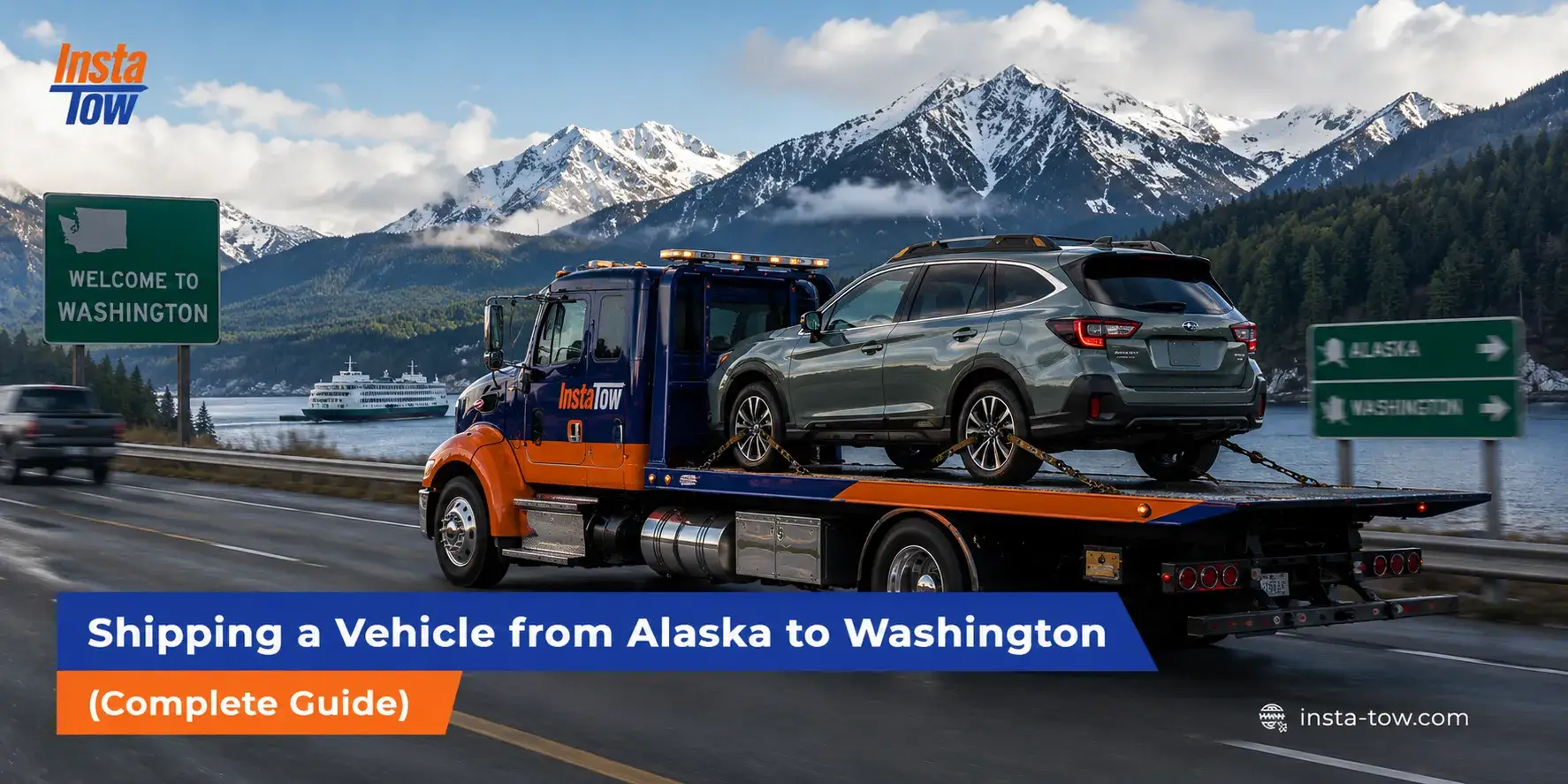
Moving a vehicle across the Gulf of Alaska to the Pacific Northwest is a logistical feat that requires more than just a standard trailer.
Whether you are relocating for a new job, heading south for the winter, or completing a military PCS, understanding the mechanics of shipping vehicle from alaska to washington is essential for a stress-free transition.
At Instatow, we specialize in bridging the gap between the Last Frontier and the Evergreen State, ensuring your car, truck, or SUV arrives safely at the Port of Tacoma or your driveway in Seattle.
This guide provides an authoritative breakdown of costs, transit times, and the specific documentation required to move your vehicle south efficiently.
From Alaska barge auto shipping nuances to choosing between open and enclosed carriers, we’ve distilled years of maritime logistics expertise into this comprehensive resource.
How to Ship a Vehicle from Alaska to Washington
For most vehicle owners, the fastest and most cost-effective way to handle shipping vehicle from alaska to washington is via ocean barge from Anchorage to Tacoma.
Ships typically depart twice weekly, with a transit time of 6-9 days once the vessel leaves the port.
Prices generally range from $1,900 to $3,200, depending on the vehicle size and whether you choose port-to-port or door-to-door service.
Main shipping methods: Ocean Barge (RoRo), Container, and Barge + Truck combinations.
Average cost range: $2,100 - $3,500 (standard vehicles).
Average transit time: 7-12 days total (including port processing).
Most common ports: Port of Alaska (Anchorage) and Port of Tacoma.
Vehicle Shipping Options from Alaska to Washington
Selecting the right transport method is the first step in your journey.
Unlike the lower 48, where a single truck usually handles the entire trip, Alaska shipments often involve a multi-modal approach combining ocean freight vehicle transport with overland hauling.
Port-to-Port Shipping (Anchorage to Tacoma/Seattle)
This is the most popular and budget-friendly option.
You are responsible for dropping your vehicle off at the Port of Alaska in Anchorage and picking it up at the terminal in Tacoma or Seattle.
This method utilizes Alaska barge auto shipping, where vehicles are driven onto specialized vessels.
Door-to-Port Transport
If you aren’t located near Anchorage-perhaps you’re in Fairbanks or the Kenai Peninsula-Instatow can arrange a carrier to pick up your vehicle from your home.
We then transport it to the Anchorage port for its voyage to Washington. You would then collect the vehicle at the Washington terminal.
Door-to-Door Auto Transport (Barge + Truck Combination)
For maximum convenience, our door-to-door car delivery service handles every mile.
We pick up the vehicle at your Alaska residence, manage the ocean transit, and then dispatch a second carrier in Washington to deliver the car directly to your new address in cities like Seattle, Bellevue, or Spokane.
RoRo vs. Container Shipping - What’s the Difference?
Understanding how your car is secured during ocean freight vehicle transport helps in managing expectations regarding safety and cost.
RoRo: Your vehicle is driven onto the ship's deck and secured in a weather-protected garage area.
Container: The vehicle is locked inside a 20ft or 40ft steel container, providing maximum protection from the elements.
Barge + Truck: Specifically designed for those needing car transport Anchorage to Seattle with final delivery to inland Washington locations.
How Much Does It Cost to Ship a Car from Alaska to Washington?
The financial investment required for shipping vehicle from alaska to washington is influenced by several logistical variables.
Because this route relies heavily on maritime schedules and fuel surcharges, prices are more fluid than standard domestic trucking.
On average, most customers should budget between $2,100 and $3,400 for a standard transport, though specific requirements can shift this range.
Average Cost by Vehicle Type
The physical footprint of your vehicle determines how much space it occupies on the barge, which directly impacts the vehicle shipping rates Alaska to WA.
Sedan: $1,950 - $2,300
SUV: $2,350 - $2,700
Truck: $2,600 - $3,100
Oversized Vehicles: $3,500+ (Requires specialized quoting)
Cost by Route (Anchorage, Fairbanks, Juneau → Seattle/Tacoma)
Where your journey begins in the Last Frontier significantly changes the price.
Moving a car from Fairbanks requires a 360-mile haul down the Parks Highway to reach the port, increasing the total.
Anchorage to Tacoma: Base rate (Lowest)
Fairbanks to Tacoma: Base + $500-$700 overland fee
Juneau to Tacoma: Specialized barge rates apply due to lack of road access
Seasonal Pricing (Summer vs Winter Rates)
Demand for Alaska barge auto shipping peaks during the Snowbird seasons.
We often see seasonal auto shipping discounts during the late fall for north-bound trips, but south-bound rates to Washington remain competitive year-round with slight spikes in late summer.
Factors That Affect AK to WA Shipping Costs
Distance to port: The mileage from your driveway to the Anchorage terminal.
Vehicle size & weight: Heavier vehicles consume more fuel and space.
Operability: Non-running vehicles require winches and extra labor.
Fuel prices: Maritime fuel surcharges fluctuate monthly.
Time of year: High-demand summer months may see rate increases.
Insurance level: Upgrading to premium gap coverage adds to the total.
You can also read: Car Shipping Scams: How to Spot Red Flags and Avoid Losing Money
How Long Does It Take to Ship a Car from Alaska to Washington?
Timeframes for shipping vehicle from alaska to washington are dictated by the sailing schedule of the primary carriers.
Typically, vessels depart Anchorage twice a week.
If you miss the Tuesday cut-off for loading, your vehicle will wait for the Friday sailing, which adds to the overall duration.
Transit Time by Shipping Method
Port-to-Port: 7-9 days from vessel departure to arrival.
Door-to-Door: 12-18 days, accounting for inland trucking on both ends.
Expedited Services: 5-7 days (limited availability).
Port Processing & Loading Time
Before a vehicle can be loaded for ocean freight vehicle transport, it must undergo a mandatory security screening and agricultural inspection.
This usually requires the vehicle to be at the terminal 48 to 72 hours before the ship departs.
Weather & Seasonal Delays
The Gulf of Alaska is notorious for volatile weather, especially between November and March.
Heavy seas can occasionally delay barge arrivals by 24-48 hours.
At Instatow, we monitor these patterns to give you realistic delivery windows.
Expedited Shipping Options
For those on a strict timeline, such as a fast-tracked military PCS vehicle move, we offer priority loading.
This ensures your vehicle is among the first offloaded in Tacoma, shaving days off the pickup window.
Projected Timeline Flow:
Day 1-2: Vehicle pickup or port drop-off and inspection.
Day 3-4: Port processing and loading onto the barge.
Day 5-10: Transit across the Gulf of Alaska.
Day 11-12: Unloading at the Port of Tacoma and final notification.
Day 13+: Optional door-to-door car delivery to your final Washington address.
Step-by-Step Process: Alaska to Washington Auto Transport
At Instatow, we have refined the logistical pipeline for shipping vehicle from alaska to washington into a seamless, seven-step journey.
Navigating maritime schedules and terminal protocols can be daunting, but our structured approach ensures you are never left wondering where your vehicle is located.
Request a quote with Instatow: Start by providing your vehicle's make, model, and pickup location. We offer transparent vehicle shipping rates Alaska to WA tailored to your specific timeframe.
Choose transport method: Decide between the budget-friendly port-to-port option or the comprehensive door-to-door car delivery service.
Schedule pickup or port drop-off: Once booked, we coordinate the timing to match the next available barge departure from Anchorage.
Vehicle inspection & documentation: A detailed Bill of Lading (BOL) is generated. We record the vehicle's condition with photos to ensure total accountability during ocean freight vehicle transport.
Ocean freight transport: Your vehicle is securely loaded onto the vessel for its voyage across the Gulf of Alaska.
Arrival in Tacoma or Seattle: Upon docking, the vehicle is offloaded and passes through a final port safety clearance.
Final delivery or pickup: You can collect your car at the terminal or wait for our carrier to bring it directly to your new Washington residence.
Major Ports & Shipping Routes (Alaska ↔ Washington)
The backbone of Alaska barge auto shipping is a network of specialized terminals designed to handle the unique demands of sub-arctic logistics.
Establishing the right route is critical for minimizing transit time and cost.
Anchorage Port
The Port of Alaska in Anchorage is the primary hub for south-bound shipments.
Most car transport Anchorage to Seattle begins here, as it serves as the central collection point for vehicles arriving from across the state.
Fairbanks Vehicle Shipping
Since Fairbanks is inland, vehicles must be trucked south to Anchorage via the Parks Highway.
We manage this overland leg, ensuring your car reaches the port in time for the scheduled sailing.
Juneau Shipping Considerations
Juneau is landlocked by the Juneau Icefield, meaning vehicles can only leave via water.
Shipping from Juneau often involves smaller feeder barges that connect to the main Tacoma-bound vessels, which can slightly alter the ocean freight vehicle transport timeline.
Tacoma Auto Transport Terminal
The Port of Tacoma is the most frequent destination for vehicles coming from Alaska.
It features massive processing centers where vehicles are sorted for customer pickup or dispatched for further delivery within the Pacific Northwest.
Seattle Vehicle Processing Center
While Tacoma handles the bulk of RoRo (Roll-on/Roll-off) cargo, some specialized or containerized shipments utilize Seattle terminals.
This is often the preferred hub for luxury or classic vehicles undergoing enclosed vs open auto transport.
Primary Hub: Port of Alaska (Anchorage)
Primary Destination: Port of Tacoma
Intermodal Connection: Fairbanks (Truck-to-Barge)
Marine Route: Gulf of Alaska / Inside Passage (Weather dependent)
Required Documents for Shipping a Car from Alaska
When shipping vehicle from alaska to washington, paperwork is the gatekeeper of the entire process.
Because your vehicle is leaving the state via maritime routes, it is subject to federal Coast Guard regulations and port security protocols that differ from standard state-to-state trucking.
Ensuring your documentation is in order prevents costly terminal storage fees and loading delays.
Title & Registration Requirements
The most critical document is the original Vehicle Title or a certified copy.
The port authorities must verify legal ownership before the car is loaded for ocean freight vehicle transport.
Original Title: Must be present or accessible.
Current Registration: Must be valid and match the name on the shipping order.
Proof of Insurance: While not always mandatory for the barge itself, it is required for any overland transport legs.
Lienholder Authorization
If your vehicle is financed or leased, you do not technically own the vehicle in the eyes of maritime law until the lien is satisfied.
Lender Permission: You must obtain a formal Lienholder Authorization Letter from your bank or leasing company.
Specific Details: The letter must be on official letterhead, include the VIN, and explicitly grant permission for the vehicle to be transported via water to Washington.
Timeline: Request this at least 10-14 days in advance, as banks often have internal processing delays.
Military PCS Documentation
Alaska is a major hub for service members.
If you are conducting a military PCS vehicle move, the documentation requirements are more stringent to ensure government reimbursement eligibility.
PCS Orders: A copy of your official Permanent Change of Station orders.
Military ID: A valid Common Access Card (CAC).
Form DD-1797: Personal Property Counseling Checklist (if applicable).
ID & Port Entry Requirements
Accessing the Port of Alaska or the Tacoma terminal requires specific identification for security purposes.
Government-issued Photo ID: A valid Driver’s License or Passport.
Booking Confirmation: Your Instatow booking number is required to enter the staging area.
Notarized Letter of Authorization: If someone other than the registered owner is dropping off or picking up the vehicle, they must have a notarized letter signed by the owner.
Military & PCS Vehicle Shipping from Alaska to Washington
Service members stationed at JBER (Joint Base Elmendorf-Richardson) or Fort Wainwright frequently relocate to bases in Washington like JBLM (Joint Base Lewis-McChord).
At Instatow, we specialize in the unique logistics of the military PCS vehicle move.
How Military Vehicle Shipping Works
The government typically pays for the shipment of one Privately Owned Vehicle (POV) when moving OCONUS (Outside Continental United States), which includes Alaska.
However, there are strict weight and size limitations.
If your vehicle exceeds these or if you need to ship a second family car, you will need a private carrier.
Reimbursement & Government Coverage
VPC vs. Private: You may choose to use a government-contracted Vehicle Processing Center (VPC) or hire a private company like Instatow and seek reimbursement (PPM/DITY move).
Weight Limits: Standard entitlement covers up to 20 measurement tons. Oversized trucks may require out-of-pocket supplements.
Why Many Service Members Choose Private Shipping
While the government VPC is an option, many choose Instatow for car transport Anchorage to Seattle due to:
Faster Timelines: We often beat government transit times by 5-7 days.
Personalized Updates: Real-time tracking that isn't always available via military channels.
Flexible Delivery: We can deliver directly to your new housing at JBLM rather than requiring a port pickup.
Tip: Always keep receipts for port fees and excess cost payments, as these may be tax-deductible or reimbursable under certain PCS allowances.
Pro Tip: Ensure your vehicle has exactly 1/4 tank of fuel or less; this is a strict Coast Guard safety requirement for all military and civilian shipments.
For more services: Auto Transport From Alaska: The Ultimate Guide to Shipping to the Lower 48
Navigating the logistics for vehicles that don't fit the standard compact or running mold requires specialized handling.
Whether you are moving a restoration project or a heavy-duty work truck, shipping vehicle from alaska to washington is still possible, though it requires specific preparations and carries additional fees.
Inoperable Vehicle Requirements
An inoperable or non-running vehicle is defined as any unit that cannot move under its own power but can still roll, steer, and brake.
At the Anchorage terminal, these vehicles cannot be driven onto the RoRo decks and instead require a winch or forklift for loading.
Winch-Only Loading: Your vehicle must be able to roll and steer to be winched onto the vessel.
Battery & Fluids: Even if it doesn't start, the vehicle must be free of major fluid leaks (oil, transmission, or brake fluid) to prevent environmental hazards on the ship's deck.
Added Handling Fees: Expect a surcharge ranging from $150 to $500 for the specialized labor and equipment needed for Alaska barge auto shipping of non-runners.
Liftgate & Winch Services
For vehicles that cannot roll or steer (totaled or project cars), specialized trailers equipped with heavy-duty liftgates are required for the overland portion of your door-to-door car delivery.
Equipment Coordination: Instatow coordinates with carriers who have integrated winch systems to pull the vehicle onto the trailer.
Port Restrictions: Some terminals have strict rules against non-rolling vehicles; we recommend confirming your vehicle's exact condition during the quoting phase.
Heavy-Duty & Commercial Vehicle Transport
If you are shipping a lifted truck, a dually, or a commercial van, your vehicle likely falls into the oversized category.
Height & Width Limits: Standard barge slots accommodate vehicles up to 7 feet high. Anything taller or wider than 8.5 feet requires a specialized flat rack or oversized deck space.
Weight Postings: Port terminals have specific axle-weight limits. Vehicles exceeding 80,000 lbs GVW require a specialized Oversized Vehicle Travel Request and may be restricted to specific sailing dates.
Auto Transport Insurance & Vehicle Protection
Entrusting your asset to a maritime voyage involves understanding the layers of protection between the Gulf of Alaska and the Port of Tacoma.
Ocean freight vehicle transport insurance is distinct from your standard Geico or State Farm policy.
What Insurance Is Included?
Every shipment with Instatow includes a base level of Marine Cargo Insurance.
This covers physical damage, theft, or total loss resulting directly from carrier negligence during the voyage.
Standard Limits: Typically covers between $100,000 and $250,000 per vehicle.
Marine Liability: Protects against major maritime incidents, such as collisions at sea or General Average (where all cargo owners share the cost of a ship's emergency).
Additional Coverage Options
For high-value assets, luxury imports, or antique vehicles, the standard cargo policy may not be sufficient.
Gap Insurance: Bridges the difference between the carrier’s payout limit and your vehicle's actual market value.
Full Value Protection: Allows you to insure the vehicle for its total replacement cost rather than just a depreciated liability amount.
Enclosed Carrier Upgrades: Choosing enclosed vs open auto transport often unlocks higher insurance tiers, as these containers are insured for significantly higher total load values.
How Claims Work
In the rare event of damage, a structured process ensures you are compensated fairly.
The Delivery Inspection: You must note any new damage on the Bill of Lading (BOL) before signing and leaving the port.
Photo Evidence: Clear, high-resolution photos of the damage compared to the origin inspection photos.
Filing Deadlines: Most maritime claims must be initiated within 24-48 hours of delivery.
Carrier Follow-up: Instatow assists in facilitating the claim between you and the maritime insurer to ensure a prompt resolution.
Crucial Note: Carrier insurance does not cover personal items left inside the car.
Exclusion: Mechanical failures (like a dead battery or engine trouble) that occur during transit but are not caused by an accident are typically excluded.
Preparing Your Vehicle for Alaska to Washington Shipping
Proper preparation is the most effective way to ensure a smooth transit and avoid unexpected fees at the port.
Maritime shipping has stricter safety standards than standard road transport, so following this checklist is essential.
Clean vehicle: Wash the exterior and interior thoroughly. A clean car allows for an accurate condition report during inspection.
Remove personal items: Clear out the cabin. While some carriers allow up to 100-250 lbs of items in the trunk/cargo area (below window level), these items are not insured. Never leave valuables, electronics, or plants inside.
Disable alarms: A triggered alarm on a moving barge can drain your battery or cause unnecessary security alerts. Ensure all anti-theft systems are off.
Reduce fuel to ¼ tank: This is a strict U.S. Coast Guard regulation for fire safety. Vehicles with more than a quarter tank may be refused at the port or charged a drainage fee. (Note: Diesel vehicles are sometimes allowed up to ½ tank).
Photograph condition: Take high-resolution photos of all four sides, the roof, and the interior. This serves as your primary evidence in the event of an insurance claim.
Check fluid leaks: Ensure the vehicle is free of active leaks (oil, coolant, or brake fluid). Leaking vehicles can damage other cargo and may be rejected by the vessel operator.
Check Antifreeze: Ensure your vehicle is properly winterized with the correct antifreeze levels to handle sub-zero temperatures during staging or transit.
Cheapest Way to Ship a Car from Alaska to Washington
If your primary goal is cost-savings, navigating the trade-offs between convenience and price is key.
Shipping vehicle from alaska to washington can be optimized by choosing the right service tier and timing.
Budget-Friendly Port-to-Port Option
Dropping off your vehicle directly at the Port of Alaska (Anchorage) and picking it up at the Port of Tacoma is the least expensive method.
By handling the last mile yourself, you avoid the $300-$800 surcharge typically added for professional carrier pickup and delivery.
Flexible Scheduling to Reduce Cost
Rates fluctuate based on demand.
If you can avoid the peak Snowbird seasons (spring and fall) and opt for a flexible sailing date, you may be able to secure seasonal auto shipping discounts.
Booking at least 2-3 weeks in advance also helps avoid emergency booking premiums.
Open vs Enclosed Transport Considerations
While the ocean leg of the journey is usually protected on a barge deck, the overland portion (if you choose door-to-door) can be done via open or enclosed trailer.
Open Transport: The standard and most affordable choice. Most vehicles moving between AK and WA use this method.
Enclosed Transport: Costs 30%-50% more. It is only recommended for high-value luxury cars or antique vehicles that require total protection from road debris and weather during the Washington-side delivery.
Why Choose Instatow for Alaska to Washington Vehicle Shipping?
When you are moving an asset as valuable as your vehicle across 1,400 miles of open ocean, the carrier you choose makes the difference between a seamless transition and a logistical nightmare.
Instatow stands as the premier authority in Pacific Northwest maritime logistics.
Licensed & Insured Transport Network
We don't just find a boat.
We operate within a vetted network of maritime partners and overland carriers.
Every shipping vehicle from alaska to washington order is backed by comprehensive marine cargo insurance, giving you peace of mind from the moment of pickup to the final delivery.
Transparent Pricing - No Hidden Fees
The quote you receive is the price you pay.
Our vehicle shipping rates Alaska to WA include all port taxes, fuel surcharges, and terminal handling fees.
We believe in clean billing-no last-minute documentation fees at the Tacoma dock.
Real-Time Shipment Updates
Gone are the days of wondering if your car is in the middle of the ocean or sitting at a terminal.
Our dedicated tracking system keeps you informed at every major milestone, from the Anchorage gate-in to the Tacoma offload.
Dedicated Shipping Coordinators
At Instatow, you aren't just a booking number.
You are assigned a dedicated coordinator who understands the nuances of military PCS vehicle move requirements, oversized vehicle permits, and the specific sailing schedules of the Alaskan fleet.
Fast Quotes in Minutes
Ready to start your journey south? Our streamlined quoting engine provides accurate, market-reflective pricing instantly.
Whether you need door-to-door car delivery or a simple port-to-port move, we have the infrastructure to handle it.
Get Your Free Alaska to Washington Shipping Quote Today
Alaska to Washington Car Shipping FAQs
Navigating the maritime logistics between the sub-arctic and the Pacific Northwest often leads to specific technical questions.
Below are the most frequent inquiries we receive at Instatow regarding the shipping vehicle from alaska to washington process.
1. How far is Alaska to Washington by shipping route?
The direct sea route from the Port of Alaska (Anchorage) to the Port of Tacoma is approximately 1,440 nautical miles.
By water, this journey takes a specialized barge roughly 5 to 7 days of actual sailing time, excluding the 2-3 days required for port staging and vessel loading.
2. Can I ship personal items inside my car?
Yes, but with strict limitations.
Most Alaska barge auto shipping carriers allow up to 250 lbs of personal belongings, provided they are secured in the trunk or below the window line in the backseat.
However, these items are not covered by marine cargo insurance.
Hazardous materials, firearms, and perishables are strictly prohibited.
3. Can I ship by train from Alaska?
Currently, there is no direct Auto Train service connecting Alaska to Washington.
While the Alaska Railroad operates within the state, it does not have a rail link to the lower 48 through Canada for passenger vehicles.
All vehicle transport south relies on ocean freight vehicle transport or driving the Alcan Highway.
4. What happens if my car is delayed?
While we strive for precision, maritime transit is subject to Gulf of Alaska weather and port congestion.
Most contracts, including those for vehicle shipping rates Alaska to WA, provide estimated delivery dates.
If a significant mechanical or weather delay occurs, Instatow provides real-time updates; however, standard maritime law typically excludes carrier liability for indirect costs like rental cars.
5. Is Seattle or Tacoma cheaper?
Tacoma is generally more cost-effective.
The Port of Tacoma serves as the primary hub for RoRo (Roll-on/Roll-off) vessels from Alaska.
Shipping directly to Seattle often involves specialized container freight, which can increase the price by 15%-25% compared to the high-volume Tacoma terminals.